
The table tennis table
The exact dimensions of a table tennis table and its markings — length, width, height, the bounce test the surface must pass, and the lines that only matter in doubles.
Overview
The playing surface is the upper surface of the table, and it is rectangular: 2.74 m long and 1.525 m wide, lying in a horizontal plane 76 cm above the floor. The vertical sides of the tabletop are not part of the playing surface.
That last clause decides points. A ball that clips the edge of the table has hit the playing surface and is good; a ball that hits the side below the top is not.
The bounce test
The playing surface may be made of any material, but it must yield a uniform bounce of about 23 cm when a standard ball is dropped onto it from a height of 30 cm.
This is why the Laws specify a performance test rather than a material. A table is defined by how it plays, not by what it is made of — and a table that fails this test is not a table tennis table however it looks.
The lines
The playing surface is uniformly dark-coloured and matt, with a white side line 2 cm wide along each 2.74 m edge and a white end line 2 cm wide along each 1.525 m edge.
For doubles, each court is divided into two equal half-courts by a white centre line 3 mm wide, running parallel with the side lines. The centre line is considered part of each right half-court — which matters because a doubles serve must land in the right half-court on both sides.
The playing space around it
The Laws of Table Tennis describe the table; the Regulations for International Competitions describe the room. The playing space must be defined by a cuboid not less than 14 m long, 7 m wide and 5 m high.
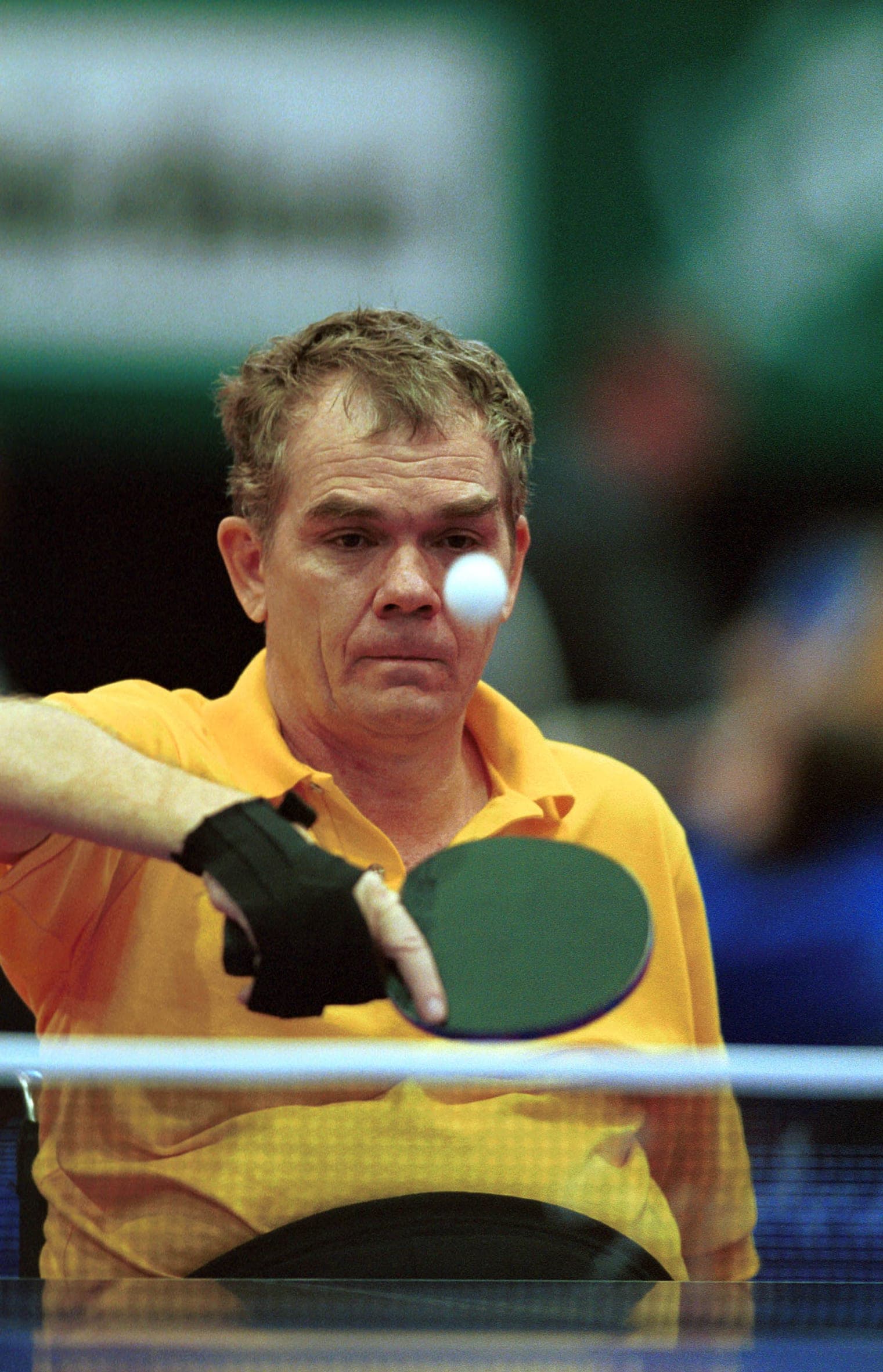
Reductions are permitted for specific events: not less than 8 m by 6 m for wheelchair events, and not less than 10 m by 5 m for Masters events. These are competition regulations rather than Laws, and a club table in a smaller hall is not breaking a rule of the game.
Good to know
- The playing surface is 2.74 m by 1.525 m, 76 cm above the floor.
- The vertical sides of the tabletop are not part of the playing surface.
- The surface must give about a 23 cm bounce from a 30 cm drop.
- Side and end lines are 2 cm wide; the doubles centre line is 3 mm.
- Minimum playing space is a competition regulation, not a Law.
Where it’s used
Sports that use the table tennis table:
Sources
The rules, dimensions and specifications on this page were read from these documents.
- ITTF Statutes — The Laws of Table Tennis — International Table Tennis Federation, 2026, Law 2.1 — The table; Regulations 3.2.3 (read 2026-09-12)
How it connects
The meaning-bearing relationships that place The table tennis table in the wider knowledge graph — each one with the reason it exists.
Foundation of
These build directly on this one.
- The table tennis net assemblyThe table tennis net assembly declares this relationship, and the graph derives the reciprocal edge from it.
- Placement and tempo in table tennisPlacement and tempo in table tennis declares this relationship, and the graph derives the reciprocal edge from it.
- The legal table tennis serveThe table tennis table declares The legal table tennis serve as “foundation of” in its sport cluster.
Frequently learned together
Taught side by side in the same stage of a learning path.
- Table tennis batBoth are taught in the “What you’ll need” stage of the Table Tennis learning path.
- The table tennis net assemblyBoth are taught in the “What you’ll need” stage of the Table Tennis learning path.
- The table tennis ballBoth are taught in the “What you’ll need” stage of the Table Tennis learning path.
- The racket, blade and rubberBoth are taught in the “What you’ll need” stage of the Table Tennis learning path.
Used with
Turns up alongside this across the same sports.
Explore across the knowledge base
Follow the threads that connect The table tennis table to the rest of SocialSportHub.
Equipment
- The table tennis net assemblyThe net, its posts and its suspension — the one height that governs both the net and the posts, and why that number appears twice in the Laws.
- Table tennis batA small wooden blade covered with rubber used to hit the ball in table tennis.
- The table tennis ballThe 40 mm plastic ball the modern game is played with — its exact diameter, weight and colour, and the two separate rule changes that people routinely merge into one.
- The racket, blade and rubberWhat the Laws actually regulate about a table tennis bat — the 85% wood rule, the exact thickness limits for pimpled and sandwich rubber, and the pimple density range.
- Wickets, stumps and bailsThe three stumps and two bails a bowler aims at and a batter defends — their exact height, width and shape, and what the Laws say about when bails may be dispensed with.
Tactics
- Placement and tempo in table tennisWhy where and when you hit the ball beats how hard — the playing elbow, the wide angles, and how taking the ball earlier removes an opponent's time without adding any power.
- Doubles formationHow a pair positions itself on court — one up, one back, or both at the net — to control space in doubles.
Rules
- The legal table tennis serveThe most-broken rule in table tennis, set out exactly — the open palm, the 16 cm toss, the no-hiding requirement, and what happens the first time an umpire is unsure.
- How a point is won in table tennisThe full list of ways a player scores — the returns that fail, the ball through the net, the double hit, the free-hand touch, and the moving-table rule most players never meet.
- Wide ballThe delivery ruled too far from the batter to be hit — the exact test the umpire applies, the two situations that cancel a wide, and why a wide costs a run and must be bowled again.
- The padel servePadel's underarm serve, set out exactly — the bounce before the strike, the waist-height limit, where the server's feet must be, and the wire-mesh fault that has no tennis equivalent.
- The tackleWhat the Laws require of both players in a rugby union tackle — the height limit, the release obligations on the tackler, what the tackled player must do, and how the offside line is created.
Techniques
- Table Tennis Forehand DriveA controlled attacking stroke in table tennis, played on the forehand side with a compact swing and light topspin.
- Chest PassA two-handed pass thrown directly from chest height in a straight line to a teammate, the most basic pass in basketball and netball.
- Spin in table tennisWhy table tennis is a spin sport before it is a speed sport — how topspin, backspin and sidespin change a ball's flight and its bounce off an opponent's bat.
- Table tennis serve techniqueHow to serve legally and still create an advantage — generating spin within the rules, keeping the ball short, and why disguise must come from contact rather than concealment.
- Inside-of-the-Foot PassThe most reliable short pass in football, played with the inside surface of the foot for accuracy over a short to medium distance.
Go deeper with The table tennis table
Everywhere else on the platform that covers The table tennis table — assembled from what actually references it, so nothing here is a dead end.
Learn it
Structured courses and paths on the platform that cover this directly.
How this page is maintained
- Content type
- Facility
- Provenance
- Tier A — evergreen educational
- Verified external sources
- 0
- Content updated
- 2026-09-12
Evergreen, first-party explanation — it makes no claim that needs an external source. How we handle sources and reviews.