
The table tennis ball
The 40 mm plastic ball the modern game is played with — its exact diameter, weight and colour, and the two separate rule changes that people routinely merge into one.
Overview
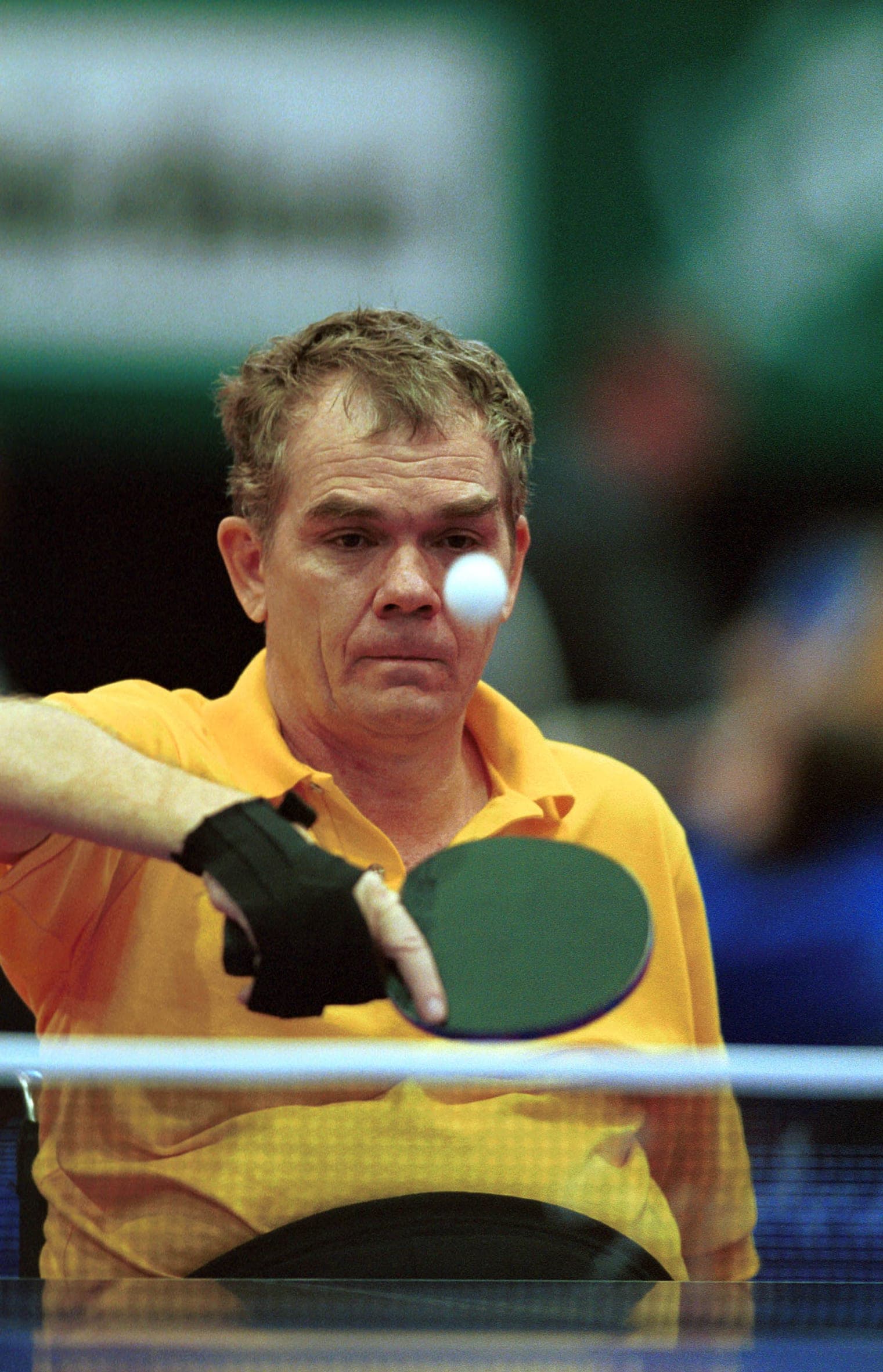
The Laws are brief here and the brevity is the point. The ball is spherical with a diameter of 40 mm, weighs 2.7 g, is made of plastic material, and is white or orange and matt.
Those four sentences are the whole specification. What makes the ball interesting is the history behind those numbers rather than the numbers themselves.
Size and material are two different changes
The larger ball was adopted to slow the game: a bigger ball meets more air resistance, carries less spin relative to its mass, and gives opponents marginally more time. It made rallies longer and the sport easier to follow.
The change from celluloid to plastic came later and for different reasons, including the handling and transport restrictions that apply to celluloid. Because plastic balls behave slightly differently, the change had playing consequences too — but it was not a second attempt to slow the game down.
Why matt and why two colours
The Laws require the ball to be matt, which removes the specular highlight that would otherwise make a fast-moving ball harder to track under bright lighting.
White or orange are both permitted so that the ball can be chosen to contrast with the playing surface and the surrounding barriers. The table itself must be uniformly dark-coloured and matt for the same reason: visibility of a 40 mm object moving very fast is a design constraint on the entire venue.
Good to know
- The ball is 40 mm in diameter and weighs 2.7 g.
- It is made of plastic material and is white or orange.
- It must be matt, which keeps it trackable under bright lighting.
- The 38 mm to 40 mm size change and the celluloid to plastic change were separate.
- The larger ball was adopted to slow the game and lengthen rallies.
Where it’s used
Sports that use the table tennis ball:
Related equipment
Table tennis bat
A small wooden blade covered with rubber used to hit the ball in table tennis.
The table tennis net assembly
The net, its posts and its suspension — the one height that governs both the net and the posts, and why that number appears twice in the Laws.
The racket, blade and rubber
What the Laws actually regulate about a table tennis bat — the 85% wood rule, the exact thickness limits for pimpled and sandwich rubber, and the pimple density range.
Sources
The rules, dimensions and specifications on this page were read from these documents.
- ITTF Statutes — The Laws of Table Tennis — International Table Tennis Federation, 2026, Law 2.3 — The ball (read 2026-09-12)
How it connects
The meaning-bearing relationships that place The table tennis ball in the wider knowledge graph — each one with the reason it exists.
Foundation of
These build directly on this one.
Frequently learned together
Taught side by side in the same stage of a learning path.
- Table tennis batBoth are taught in the “What you’ll need” stage of the Table Tennis learning path.
- The table tennis net assemblyBoth are taught in the “What you’ll need” stage of the Table Tennis learning path.
- The racket, blade and rubberBoth are taught in the “What you’ll need” stage of the Table Tennis learning path.
- The table tennis tableBoth are taught in the “What you’ll need” stage of the Table Tennis learning path.
Used with
Turns up alongside this across the same sports.
Explore across the knowledge base
Follow the threads that connect The table tennis ball to the rest of SocialSportHub.
Techniques
- Spin in table tennisWhy table tennis is a spin sport before it is a speed sport — how topspin, backspin and sidespin change a ball's flight and its bounce off an opponent's bat.
- The push and the chopTable tennis's backspin strokes — the short push that stops an opponent attacking, the long push that changes the rally, and the chop that defends from distance.
- The slice in tennisThe underspin stroke that changes a rally's height and pace — how slice keeps the ball low, when it is defensive and when it is an attack, and what it does on different surfaces.
Facilities
- The table tennis tableThe exact dimensions of a table tennis table and its markings — length, width, height, the bounce test the surface must pass, and the lines that only matter in doubles.
- Padel court dimensionsThe exact size and markings of a padel court under FIP rules — the 10 by 20 metre rectangle, the service lines, the line width, and the free height the rules require above it.
- Tennis court geometryEvery measurement on a tennis court and the rule that governs them all — court and service-box dimensions, line widths, the centre mark, and why measurements are taken to the outside of the lines.
Rules
- Continuous play and the time between pointsWhat the ITF Rules say about pace of play — 25 seconds between points, 90 seconds at a changeover, 120 at a set break — and why tour rulebooks are a separate document.
- Wide ballThe delivery ruled too far from the batter to be hit — the exact test the umpire applies, the two situations that cancel a wide, and why a wide costs a run and must be bowled again.
- How a point is won in table tennisThe full list of ways a player scores — the returns that fail, the ball through the net, the double hit, the free-hand touch, and the moving-table rule most players never meet.
Go deeper with The table tennis ball
Everywhere else on the platform that covers The table tennis ball — assembled from what actually references it, so nothing here is a dead end.
Learn it
Structured courses and paths on the platform that cover this directly.
Take it away
Open data and the whole-platform view of this subject.
How this page is maintained
- Content type
- Equipment
- Provenance
- Tier A — evergreen educational
- Verified external sources
- 0
- Content updated
- 2026-09-12
Evergreen, first-party explanation — it makes no claim that needs an external source. How we handle sources and reviews.