
Cricket fielding positions
How cricket names the places a fielder can stand — the off-side and leg-side halves, the forward and behind-square split, and why the same spot has a different name for each batter.
Overview
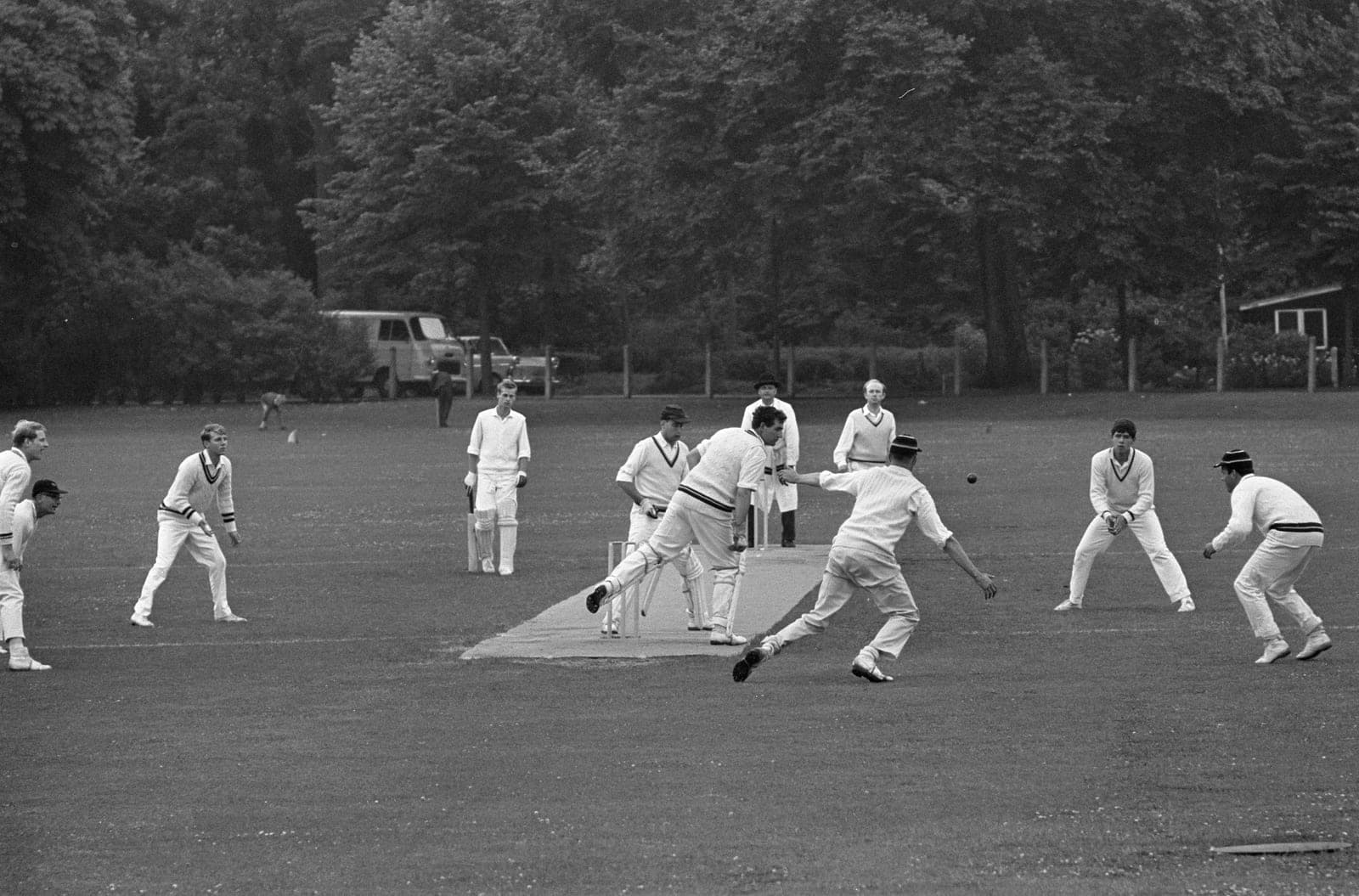
Cricket has no fixed positions in the way football does. A captain may place fielders almost anywhere, and the names — slip, gully, point, cover, mid-off, mid-on, midwicket, square leg, fine leg, third — describe regions rather than assigned roles.
The naming system is a coordinate grid in disguise. Once you know how it is constructed, an unfamiliar name becomes readable rather than something to memorise.
The grid: two halves and two quadrants
The field is split lengthways by the line of the pitch into the off side and the leg side. Which is which depends on the batter: the leg side is the side the batter's legs are on when in their stance, so it swaps when a left-hander comes in. The same physical patch of grass is midwicket for one batter and cover for the other.
The field is then split across by the popping crease into in front of square and behind square. Combining the two gives four quadrants, and almost every fielding name locates a position within one of them.
Distance is a modifier, not a new name
Positions are modified by depth rather than renamed. "Short" means closer to the bat, "deep" or "long" means near the boundary, and "silly" means dangerously close — silly point is point brought in to a few metres from the bat.
"Fine" and "square" modify angle: fine leg is close to the line of the stumps behind the batter, square leg is at right angles to the pitch. Once these modifiers are understood, most positions can be located without ever having been memorised.
What a field setting tells you
A field is a statement of intent that a batter can read. Several slips and a gully mean the bowler is attacking the edge and expects the ball to move away. A packed leg side means the bowler is bowling straight and inviting a stroke into a trap.
An empty area is rarely an oversight. Captains leave gaps where they want the batter to hit, because a boundary conceded there is cheaper than the wicket they expect the attempt to produce.
Responsibilities
- Fielding names describe regions, not assigned roles.
- Off side and leg side are defined relative to the batter and swap for a left-hander.
- The popping crease divides in front of square from behind square.
- Short, silly, deep and long are distance modifiers rather than separate positions.
- Gaps in a field are usually deliberate invitations, not mistakes.
Where it’s used
Sports that use cricket fielding positions:
Sources
The rules, dimensions and specifications on this page were read from these documents.
- The Laws of Cricket — Marylebone Cricket Club (MCC), 2017 Code, Law 28 — The fielder; Law 41 — Unfair play (read 2026-09-12)
How it connects
The meaning-bearing relationships that place Cricket fielding positions in the wider knowledge graph — each one with the reason it exists.
Foundation of
These build directly on this one.
Frequently learned together
Taught side by side in the same stage of a learning path.
Explore across the knowledge base
Follow the threads that connect Cricket fielding positions to the rest of SocialSportHub.
Tactics
- Setting a cricket fieldHow a captain turns nine fielders into a plan — attacking and defensive settings, the trade between catchers and boundary riders, and the fielding restrictions competitions add.
- Point constructionHow tennis points are built rather than won — the neutral, attacking and defensive positions, what each one permits, and why most errors come from playing the wrong shot for the position.
- Approaching the netHow a point is moved forward — which balls justify an approach, why the approach is hit down the line, and the transition volley that has to be played from no-man's land.
Player roles
- CaptainThe captain is a team's on-field leader who communicates, makes in-game decisions and sets standards — a role any player can hold, not a fixed position.
- All-RounderAn all-rounder is a versatile player who contributes across attack and defence rather than specialising in a single phase, position, or skill.
- Utility playerA dependable, versatile player who can competently fill several different positions as the team needs, rather than specialising in just one.
Learning paths
Scoring systems
- Extras: byes, leg byes, wides and no-ballsThe runs a fielding side gives away rather than the batting side earning — what separates a bye from a leg bye, why a wide and a no-ball each cost a penalty run, and how each is recorded.
- Runs and boundaries in cricketHow runs are actually scored in cricket — by running, by finding the boundary, and by the penalties the fielding side concedes — and how each kind is credited in the scorebook.
Go deeper with Cricket fielding positions
Everywhere else on the platform that covers Cricket fielding positions — assembled from what actually references it, so nothing here is a dead end.
Learn it
Structured courses and paths on the platform that cover this directly.
How this page is maintained
- Content type
- Position
- Provenance
- Tier A — evergreen educational
- Verified external sources
- 0
- Content updated
- 2026-09-12
Evergreen, first-party explanation — it makes no claim that needs an external source. How we handle sources and reviews.