The push and the chop
Table tennis's backspin strokes — the short push that stops an opponent attacking, the long push that changes the rally, and the chop that defends from distance.
Overview
Push and chop are the backspin family. Both open the bat face and brush under the ball, and both make the ball hard to attack because the returning player must lift it against the rotation.
The difference is distance and intent. A push is played close to the table as a control stroke; a chop is played several metres back as a defensive one.
The short push
A push kept short — bouncing twice on the opponent's side if left — denies them the space to loop. They cannot swing through a ball that is still over the table, so they are forced to push back, and the rally stays in a controlled backspin exchange.
This is the quiet battle at the start of most rallies between good players. Neither wants to be first to give the other a ball they can attack, so both keep pushing short until someone produces a ball long enough to loop.
The long push
A long push deliberately gives the opponent a ball they can attack, but does it with heavy backspin and good placement. It is used when the player is confident of blocking or counter-looping the reply, or when the opponent lifts backspin poorly.
It is the same stroke as a short push with more forward acceleration, which is what makes it hard to read — a receiver cannot tell short from long until the ball has left the bat.
The chop
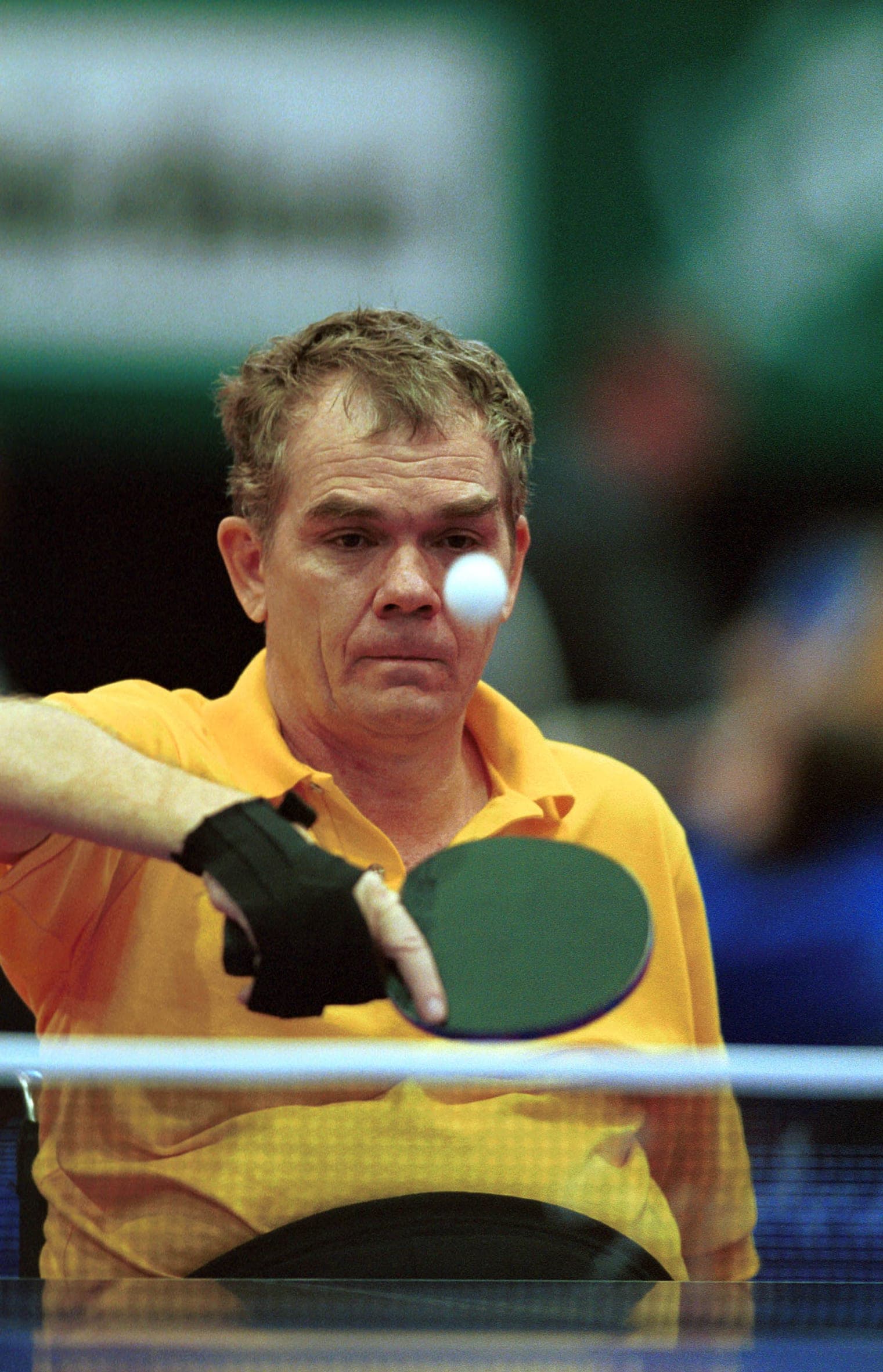
A chop is played well back from the table against a loop, with a long downward brushing motion that converts the incoming topspin into heavy backspin. Because it is played from distance, the defender has time — the reason chopping is viable at all against attacking play.
It is a complete playing style rather than an occasional stroke. A chopper wins by returning ball after ball with varying amounts of backspin until the attacker misjudges one, which makes consistency and spin variation the whole skill.
How to do it
- 1Open the bat face so it points partly upwards.
- 2Move the bat forward and downwards, brushing under the ball.
- 3For a short push, contact the ball early and keep the stroke small.
- 4For a long push, use the same motion with more forward acceleration.
- 5For a chop, move back from the table and use a longer downward brushing path.
- 6Vary how much you brush versus how much you hit to change the amount of backspin.
Key points
- Push and chop both brush under the ball with an open bat face.
- A short push denies the opponent room to loop.
- Short and long pushes look the same until the ball leaves the bat.
- A chop is played from distance and turns incoming topspin into backspin.
- Spin variation, not power, is what makes the backspin strokes effective.
Where it’s used
Sports that use the push and the chop:
Related techniques
Table Tennis Forehand Drive
A controlled attacking stroke in table tennis, played on the forehand side with a compact swing and light topspin.
Spin in table tennis
Why table tennis is a spin sport before it is a speed sport — how topspin, backspin and sidespin change a ball's flight and its bounce off an opponent's bat.
Table tennis serve technique
How to serve legally and still create an advantage — generating spin within the rules, keeping the ball short, and why disguise must come from contact rather than concealment.
How it connects
The meaning-bearing relationships that place The push and the chop in the wider knowledge graph — each one with the reason it exists.
Builds on
Understanding these first makes this one make sense.
Alternative to
Comparable enough that people choose between them.
Frequently learned together
Taught side by side in the same stage of a learning path.
- Table Tennis Forehand DriveBoth are taught in the “Build your technique” stage of the Table Tennis learning path.
- Spin in table tennisBoth are taught in the “Build your technique” stage of the Table Tennis learning path.
- Table tennis serve techniqueBoth are taught in the “Build your technique” stage of the Table Tennis learning path.
- The loop and the blockBoth are taught in the “Build your technique” stage of the Table Tennis learning path.
Explore across the knowledge base
Follow the threads that connect The push and the chop to the rest of SocialSportHub.
Tactics
- Placement and tempo in table tennisWhy where and when you hit the ball beats how hard — the playing elbow, the wide angles, and how taking the ball earlier removes an opponent's time without adding any power.
- Serve and third ballTable tennis's most-rehearsed tactical pattern — using a serve to force a predictable return so the third ball of the rally can be attacked from a known position.
- The penalty killHow a team defends a player short — the box and diamond formations, why killers ice the puck legally, and what a short-handed team is actually trying to protect.
- Serve and volleyAn attacking tennis tactic where the server follows their serve to the net to finish the point with a volley.
- Baseline playA patient tennis style built around rallying from the back of the court and constructing points with groundstrokes.
Skills
- Returning serveThe skill of reading and playing back an opponent’s serve to stay in the rally.
- SprintingThe skill of running or riding at maximum controlled speed over a short distance.
- SpikingThe volleyball skill of jumping and striking the ball forcefully down into the opponent’s court.
- ServingThe skill of putting the ball or shuttle into play to start a point or rally.
- RallyingThe skill of exchanging shots back and forth to build and win a point.
Scoring systems
- Table tennis scoring and service orderHow games and matches are won — 11 points with a two-point margin, service changing every two points, and the expedite system that stops a game lasting forever.
- Table tennis scoringTable tennis is scored on every rally to 11 points per game, won by two clear points, over a best-of odd number of games.
Equipment
- The table tennis ballThe 40 mm plastic ball the modern game is played with — its exact diameter, weight and colour, and the two separate rule changes that people routinely merge into one.
- Swim finsFoot blades that increase propulsion when swimming, snorkelling or diving.
- The goal and the creaseThe net a hockey team defends and the protected area in front of it — the exact goal dimensions, what the crease area includes, and why goaltender contact so often disallows a goal.
Go deeper with The push and the chop
Everywhere else on the platform that covers The push and the chop — assembled from what actually references it, so nothing here is a dead end.
Learn it
Structured courses and paths on the platform that cover this directly.
Take it away
Open data and the whole-platform view of this subject.
How this page is maintained
- Content type
- Technique
- Provenance
- Tier A — evergreen educational
- Verified external sources
- 0
- Content updated
- 2026-09-12
Evergreen, first-party explanation — it makes no claim that needs an external source. How we handle sources and reviews.