
The ice hockey rink
The dimensions and markings of an IIHF ice hockey rink — length, width, corner radius, the blue and centre lines, the goal lines and the face-off circles, with the line widths the rule book specifies.
Overview
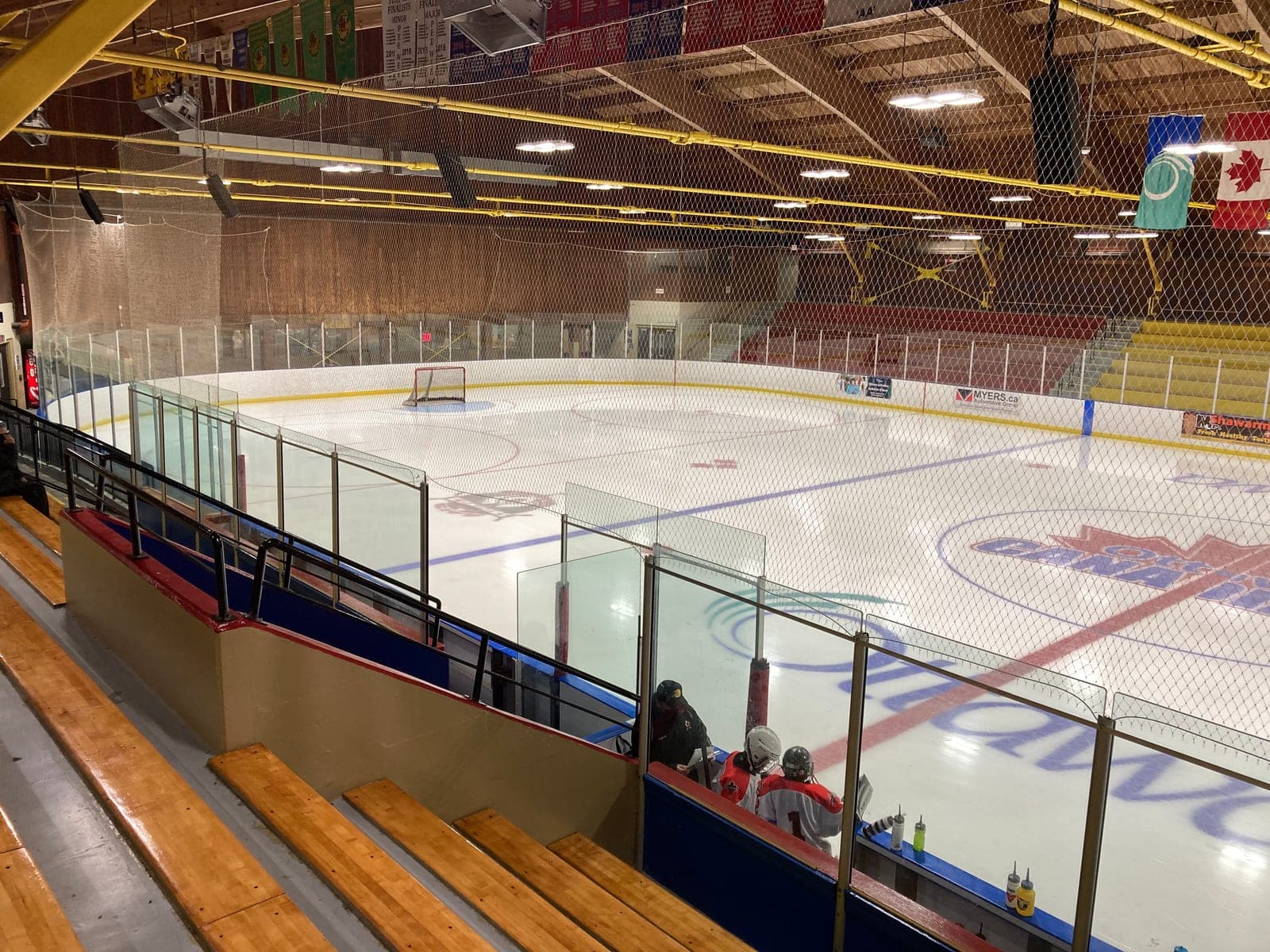
An ice hockey rink is a rounded rectangle enclosed by boards. Its markings divide the ice into three zones and fix the positions of every face-off, which means the geometry of the rink directly determines where play restarts after every stoppage.
Under the IIHF rule book the rink is 60 m long and between 26 m and 30 m wide, with corners rounded to a radius of 7.0 m to 8.50 m. Any deviation from those dimensions in an IIHF competition requires IIHF approval.
The lines and the three zones
Two blue lines, each 30 cm wide, run completely across the rink parallel with the goal lines and continue vertically up the boards. They divide the ice into a defending zone, a neutral zone and an attacking zone — and which is which depends entirely on which team you are.
The centre line is red, also 30 cm wide, and runs across the middle of the ice. The goal lines are red and 5 cm wide. The blue lines sit 22.50 m from each end board, leaving a neutral zone of 15.00 m between them, and each goal line is 4.00 m from the end boards.
Face-off spots and circles
There are nine face-off spots: one at centre ice, four in the neutral zone and four in the end zones. The centre-ice spot is blue and 30 cm in diameter; the face-off circles have a radius of 4.50 m.
Face-off location is not cosmetic. Where a face-off is taken after a stoppage is itself a sanction or a reward — an icing, for example, sends the face-off back into the offending team's own end zone, which is the real cost of the infraction.
Boards, glass and the creases
The rink is surrounded by boards whose ideal height above the ice is 1.07 m, with a light-yellow kick plate at the bottom. Protective glass along the sides must be 1.8 m above the boards, except in front of the players' benches, and is required in front of the penalty boxes. Protective netting is suspended above the end-zone glass behind both goals.
Two crease areas are marked in red. The goal crease sits in front of each goal frame — the marked line belongs to the crease, and the crease area extends vertically to the top of the crossbar. The on-ice officials' crease is a separate 5 cm red line with a radius of 3.0 m, where players may not go to dispute a call.
Good to know
- An IIHF rink is 60 m long and 26–30 m wide, with corners of 7.0–8.50 m radius.
- Blue lines are 30 cm wide and sit 22.50 m from each end board.
- The neutral zone between the blue lines is 15.00 m.
- Face-off circles have a radius of 4.50 m; the centre spot is 30 cm across.
- Boards are ideally 1.07 m high with 1.8 m of protective glass along the sides.
Where it’s used
Sports that use the ice hockey rink:
Sources
The rules, dimensions and specifications on this page were read from these documents.
- IIHF Official Rule Book — International Ice Hockey Federation, 2026/27, Rule 1 — Rink; Appendix VI — Rink lines (read 2026-09-12)
How it connects
The meaning-bearing relationships that place The ice hockey rink in the wider knowledge graph — each one with the reason it exists.
Foundation of
These build directly on this one.
- The goal and the creaseThe goal and the crease declares this relationship, and the graph derives the reciprocal edge from it.
- Off-side in ice hockeyOff-side in ice hockey declares this relationship, and the graph derives the reciprocal edge from it.
- Face-offsFace-offs declares this relationship, and the graph derives the reciprocal edge from it.
- IcingThe ice hockey rink declares Icing as “foundation of” in its sport cluster.
Explore across the knowledge base
Follow the threads that connect The ice hockey rink to the rest of SocialSportHub.
Equipment
- The goal and the creaseThe net a hockey team defends and the protected area in front of it — the exact goal dimensions, what the crease area includes, and why goaltender contact so often disallows a goal.
- The puckThe vulcanised rubber disc ice hockey is played with — its exact diameter, thickness and weight under IIHF rules, and the limits on what may be printed on it.
- The padel racketWhat the FIP rules fix about a padel racket — the maximum length, width and thickness, the mandatory cord, and the perforation limits that define the hitting surface.
- Wickets, stumps and bailsThe three stumps and two bails a bowler aims at and a batter defends — their exact height, width and shape, and what the Laws say about when bails may be dispensed with.
Rules
- Off-side in ice hockeyThe rule that stops attackers waiting in the attacking zone — where exactly the blue line is crossed, why skates and not sticks decide it, and what a delayed off-side means.
- IcingThe rule that stops a team simply firing the puck the length of the ice — what triggers icing, what nullifies it, the goaltender exception, and the line-change penalty that follows.
- Ice hockey penaltiesHow hockey punishes infractions by putting a player in the box — minor, double-minor, major, misconduct and game misconduct — and which ones end early when a goal is scored.
Positions
- Ice hockey positionsThe six players on the ice and what each does — centre, two wings, two defence and the goaltender — plus why hockey substitutes in lines rather than individually.
- Centre (netball)The centre is netball’s link between attack and defence, the only player allowed in every third except the two goal circles, and the player who takes the centre pass.
How this page is maintained
- Content type
- Facility
- Provenance
- Tier A — evergreen educational
- Verified external sources
- 0
- Content updated
- 2026-09-12
Evergreen, first-party explanation — it makes no claim that needs an external source. How we handle sources and reviews.