
The goal and the crease
The net a hockey team defends and the protected area in front of it — the exact goal dimensions, what the crease area includes, and why goaltender contact so often disallows a goal.
Overview
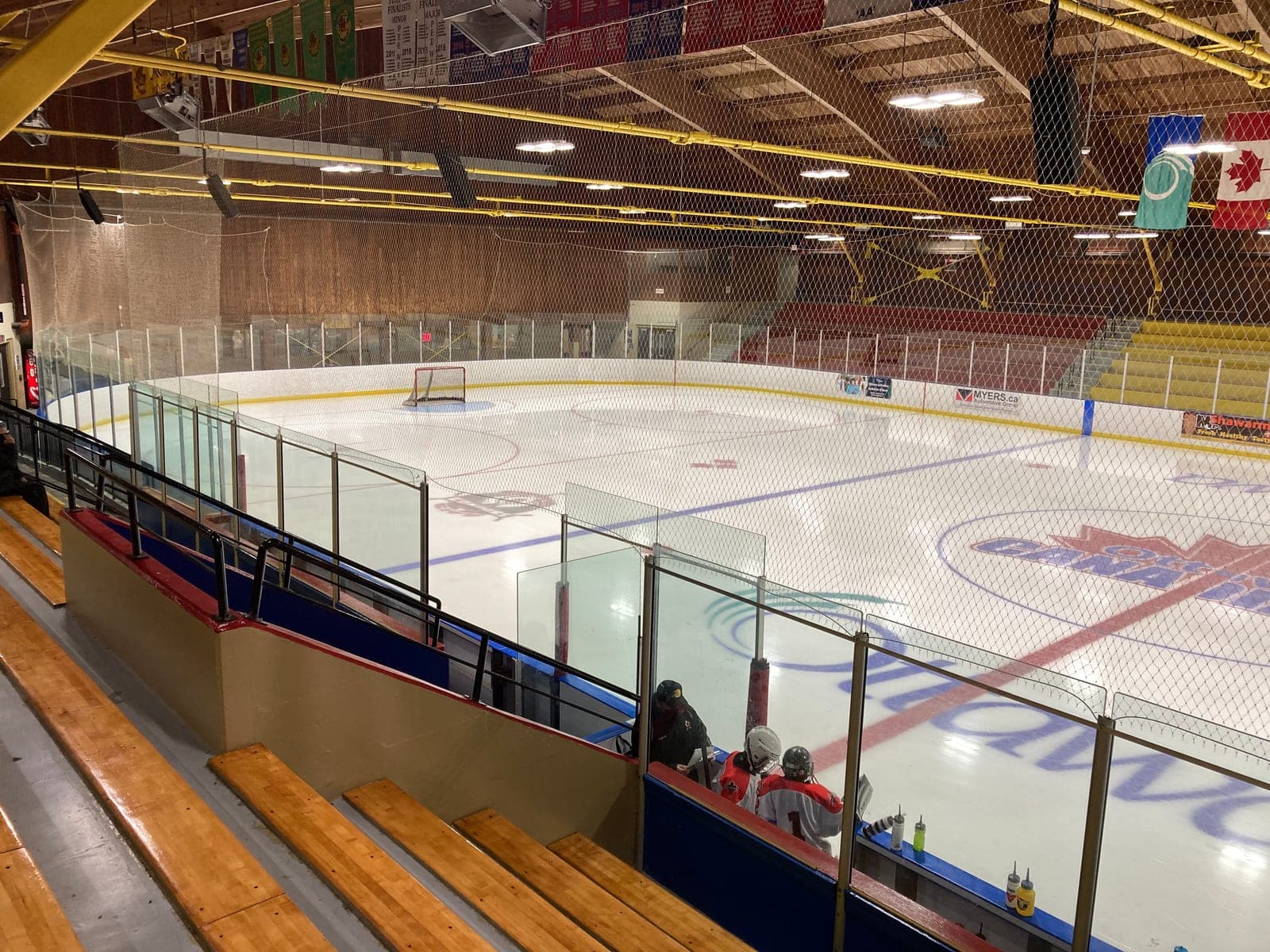
Each rink has two goals, one at either end, located in the centre of the goal line with the open end facing centre ice. A goal comprises a frame and netting, and the pegs that hold it are located exactly on the goal line.
The goal posts extend vertically 1.22 m above the ice and are set 1.83 m apart, measured from the inside of the posts. A crossbar of the same material joins the tops of the posts. Posts and crossbar are painted red; all other exterior surfaces are white.
The crease is a volume, not an outline
In front of each goal frame a goal crease is marked by a red line, and the marked line belongs to the crease. The crease area includes all of the space outlined by the crease lines and extends vertically until the top of the crossbar.
That vertical extension is the part people miss. The crease is a three-dimensional box rather than a painted shape on the ice, which is why a stick or a skate above the paint is still in the crease.
Goaltender contact and disallowed goals
If an attacking player initiates relevant contact with a goaltender who is in their crease — incidental or otherwise — and a goal is scored, the goal is disallowed. If a goaltender establishing position within the crease initiates contact with an attacker who is in the crease, and that impairs the goaltender's ability to defend, a goal is likewise disallowed.
And if, after contact by a goaltender attempting to establish position, the attacking player does not immediately vacate their position in the crease, a goal scored is disallowed. In all such cases the attacking player also receives the appropriate penalty, whether or not a goal was scored.
Outside the crease
A goaltender outside the crease is not unprotected. If an attacking player initiates any relevant contact other than incidental contact with a goaltender outside the crease and a goal is scored, the goal is disallowed — the rule book's phrasing is that a goaltender is not "fair game" just because they are outside the crease.
Incidental contact is permitted when the goaltender is playing the puck outside the crease, provided the attacking player has made a reasonable effort to avoid unnecessary contact. And a goaltender prevented from returning to their crease by an attacker's deliberate actions may see that player penalised.
Good to know
- The goal is 1.83 m wide and 1.22 m high, measured inside the posts.
- The marked crease line belongs to the crease.
- The crease is a volume extending up to the top of the crossbar.
- Contact with a goaltender in their crease disallows a goal scored on the play.
- A goaltender outside the crease is still protected from non-incidental contact.
Where it’s used
Sports that use the goal and the crease:
Sources
The rules, dimensions and specifications on this page were read from these documents.
- IIHF Official Rule Book — International Ice Hockey Federation, 2026/27, Rule 2 — Goal posts and nets; Goal crease (read 2026-09-12)
How it connects
The meaning-bearing relationships that place The goal and the crease in the wider knowledge graph — each one with the reason it exists.
Builds on
Understanding these first makes this one make sense.
Foundation of
These build directly on this one.
Explore across the knowledge base
Follow the threads that connect The goal and the crease to the rest of SocialSportHub.
Facilities
- The ice hockey rinkThe dimensions and markings of an IIHF ice hockey rink — length, width, corner radius, the blue and centre lines, the goal lines and the face-off circles, with the line widths the rule book specifies.
- Padel court dimensionsThe exact size and markings of a padel court under FIP rules — the 10 by 20 metre rectangle, the service lines, the line width, and the free height the rules require above it.
- The table tennis tableThe exact dimensions of a table tennis table and its markings — length, width, height, the bounce test the surface must pass, and the lines that only matter in doubles.
- Ice rinkA sheet of prepared ice, usually rink-boarded with rounded corners, used for skating and ice sports.
- Badminton courtA rectangular indoor court, divided by a high net, on which badminton is played as singles or doubles.
Positions
- The goaltenderHockey's most specialised position — how a goaltender covers a 1.83 m by 1.22 m net, what the butterfly style is for, and the rule protections and restrictions unique to the role.
- Ice hockey positionsThe six players on the ice and what each does — centre, two wings, two defence and the goaltender — plus why hockey substitutes in lines rather than individually.
- Outside hitterThe outside hitter attacks from the left side of the net and is often a volleyball team’s main scoring option.
- OppositeThe opposite is a volleyball attacker who plays on the right side of the net, opposite the setter in the rotation, and is often a key scorer.
Techniques
- Ice hockey shootingThe four shots hockey is scored with — wrist shot, snap shot, slap shot and backhand — how each trades power against release time, and why the stick is bent on purpose.
- Ice hockey skatingThe skill everything else in hockey sits on — how a skater generates power from the edges, why stopping and turning use the same mechanism, and what makes crossovers faster than striding.
- The push and the chopTable tennis's backspin strokes — the short push that stops an opponent attacking, the long push that changes the rally, and the chop that defends from distance.
Rules
- IcingThe rule that stops a team simply firing the puck the length of the ice — what triggers icing, what nullifies it, the goaltender exception, and the line-change penalty that follows.
- How a point is lost in padelThe actions that end a padel rally — the second bounce, touching the net, direct contact with the opponent's enclosure, and the neutral-zone exception on the court doors.
- Three-hit ruleThe volleyball rule that a team may contact the ball at most three times before it must cross the net.
- Cricket creasesThe white lines marked at each end of a cricket pitch — bowling, popping and return creases — what each one is for, and the exact measurements that decide no-balls, run-outs and stumpings.
- GoaltendingA basketball violation for interfering with a shot while the ball is on its downward path to the basket or above the rim.
Go deeper with The goal and the crease
Everywhere else on the platform that covers The goal and the crease — assembled from what actually references it, so nothing here is a dead end.
Take it away
Open data and the whole-platform view of this subject.
How this page is maintained
- Content type
- Equipment
- Provenance
- Tier A — evergreen educational
- Verified external sources
- 0
- Content updated
- 2026-09-12
Evergreen, first-party explanation — it makes no claim that needs an external source. How we handle sources and reviews.