
The padel racket
What the FIP rules fix about a padel racket — the maximum length, width and thickness, the mandatory cord, and the perforation limits that define the hitting surface.
Overview
A padel racket has no strings. It is a solid, perforated hitting surface made up of two parts — head and handle — manufactured in accordance with the FIP's Padel Rackets Homologation annex.
The total length of head plus handle may not exceed 45.5 cm. The head has a maximum width of 26 cm and a maximum thickness of 38 mm; the handle has a maximum length of 20 cm, a maximum width at the throat of 50 mm and a maximum thickness of 50 mm.
The holes are regulated
The hitting surface is perforated by an unlimited number of cylindrical holes, each measuring between 9 and 13 mm in the centre area. Around the edge, in an area of no more than 4 cm measured from the racket edge, the holes may have a larger diameter or a different shape with variable length and width — not more than 20 mm — provided this does not affect the essence of the game.
Both sides of the racket must be flat, but may be smooth or rough. That permission is what allows the textured surfaces used to generate spin.
The safety cord is not optional
The racket must be free of any objects or devices attached to it other than those used to limit or prevent deterioration, vibration or to distribute weight. And a padel racket carries a cord attached to the wrist as a protection against accidents.
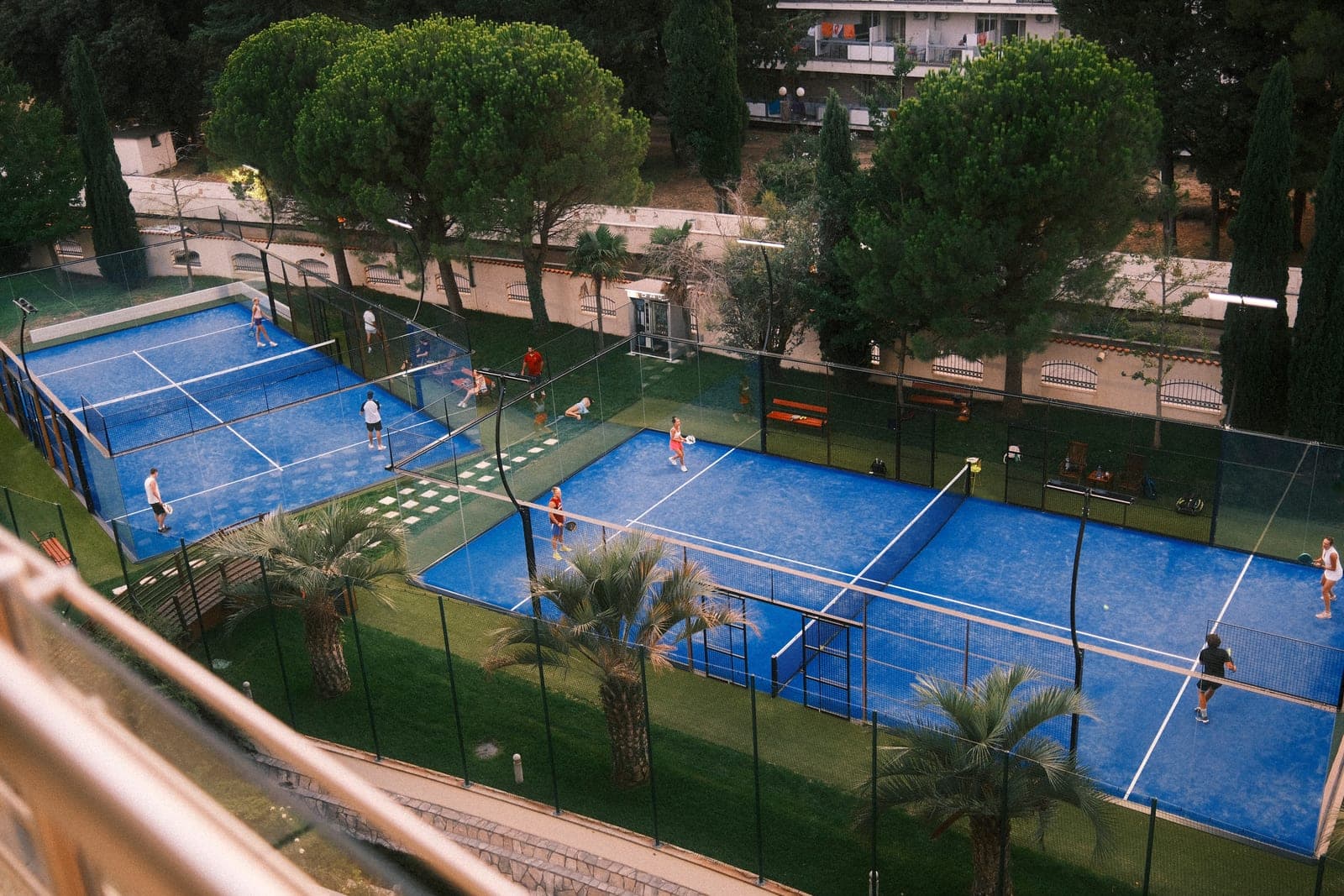
This exists because padel is a doubles sport played in an enclosed space, with four players and two walls inside a 20 m by 10 m box. A released racket has nowhere safe to go.
Tolerances
When conducting a control of racket measurements, a tolerance of 2.5% in the thickness is allowed. No comparable tolerance is stated for the length and width limits.
It is worth being precise about this: the tolerance applies to thickness specifically, and quoting it as a general allowance on every dimension would misstate the rule.
Good to know
- A padel racket is solid and perforated — it has no strings.
- Total length may not exceed 45.5 cm; head width may not exceed 26 cm.
- Central holes are 9–13 mm; edge-area holes may differ up to 20 mm.
- Both faces must be flat but may be smooth or rough.
- A wrist cord is required, and a 2.5% tolerance applies to thickness only.
Where it’s used
Sports that use the padel racket:
Related equipment
Padel racket
A solid, stringless racket perforated with holes, used to play padel. The lack of strings gives padel its distinctive shorter, flatter shots.
The padel net
The net that divides a padel court — its two different heights, the maximum post height, the white strip that tops it, and why the posts sit at the lateral limits.
The padel ball
The padel ball's own specification — diameter, weight, bounce and internal pressure — and the separate altitude ball the rules provide for above 1,000 metres.
Sources
The rules, dimensions and specifications on this page were read from these documents.
- Rules of Padel — International Padel Federation (FIP), application review 01.01.2026, The Padel Racket (read 2026-09-12)
How it connects
The meaning-bearing relationships that place The padel racket in the wider knowledge graph — each one with the reason it exists.
Frequently learned together
Taught side by side in the same stage of a learning path.
- Padel racketBoth are taught in the “What you’ll need” stage of the Padel learning path.
- The padel netBoth are taught in the “What you’ll need” stage of the Padel learning path.
- The padel ballBoth are taught in the “What you’ll need” stage of the Padel learning path.
- Padel courtBoth are taught in the “What you’ll need” stage of the Padel learning path.
- Padel court dimensionsBoth are taught in the “What you’ll need” stage of the Padel learning path.
Used with
Turns up alongside this across the same sports.
Explore across the knowledge base
Follow the threads that connect The padel racket to the rest of SocialSportHub.
Facilities
- Padel courtAn enclosed court, much smaller than a tennis court, walled with glass and mesh so the ball can be played off the walls.
- Padel court dimensionsThe exact size and markings of a padel court under FIP rules — the 10 by 20 metre rectangle, the service lines, the line width, and the free height the rules require above it.
- The table tennis tableThe exact dimensions of a table tennis table and its markings — length, width, height, the bounce test the surface must pass, and the lines that only matter in doubles.
- The ice hockey rinkThe dimensions and markings of an IIHF ice hockey rink — length, width, corner radius, the blue and centre lines, the goal lines and the face-off circles, with the line widths the rule book specifies.
- The rugby union fieldThe dimensions and markings of a rugby union pitch — the field of play, the in-goal areas, the 22-metre and 10-metre lines, the goal posts, and what the Laws fix versus what they leave open.
Learning paths
Rules
- Swimming stroke rulesThe technical rules that define how each competitive swimming stroke must be performed and how walls are touched.
- Test, ODI and T20 cricket comparedThe three international formats of cricket side by side — innings structure, over limits and match length — and why almost everything that separates them is a competition rule rather than a Law.
- Innings and oversHow a cricket match is structured — what an innings is, why an over is six balls, how the bowling end alternates, and which parts of the structure the Laws fix and which a competition sets.
Go deeper with The padel racket
Everywhere else on the platform that covers The padel racket — assembled from what actually references it, so nothing here is a dead end.
Learn it
Structured courses and paths on the platform that cover this directly.
Take it away
Open data and the whole-platform view of this subject.
How this page is maintained
- Content type
- Equipment
- Provenance
- Tier A — evergreen educational
- Verified external sources
- 0
- Content updated
- 2026-09-12
Evergreen, first-party explanation — it makes no claim that needs an external source. How we handle sources and reviews.