
Net position and the lob
The tactical core of padel — why the pair at the net wins most points, why the lob is the main weapon for taking that position, and how the walls make the exchange repeatable.
Overview
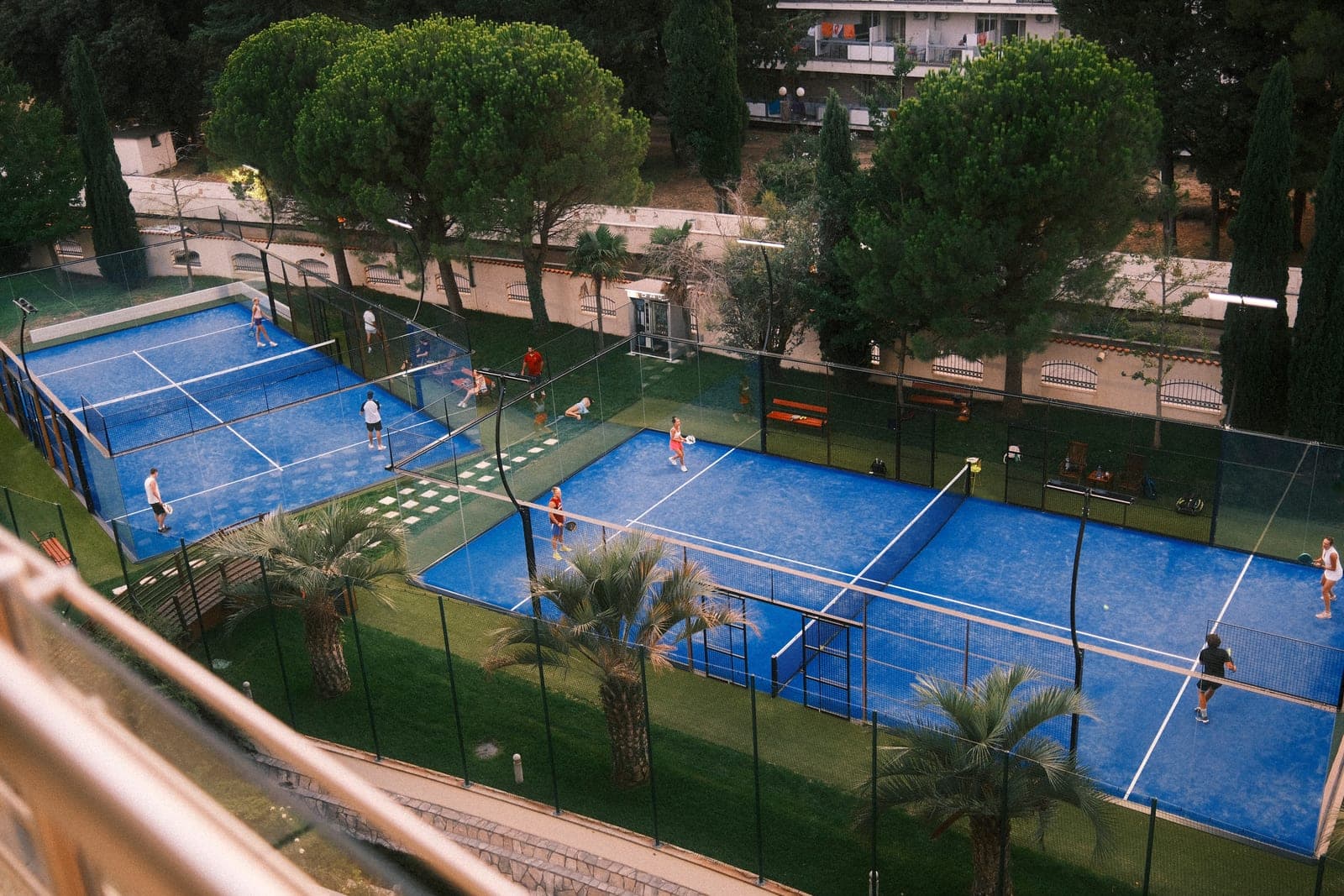
Padel is a positional game before it is a shot-making game. The pair at the net hits down; the pair at the back hits up. That asymmetry decides most points, which makes the net the thing both pairs are actually competing for.
The lob is the primary tool for taking it. A deep lob over the net pair forces them to retreat, and a pair moving backwards cannot hold the net.
Why the net is worth so much
From the net a player volleys the ball downwards into a court with walls that will not rescue a low ball. From the back, every shot has to travel upwards over a net 0.88 m high at its centre, which gives the opponents time and a ball they can attack.
The enclosure amplifies this. A pair at the back can defend almost indefinitely using the walls, but they cannot easily win the point from there — so a rally between a good net pair and a good back pair is a siege rather than an exchange.
The lob as the main weapon
A lob that lands deep forces the net pair to turn and retreat, which either wins the net outright or produces a weak overhead. The court's minimum free height of 6 metres exists precisely because this shot is central to the sport.
The counter is the bandeja: a controlled, sliced overhead that lets the net pair answer a lob without giving up their position. The whole bandeja-versus-lob exchange is a fight over one piece of ground.
Moving as a pair
The two players move up and back together. A pair with one at the net and one at the back has a diagonal gap through the middle and is vulnerable to a ball played between them.
This applies in defence as well: both retreat together after a successful lob against them, and both advance together when the opportunity comes. Padel positioning errors are almost always a failure to move as a unit rather than an individual being out of place.
Key points
- The pair at the net hits downwards; the pair at the back must hit upwards.
- The walls let a back pair defend almost indefinitely but not win easily.
- A deep lob forces the net pair to retreat and is the main way to take the net.
- The bandeja answers a lob without surrendering net position.
- Partners must move up and back together or leave a diagonal gap.
Where it’s used
Sports that use net position and the lob:
Related tactics
Serve and volley
An attacking tennis tactic where the server follows their serve to the net to finish the point with a volley.
Baseline play
A patient tennis style built around rallying from the back of the court and constructing points with groundstrokes.
Doubles formation
How a pair positions itself on court — one up, one back, or both at the net — to control space in doubles.
Sources
The rules, dimensions and specifications on this page were read from these documents.
- Rules of Padel — International Padel Federation (FIP), application review 01.01.2026, The Court — Dimensions; Net (read 2026-09-12)
How it connects
The meaning-bearing relationships that place Net position and the lob in the wider knowledge graph — each one with the reason it exists.
Builds on
Understanding these first makes this one make sense.
Requires
You need this to make sense of the other one.
Frequently learned together
Taught side by side in the same stage of a learning path.
- Serve and volleyBoth are taught in the “Understand tactics & strategy” stage of the Padel learning path.
- Baseline playBoth are taught in the “Understand tactics & strategy” stage of the Padel learning path.
- Doubles formationBoth are taught in the “Understand tactics & strategy” stage of the Padel learning path.
- Net playBoth are taught in the “Understand tactics & strategy” stage of the Padel learning path.
Supported by
These help the training or recovery side of this.
Explore across the knowledge base
Follow the threads that connect Net position and the lob to the rest of SocialSportHub.
Techniques
- Playing the walls in padelThe skill that separates padel from every other racket sport — reading a rebound off glass, positioning behind the bounce rather than at it, and using your own back wall to attack.
- The bandeja and the víboraPadel's two signature overheads — the controlled bandeja that holds the net, and the sliced víbora that attacks from it — and why a full smash is usually the wrong choice.
- Padel BandejaA controlled overhead shot in padel, hit with slice and moderate pace to keep the player at the net without over-committing.
- Free ThrowAn unguarded basketball shot taken from the free-throw line, relying on a calm, repeatable routine rather than power.
Learning paths
Practice & sessions
Skills Academy
Skills
Facilities
- Padel courtAn enclosed court, much smaller than a tennis court, walled with glass and mesh so the ball can be played off the walls.
- Padel walls and enclosureThe feature that makes padel its own sport — the glass and mesh enclosure, the two permitted side-wall layouts, and why the wall material is specified by how the ball bounces off it.
Go deeper with Net position and the lob
Everywhere else on the platform that covers Net position and the lob — assembled from what actually references it, so nothing here is a dead end.
Learn it
Structured courses and paths on the platform that cover this directly.
How this page is maintained
- Content type
- Tactic
- Provenance
- Tier A — evergreen educational
- Verified external sources
- 0
- Content updated
- 2026-09-12
Evergreen, first-party explanation — it makes no claim that needs an external source. How we handle sources and reviews.