
Padel walls and enclosure
The feature that makes padel its own sport — the glass and mesh enclosure, the two permitted side-wall layouts, and why the wall material is specified by how the ball bounces off it.
Overview
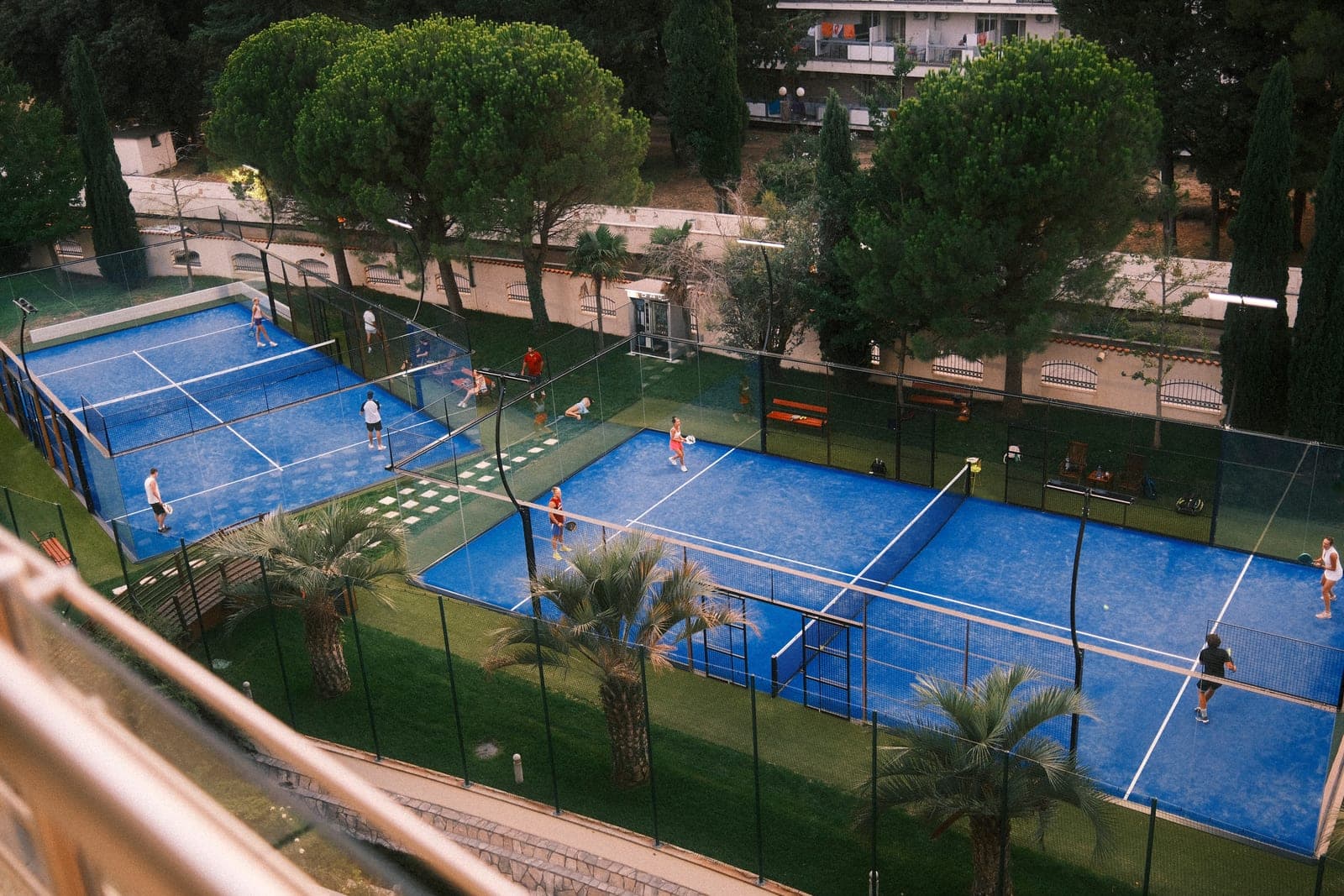
A padel court must be completely enclosed. The ends measured from the inside are 10 metres long and the inside length of the sides is 20 metres, and the enclosure is built from a mixture of solid wall and metal fencing.
At the ends, the total height is 4 metres: the first 3 m is wall, which may be any transparent or solid material such as glass or brick, and the last 1 metre is metallic fence.
Two permitted side layouts
The rules allow two variations on the side enclosures. Variant 1 is a stepped arrangement: at each end, a first step 3 m high by 2 m long and a second step 2 m high by 2 m long, with metal fencing completing the enclosure up to 3 m across the central 6 m and up to 4 m at both ends.
Variant 2, the glass variant, has a wall area at each end zone three metres high by four metres in length with no step, and metal mesh completing the enclosure to four metres in height at the outer two metres. All dimensions are measured from the inside of the court.
The material is defined by its bounce
The walls may be made of any transparent or opaque material — glass, brick and others are named — but always with the correct consistency and ensuring a uniform bounce of the ball. Whatever the material, the surface must be uniform, hard and completely smooth, allowing bodily contact or balls sliding along it.
This is the same principle seen in the table tennis table: the rules specify a playing property rather than a material, because what matters is how the surface behaves when the ball meets it. A wall that does not return the ball uniformly is not a padel wall.
Fencing, joins and colour
The metallic fencing is always placed in line with the inner side of the wall, so the playing surface of the enclosure is continuous. Where the fencing is fixed to a frame, its upper part must be free of elements that are not part of the metallic structure — no cables, electrical boxes or light fittings.
Opaque walls should be a single uniform colour that does not affect the course of play and is clearly different from the floor surface colour. Logo imprinting or painting is allowed, but no more than one per single wall, and in dimensions and colours that do not interfere with players' vision.
Good to know
- The court must be completely enclosed; walls and fencing are both in play.
- End walls are 3 m of wall with 1 m of metallic fence above, 4 m in total.
- Two side layouts are permitted — a stepped variant and a glass variant.
- Wall material is unrestricted provided the bounce is uniform.
- Fencing sits flush with the inner face of the wall so the surface is continuous.
Where it’s used
Sports that use padel walls and enclosure:
Related facilities
Padel court
An enclosed court, much smaller than a tennis court, walled with glass and mesh so the ball can be played off the walls.
Padel court dimensions
The exact size and markings of a padel court under FIP rules — the 10 by 20 metre rectangle, the service lines, the line width, and the free height the rules require above it.
Sources
The rules, dimensions and specifications on this page were read from these documents.
- Rules of Padel — International Padel Federation (FIP), application review 01.01.2026, The Court — Enclosures, Ends, Sides (read 2026-09-12)
How it connects
The meaning-bearing relationships that place Padel walls and enclosure in the wider knowledge graph — each one with the reason it exists.
Foundation of
These build directly on this one.
Used with
Turns up alongside this across the same sports.
Explore across the knowledge base
Follow the threads that connect Padel walls and enclosure to the rest of SocialSportHub.
Rules
- Ball in play and the wallsWhat counts as part of the court in padel and how the walls change a rally — which surfaces the ball may use, the order it must use them in, and the returns the rules explicitly permit.
- Out-of-court play in padelThe rule that lets a padel player leave the court to keep a rally alive — when it is authorised, what the court must provide for it, and why it depends on the safety area.
- The padel servePadel's underarm serve, set out exactly — the bounce before the strike, the waist-height limit, where the server's feet must be, and the wire-mesh fault that has no tennis equivalent.
- How a point is lost in padelThe actions that end a padel rally — the second bounce, touching the net, direct contact with the opponent's enclosure, and the neutral-zone exception on the court doors.
Techniques
- Playing the walls in padelThe skill that separates padel from every other racket sport — reading a rebound off glass, positioning behind the bounce rather than at it, and using your own back wall to attack.
- The cricket driveCricket's foundational attacking stroke, played straight down the ground or through the off side — the cover, straight and on drive, and the length that makes each one available.
- Flat, slice and kick servesThe three serves and what actually separates them — the contact point on the ball and the toss that makes it possible — plus what each one does to the ball after it bounces.
Learning paths
Equipment
- The padel netThe net that divides a padel court — its two different heights, the maximum post height, the white strip that tops it, and why the posts sit at the lateral limits.
- Golf ballA small, firm, dimpled ball struck with a club and played toward the hole on a golf course.
- The padel ballThe padel ball's own specification — diameter, weight, bounce and internal pressure — and the separate altitude ball the rules provide for above 1,000 metres.
- Football (soccer ball)A round, inflated ball used to play association football and futsal. Futsal uses a smaller, heavier ball that bounces far less on a hard court.
How this page is maintained
- Content type
- Facility
- Provenance
- Tier A — evergreen educational
- Verified external sources
- 0
- Content updated
- 2026-09-01
Evergreen, first-party explanation — it makes no claim that needs an external source. How we handle sources and reviews.