
The padel net
The net that divides a padel court — its two different heights, the maximum post height, the white strip that tops it, and why the posts sit at the lateral limits.
Overview
The net must be 10 metres long and 0.88 m high at the centre, rising to 0.92 metres at the ends, with a maximum tolerance of 0.005 metres.
Two heights for one net is not an inconsistency. Like the nets in tennis and badminton, a padel net sags to its lowest point in the middle, and the rules specify both the centre and the ends so that the sag is controlled rather than incidental.
Suspension and posts
The net is suspended by a metal cable with a maximum diameter of 0.01 metres, with the ends attached to two lateral posts of a maximum height of 1.05 metres — or to a part of the court structure allowing correct suspension and tension.
The outer side of the net posts should coincide with the lateral limits of the court. Posts may be circular or square but must have rounded edges, and the tensioning mechanism must be designed so it cannot loosen unexpectedly or become a risk to players.
The strip and what may go on it
The net must be capped with a white strip measuring between 5.0 and 6.3 cm once in place, with the tension cable beneath it. An additional strip carrying advertising, of any colour, may be incorporated provided it does not interfere with the course of play — but in any case the strip cannot be higher than 11.0 cm.
It is prohibited to affix any item to the net strings. Painting the strings for advertising purposes is allowed as long as it does not affect the regular course of play.
No gaps
The net must be fully extended so that it fills the space between the two net posts and the court surface, with no spaces between the extremes of the net and the posts. It should not, however, be tense.
The 0.92 m figure appears again in play: above 0.92 metres, and only where out-of-court play is authorised, the dividing vertical post in the court doors is considered a neutral zone that any of the four players may touch or hold.
Good to know
- The net is 0.88 m high at the centre and 0.92 m at the ends.
- Posts are a maximum of 1.05 m high, with their outer sides at the court limits.
- A white strip of 5.0–6.3 cm caps the net, and no strip may exceed 11.0 cm.
- Nothing may be affixed to the net strings.
- The net must fill the space to the posts and the surface, with no gaps.
Where it’s used
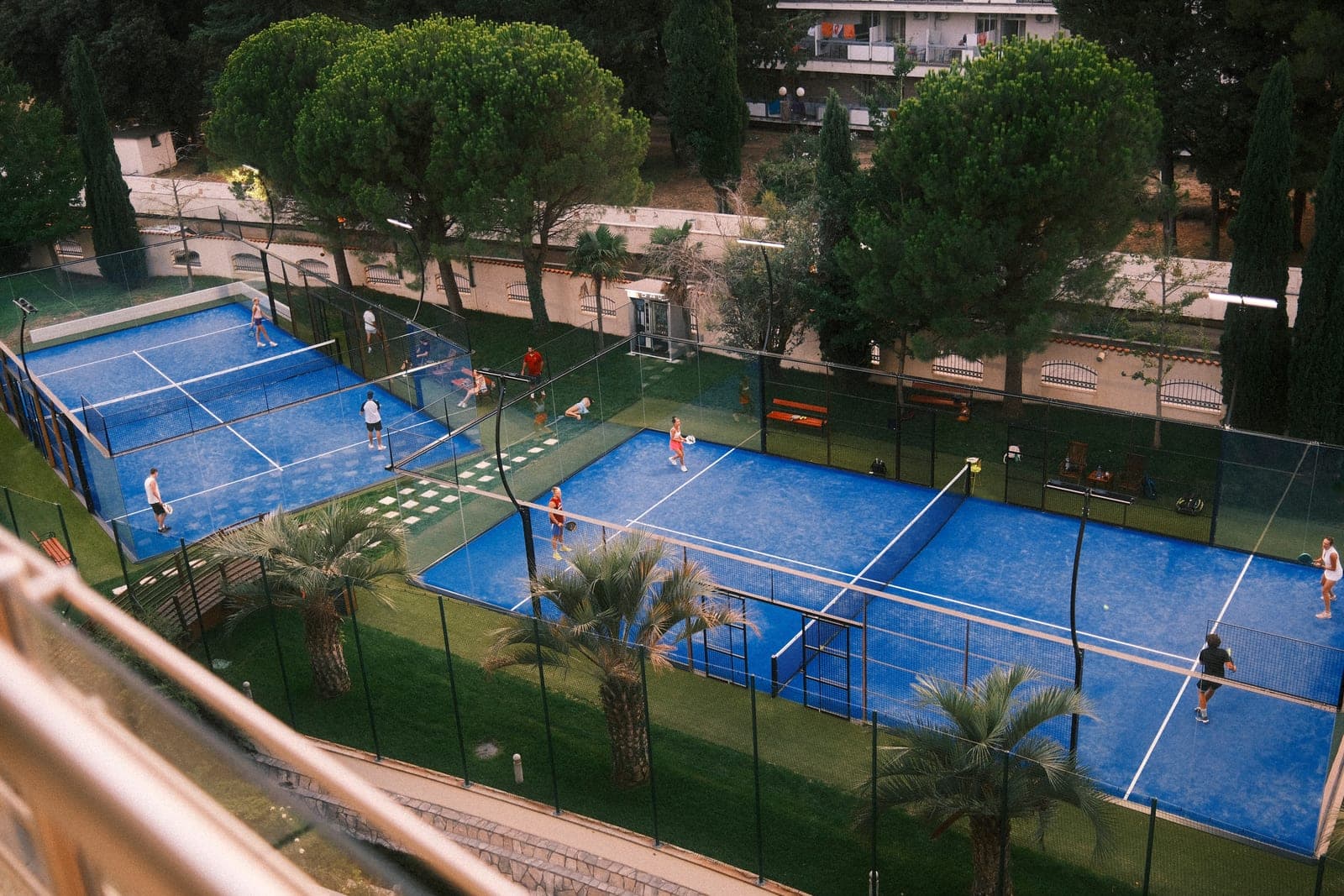
Sports that use the padel net:
Related equipment
Padel racket
A solid, stringless racket perforated with holes, used to play padel. The lack of strings gives padel its distinctive shorter, flatter shots.
The padel ball
The padel ball's own specification — diameter, weight, bounce and internal pressure — and the separate altitude ball the rules provide for above 1,000 metres.
The padel racket
What the FIP rules fix about a padel racket — the maximum length, width and thickness, the mandatory cord, and the perforation limits that define the hitting surface.
Sources
The rules, dimensions and specifications on this page were read from these documents.
- Rules of Padel — International Padel Federation (FIP), application review 01.01.2026, The Court — Net (read 2026-09-12)
How it connects
The meaning-bearing relationships that place The padel net in the wider knowledge graph — each one with the reason it exists.
Builds on
Understanding these first makes this one make sense.
Frequently learned together
Taught side by side in the same stage of a learning path.
- Padel racketBoth are taught in the “What you’ll need” stage of the Padel learning path.
- The padel ballBoth are taught in the “What you’ll need” stage of the Padel learning path.
- The padel racketBoth are taught in the “What you’ll need” stage of the Padel learning path.
- Padel courtBoth are taught in the “What you’ll need” stage of the Padel learning path.
- Padel court dimensionsBoth are taught in the “What you’ll need” stage of the Padel learning path.
Explore across the knowledge base
Follow the threads that connect The padel net to the rest of SocialSportHub.
Facilities
- Padel court dimensionsThe exact size and markings of a padel court under FIP rules — the 10 by 20 metre rectangle, the service lines, the line width, and the free height the rules require above it.
- Padel courtAn enclosed court, much smaller than a tennis court, walled with glass and mesh so the ball can be played off the walls.
- The rugby union fieldThe dimensions and markings of a rugby union pitch — the field of play, the in-goal areas, the 22-metre and 10-metre lines, the goal posts, and what the Laws fix versus what they leave open.
- Volleyball courtA rectangular court split by a high net over which two teams rally the ball, played indoors or on sand.
- Badminton courtA rectangular indoor court, divided by a high net, on which badminton is played as singles or doubles.
Rules
- How a point is lost in padelThe actions that end a padel rally — the second bounce, touching the net, direct contact with the opponent's enclosure, and the neutral-zone exception on the court doors.
- The padel servePadel's underarm serve, set out exactly — the bounce before the strike, the waist-height limit, where the server's feet must be, and the wire-mesh fault that has no tennis equivalent.
- Out-of-court play in padelThe rule that lets a padel player leave the court to keep a rally alive — when it is authorised, what the court must provide for it, and why it depends on the safety area.
- Drafting rulesRules that govern when a rider or athlete may sit in the slipstream of another to save energy.
- Ball in play and the wallsWhat counts as part of the court in padel and how the walls change a rally — which surfaces the ball may use, the order it must use them in, and the returns the rules explicitly permit.
Learning paths
Tactics
- Doubles formationHow a pair positions itself on court — one up, one back, or both at the net — to control space in doubles.
- Net position and the lobThe tactical core of padel — why the pair at the net wins most points, why the lob is the main weapon for taking that position, and how the walls make the exchange repeatable.
- Crosscourt and down the lineThe geometry that makes crosscourt the default tennis shot — the net is lower in the middle and the court is longer on the diagonal — and when down the line is worth its extra risk.
Techniques
- The bandeja and the víboraPadel's two signature overheads — the controlled bandeja that holds the net, and the sliced víbora that attacks from it — and why a full smash is usually the wrong choice.
- The slice in tennisThe underspin stroke that changes a rally's height and pace — how slice keeps the ball low, when it is defensive and when it is an attack, and what it does on different surfaces.
- Padel BandejaA controlled overhead shot in padel, hit with slice and moderate pace to keep the player at the net without over-committing.
Go deeper with The padel net
Everywhere else on the platform that covers The padel net — assembled from what actually references it, so nothing here is a dead end.
Learn it
Structured courses and paths on the platform that cover this directly.
Take it away
Open data and the whole-platform view of this subject.
How this page is maintained
- Content type
- Equipment
- Provenance
- Tier A — evergreen educational
- Verified external sources
- 0
- Content updated
- 2026-09-12
Evergreen, first-party explanation — it makes no claim that needs an external source. How we handle sources and reviews.