
Ball in play and the walls
What counts as part of the court in padel and how the walls change a rally — which surfaces the ball may use, the order it must use them in, and the returns the rules explicitly permit.
Overview
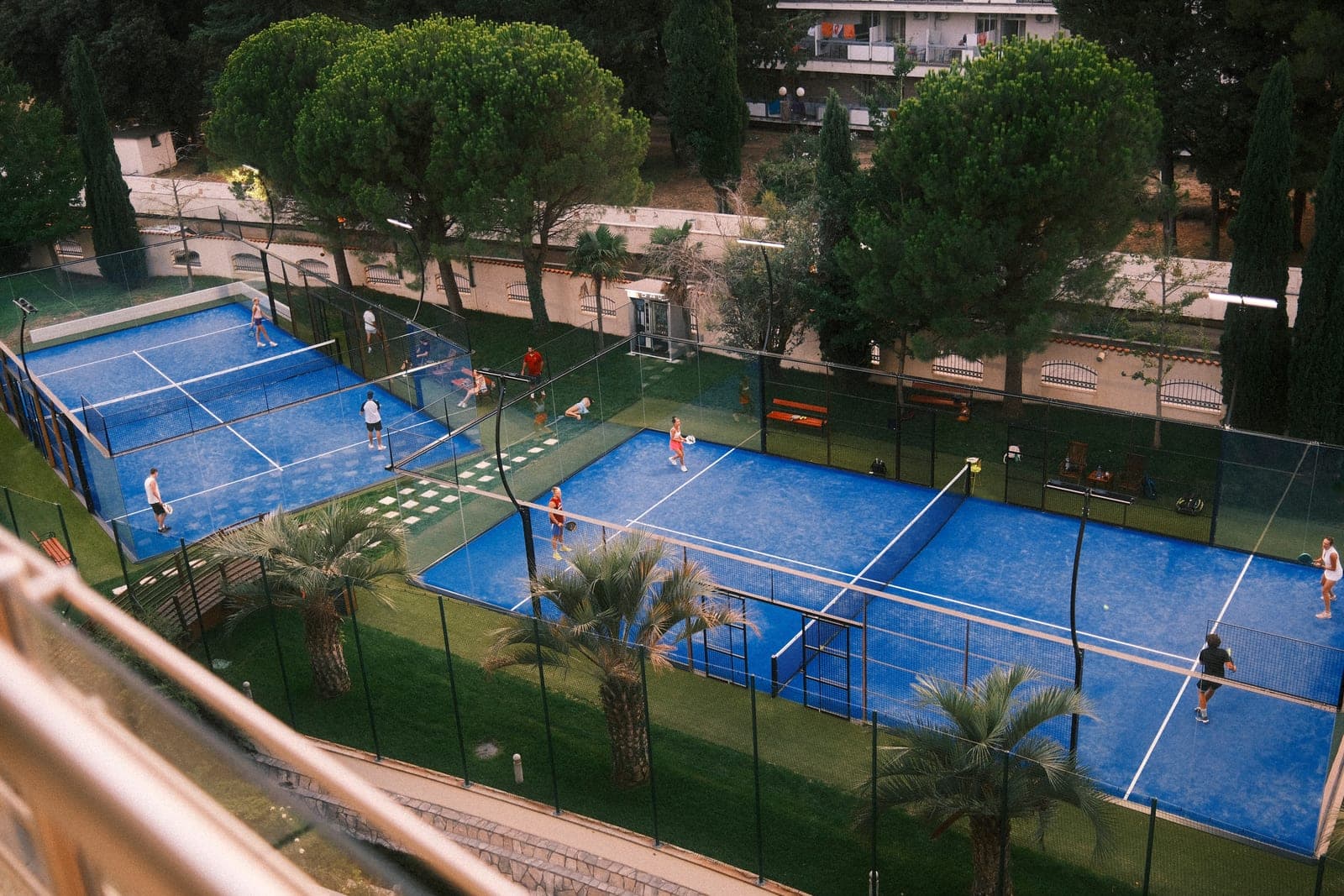
In padel the enclosure is not a boundary — it is playing surface. The rules say so directly: parts of the court include the insides of the walls, the metallic mesh fence that encloses the court, the ground, the net and the net posts, with the mesh and frame in its entirety considered part of the fence.
The ball is in play from the moment a valid service takes place until a let is called or the point is decided, and is hit alternately by each pair.
The order matters
If the ball in play hits any part of the court after having bounced in the opponent's ground, it remains in play and should be returned before it bounces for a second time. The bounce on the ground must come first.
This single ordering rule is what makes padel padel. A ball that hits a wall before bouncing on the ground has not been correctly played, while exactly the same contact after the ground bounce keeps the rally alive.
What counts as a correct return
The rules list the correct returns explicitly. A return is correct when the ball, after being hit, bounces directly into the opponent's court — or hits the wall in the player's OWN court first and then bounces into the opponent's court.
It is also correct when the ball bounces in the opponent's court and then hits the metallic fence or one of the walls; when it touches the net or net posts and then lands in the opponent's court; and when, as a result of the direction and force of the hit, it bounces in the opponent's court and then goes out of court, hits the ceiling, the lights or any other object not related to the court.
The ball that comes back
One listed return is worth reading twice. If, after hitting the ball, it bounces correctly into the opposition's court and then comes back into the server's own court, the opposition player may hit it there.
This is only allowed provided the player, their clothing and their racket have not touched the net, the posts or the opponent's court. A ball with enough backspin to return over the net is legally playable in the court it came from.
Key points
- The walls, the fence, the net and the posts are all part of the court.
- A ball must bounce on the ground before it may use any other surface.
- A player may play the ball off their own wall before returning it.
- A ball hitting a wall or fence after the opponent's bounce stays in play.
- A ball that returns over the net may legally be played in the court it came from.
Where it’s used
Sports that use ball in play and the walls:
Related rules
The padel serve
Padel's underarm serve, set out exactly — the bounce before the strike, the waist-height limit, where the server's feet must be, and the wire-mesh fault that has no tennis equivalent.
How a point is lost in padel
The actions that end a padel rally — the second bounce, touching the net, direct contact with the opponent's enclosure, and the neutral-zone exception on the court doors.
Out-of-court play in padel
The rule that lets a padel player leave the court to keep a rally alive — when it is authorised, what the court must provide for it, and why it depends on the safety area.
Sources
The rules, dimensions and specifications on this page were read from these documents.
- Rules of Padel — International Padel Federation (FIP), application review 01.01.2026, Rule 12 — Ball in play; Rule 14 — Correct return (read 2026-09-12)
How it connects
The meaning-bearing relationships that place Ball in play and the walls in the wider knowledge graph — each one with the reason it exists.
Builds on
Understanding these first makes this one make sense.
Foundation of
These build directly on this one.
Explained by
The underlying "why" behind this.
Broader than
A wider grouping that contains these.
Frequently learned together
Taught side by side in the same stage of a learning path.
- The padel serveBoth are taught in the “Get to know the game” stage of the Padel learning path.
- How a point is lost in padelBoth are taught in the “Get to know the game” stage of the Padel learning path.
- Out-of-court play in padelBoth are taught in the “Get to know the game” stage of the Padel learning path.
- Tennis scoringBoth are taught in the “Get to know the game” stage of the Padel learning path.
- Padel scoringBoth are taught in the “Get to know the game” stage of the Padel learning path.
Explore across the knowledge base
Follow the threads that connect Ball in play and the walls to the rest of SocialSportHub.
Facilities
- Padel walls and enclosureThe feature that makes padel its own sport — the glass and mesh enclosure, the two permitted side-wall layouts, and why the wall material is specified by how the ball bounces off it.
- Padel courtAn enclosed court, much smaller than a tennis court, walled with glass and mesh so the ball can be played off the walls.
- Volleyball courtA rectangular court split by a high net over which two teams rally the ball, played indoors or on sand.
- Tennis courtA rectangular marked court, divided across the middle by a net, where tennis is played as singles or doubles.
- Padel court dimensionsThe exact size and markings of a padel court under FIP rules — the 10 by 20 metre rectangle, the service lines, the line width, and the free height the rules require above it.
Techniques
- Playing the walls in padelThe skill that separates padel from every other racket sport — reading a rebound off glass, positioning behind the bounce rather than at it, and using your own back wall to attack.
- The slice in tennisThe underspin stroke that changes a rally's height and pace — how slice keeps the ball low, when it is defensive and when it is an attack, and what it does on different surfaces.
- Spin in table tennisWhy table tennis is a spin sport before it is a speed sport — how topspin, backspin and sidespin change a ball's flight and its bounce off an opponent's bat.
- Flip TurnA fast turn in freestyle where the swimmer somersaults at the wall, pushes off on their back and rotates to continue swimming.
Scoring systems
- Tennis scoringTennis is scored in points, games and sets, using the distinctive 15–30–40 point sequence and a win-by-two margin at every level.
- Padel scoringPadel borrows tennis scoring, counting points as 15–30–40 within games and playing sets to six games decided by a tiebreak.
- Padel scoring and the tie-breakHow padel matches are counted — the game and set structure, the tie-break serving order, and the alternative scoring methods the FIP rules explicitly authorise.
Equipment
- The padel ballThe padel ball's own specification — diameter, weight, bounce and internal pressure — and the separate altitude ball the rules provide for above 1,000 metres.
- Road bikeA lightweight bicycle built for speed and efficiency on paved surfaces.
- Squash racquetA slim strung racquet used to hit the ball against the walls in squash.
- The padel netThe net that divides a padel court — its two different heights, the maximum post height, the white strip that tops it, and why the posts sit at the lateral limits.
Learning paths
Beginner guides
- Your First Padel SessionA warm, honest look at what your very first padel session actually involves — the doubles court, the walls, and the easygoing rallying that makes it so welcoming to newcomers.
- How to Use a Learning CurriculumA learning curriculum is a plain, ordered map of what to learn in a sport and in roughly what order — here is how to use one to steer your own practice and sessions without turning it into a deadline.
Go deeper with Ball in play and the walls
Everywhere else on the platform that covers Ball in play and the walls — assembled from what actually references it, so nothing here is a dead end.
Learn it
Structured courses and paths on the platform that cover this directly.
Take it away
Open data and the whole-platform view of this subject.
How this page is maintained
- Content type
- Rule
- Provenance
- Tier A — evergreen educational
- Verified external sources
- 0
- Content updated
- 2026-09-01
Evergreen, first-party explanation — it makes no claim that needs an external source. How we handle sources and reviews.