
Out-of-court play in padel
The rule that lets a padel player leave the court to keep a rally alive — when it is authorised, what the court must provide for it, and why it depends on the safety area.
Overview
Padel allows something no other racket sport does: a player may leave the enclosed court entirely, through the door, and play the ball from outside before returning it over the net.
The rules make this conditional rather than universal. Players are authorised to leave the court to play the ball whenever the court fulfils the conditions established in the section on the court, the safety area and out-of-court play.
It depends on the venue, not the player
Whether out-of-court play is available is a property of the court, not a choice a player makes in the moment. A court without an adequate safety area outside the enclosure does not permit it, because there is nowhere safe to run to.
This is why the same shot is legal at one club and not at another. A player arriving at an unfamiliar court cannot assume either way.
How the serve rules reflect it
The serving faults make the dependency explicit. A serve is a fault if the ball bounces in the receiver's service box and then bounces out of court directly through the gates of a court WITHOUT a safety zone — that is, a court where out-of-court play is not authorised.
On a court that does have the safety zone, the same ball is not automatically a fault, because leaving the court through the gates is a permitted continuation of play.
The door post is a handhold
Above 0.92 metres, and only where out-of-court play is authorised, the dividing vertical post in the doors is a neutral zone that any of the four players may touch or hold on to.
That is the practical detail that makes the rule usable: a player running out through the door at speed needs something to grab, and the rules provide for it explicitly rather than leaving it to be penalised as touching the structure.
Key points
- A padel player may leave the court to play the ball where the court allows it.
- Authorisation depends on the safety area outside the enclosure.
- The same shot can be legal at one venue and not at another.
- The serve faults differ between courts with and without a safety zone.
- The door post above 0.92 m may be held where out-of-court play is authorised.
Where it’s used
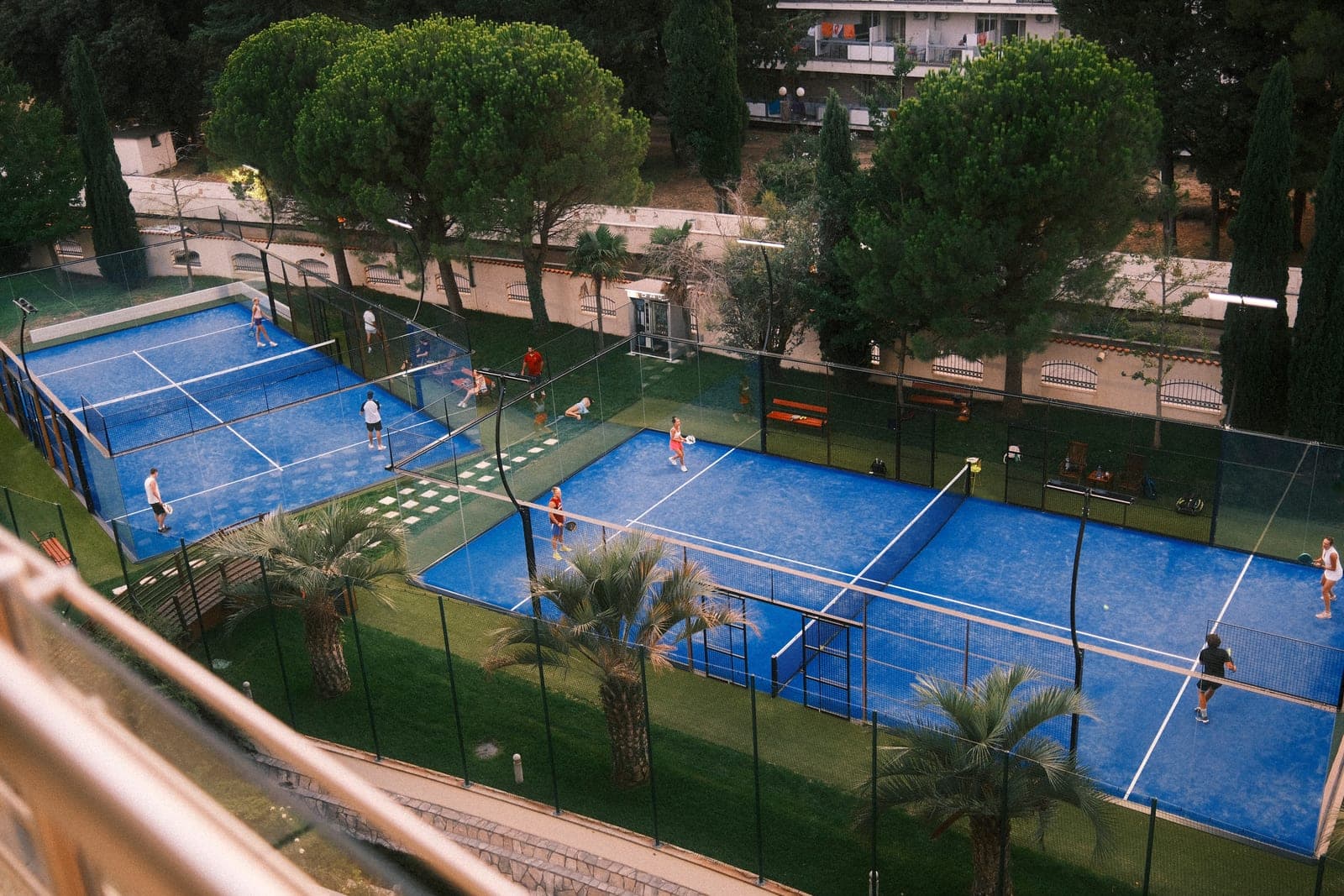
Sports that use out-of-court play in padel:
Related rules
The padel serve
Padel's underarm serve, set out exactly — the bounce before the strike, the waist-height limit, where the server's feet must be, and the wire-mesh fault that has no tennis equivalent.
Ball in play and the walls
What counts as part of the court in padel and how the walls change a rally — which surfaces the ball may use, the order it must use them in, and the returns the rules explicitly permit.
How a point is lost in padel
The actions that end a padel rally — the second bounce, touching the net, direct contact with the opponent's enclosure, and the neutral-zone exception on the court doors.
Sources
The rules, dimensions and specifications on this page were read from these documents.
- Rules of Padel — International Padel Federation (FIP), application review 01.01.2026, Rule 16 — Authorized out-of-court play; Rule 7 — Serve fault (read 2026-09-12)
How it connects
The meaning-bearing relationships that place Out-of-court play in padel in the wider knowledge graph — each one with the reason it exists.
Frequently learned together
Taught side by side in the same stage of a learning path.
- The padel serveBoth are taught in the “Get to know the game” stage of the Padel learning path.
- Ball in play and the wallsBoth are taught in the “Get to know the game” stage of the Padel learning path.
- How a point is lost in padelBoth are taught in the “Get to know the game” stage of the Padel learning path.
- Tennis scoringBoth are taught in the “Get to know the game” stage of the Padel learning path.
- Padel scoringBoth are taught in the “Get to know the game” stage of the Padel learning path.
Part of
The wider grouping this belongs to.
Explore across the knowledge base
Follow the threads that connect Out-of-court play in padel to the rest of SocialSportHub.
Scoring systems
Facilities
- Padel walls and enclosureThe feature that makes padel its own sport — the glass and mesh enclosure, the two permitted side-wall layouts, and why the wall material is specified by how the ball bounces off it.
- Padel courtAn enclosed court, much smaller than a tennis court, walled with glass and mesh so the ball can be played off the walls.
- Volleyball courtA rectangular court split by a high net over which two teams rally the ball, played indoors or on sand.
- Padel court dimensionsThe exact size and markings of a padel court under FIP rules — the 10 by 20 metre rectangle, the service lines, the line width, and the free height the rules require above it.
Learning paths
Tactics
- Zone defenceA defensive system where each player guards an area of the court rather than a specific opponent.
- Crosscourt and down the lineThe geometry that makes crosscourt the default tennis shot — the net is lower in the middle and the court is longer on the diagonal — and when down the line is worth its extra risk.
- Breakdown strategyThe contest that decides most rugby union matches — when to commit players to a ruck and when to leave it, what a jackal is trying to do, and why the counter-ruck is a gamble.
- Territory versus possessionRugby union's central strategic trade — when to keep the ball and when to kick it away — and why the 22-metre line makes field position worth more than possession in some parts of the field.
- Neutral-zone play and the breakoutThe 15 metres between the blue lines where most hockey possession is decided — how a breakout moves the puck out of the defensive zone, and why zone entries are so contested.
Equipment
- The padel ballThe padel ball's own specification — diameter, weight, bounce and internal pressure — and the separate altitude ball the rules provide for above 1,000 metres.
- Swimming gogglesSealed eyewear that lets swimmers see clearly and keep water out of the eyes.
- The padel netThe net that divides a padel court — its two different heights, the maximum post height, the white strip that tops it, and why the posts sit at the lateral limits.
Go deeper with Out-of-court play in padel
Everywhere else on the platform that covers Out-of-court play in padel — assembled from what actually references it, so nothing here is a dead end.
Learn it
Structured courses and paths on the platform that cover this directly.
Take it away
Open data and the whole-platform view of this subject.
How this page is maintained
- Content type
- Rule
- Provenance
- Tier A — evergreen educational
- Verified external sources
- 0
- Content updated
- 2026-09-12
Evergreen, first-party explanation — it makes no claim that needs an external source. How we handle sources and reviews.