
Volleyball court
A rectangular court split by a high net over which two teams rally the ball, played indoors or on sand.
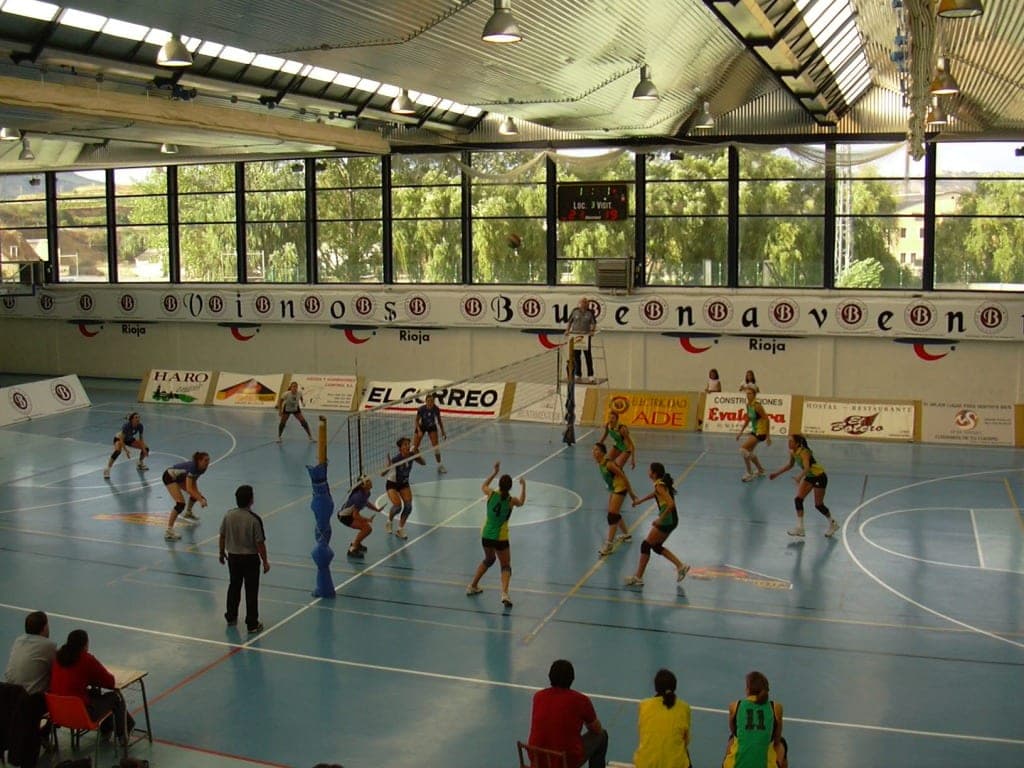
.jpg)
Overview
A volleyball court is a rectangular area divided into two equal halves by a high net. On each side an attack line separates the front-court from the back-court and governs where back-row players may attack the ball.
Indoor courts use wood or synthetic surfaces, while beach volleyball is played on sand with a slightly smaller court and no attack line.
Good to know
- The net is set above a player's reach, with different standard heights for men's and women's play.
- The attack line marks where back-row players must take off from behind to attack the ball.
- A serve is struck from behind the end line into the opponent’s half of the court.
- Beach courts are a little smaller than indoor courts and have no attack line.
Where it’s used
Sports that use volleyball court:
How it connects
The meaning-bearing relationships that place Volleyball court in the wider knowledge graph — each one with the reason it exists.
Frequently learned together
Taught side by side in the same stage of a learning path.
- VolleyballBoth are taught in the “What you’ll need” stage of the Volleyball learning path.
- Sports hallBoth are taught in the “What you’ll need” stage of the Volleyball learning path.
- Hard courtBoth are taught in the “What you’ll need” stage of the Volleyball learning path.
- WoodBoth are taught in the “What you’ll need” stage of the Volleyball learning path.
- SandBoth are taught in the “What you’ll need” stage of the Volleyball learning path.
Explore across the knowledge base
Follow the threads that connect Volleyball court to the rest of SocialSportHub.
Equipment
- VolleyballA soft, inflated ball struck with the hands and arms in volleyball, light enough to be played off the forearms without hurting.
- The padel netThe net that divides a padel court — its two different heights, the maximum post height, the white strip that tops it, and why the posts sit at the lateral limits.
- The tennis net, posts and singles sticksThe net's two heights and the hardware that holds them — post height and position, the singles sticks that convert a doubles net, and the strap and band that finish it.
- Wickets, stumps and bailsThe three stumps and two bails a bowler aims at and a batter defends — their exact height, width and shape, and what the Laws say about when bails may be dispensed with.
- The goal and the creaseThe net a hockey team defends and the protected area in front of it — the exact goal dimensions, what the crease area includes, and why goaltender contact so often disallows a goal.
Playing surfaces
- Hard courtA rigid acrylic, concrete or asphalt court that gives a true, consistent, medium-paced bounce — the standard multi-use outdoor surface.
- WoodAn indoor sprung timber or parquet floor — grippy, consistent and lightly cushioned; the classic surface for indoor court sports.
- SandLoose beach sand: a soft, shifting, energy-sapping surface with no true bounce that rewards balance and footwork, used for beach sports and conditioning.
- ClayA soft, granular racquet-sport surface of crushed brick, stone or shale that slows the ball, gives a high bounce and lets players slide into shots.
Techniques
- Volleyball SpikeA powerful attacking hit that drives the ball sharply downward over the net into the opponent's court, usually after an approach and jump.
- Volleyball DigA defensive contact that keeps a hard-driven ball in play by passing it up off the forearms, usually from a low position.
- Volleyball SetAn overhead pass using the fingertips of both hands to place the ball accurately for a teammate to attack.
- The slice in tennisThe underspin stroke that changes a rally's height and pace — how slice keeps the ball low, when it is defensive and when it is an attack, and what it does on different surfaces.
- Badminton ClearAn overhead stroke that sends the shuttlecock high and deep to the opponent's back court, resetting the rally or buying time.
Positions
- LiberoThe libero is a defensive volleyball specialist who wears a contrasting shirt, plays only in the back row, and cannot attack the ball above the height of the net.
- Outside hitterThe outside hitter attacks from the left side of the net and is often a volleyball team’s main scoring option.
- SetterThe setter is volleyball’s playmaker, taking the team’s second contact and delivering accurate sets for hitters to attack.
- OppositeThe opposite is a volleyball attacker who plays on the right side of the net, opposite the setter in the rotation, and is often a key scorer.
- Middle blockerThe middle blocker plays in the centre of the net, leading the team’s blocking and attacking with fast, quick sets.
Go deeper with Volleyball court
Everywhere else on the platform that covers Volleyball court — assembled from what actually references it, so nothing here is a dead end.
Learn it
Structured courses and paths on the platform that cover this directly.
How this page is maintained
- Content type
- Facility
- Provenance
- Tier A — evergreen educational
- Verified external sources
- 0
- Content updated
- 2026-09-12
Evergreen, first-party explanation — it makes no claim that needs an external source. How we handle sources and reviews.