
The quiet engineering of a running track
A track is specified by how much force it swallows and how far it sinks, not by how well it grips. Both numbers have an upper bound as well as a lower one, and that is the whole design problem: a surface springy enough to give energy back is soft enough to waste it.
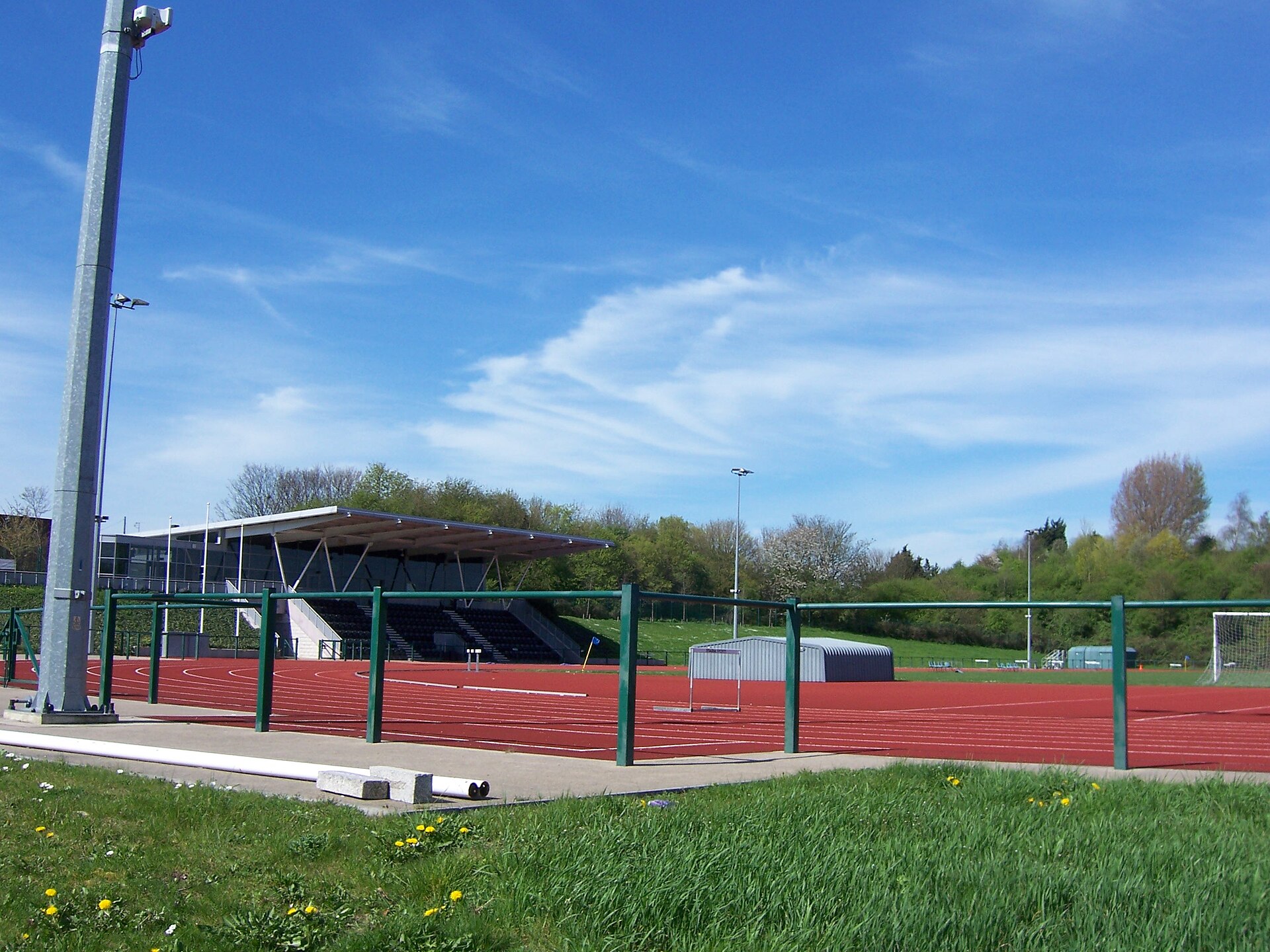
World Athletics does not specify a running track primarily by how well it grips. The first two numbers in the standard are about force and movement. A standard impact must produce a peak force 35% to 50% lower than the same impact on a rigid concrete floor, and under that impact the surface must compress by between 0.6 mm and 2.5 mm. Both windows have to hold at any surface temperature from 10 °C to 40 °C.
Grip is in there too, but in a different grammar: a coefficient of dynamic friction no less than 0.5 in the wet, with no maximum, because a synthetic surface always grips harder dry than wet. It arrives differently as well, from an embossed or textured finish on top rather than from the bulk of the material underneath.
Reference Shock absorption of 35–50% and vertical deformation of 0.6–2.5 mm at surface temperatures of 10–40 °C, and the wet friction minimum of 0.5, are set out in Chapter 3 of the World Athletics Track and Field Facilities Manual.
A one-sided limit is a safety requirement. A window with both edges specified is a tuning problem — a declaration that the property can be wrong in either direction. Shock absorption and vertical deformation between them decide how much of the energy a runner pushes into the ground comes back out of it, and the standard has taken a position on how much of it should.
The manual is candid that the tuning could be pushed further. The technology exists to formulate a surface that favours one kind of event over another; because a championship arena holds sprints, distance races, jumps and throws on the same slab, doing so is judged unacceptable. Every certified system is described instead as a compromise between the needs of different events.
Reference The manual states that surfaces can be formulated to favour particular events, that such tuning is not acceptable for facilities hosting all events, and that all systems represent a compromise.
A surface asked to give the energy back
When a foot lands, work is done on the surface. Some of it is stored as elastic strain and returned as the material recovers its shape; the rest is dissipated internally and leaves as heat. The split is a material property, and on other sports surfaces it is measured directly. In football-turf testing, a 20 kg mass carrying a spring is released onto the sample, and the energy of restitution is reported as the energy of the falling mass after impact divided by its energy before, as a percentage.
Reference FIFA’s test manual defines energy of restitution as the ratio of the falling mass’s energy after and before impact, using the 20 kg Advanced Artificial Athlete.
The same drop produces the other two numbers: shock absorption compares the peak force on the sample with a reference force for concrete, fixed at 6,760 N in that method, and vertical deformation is how far the test foot travels down. World Athletics uses the same family of instrument — an artificial athlete with a spherical-based foot for shock absorption, a flat-based one for deformation — and publishes no restitution requirement at all. It bounds the two properties that govern restitution instead.
Returning energy is not by itself useful. It has to arrive while the foot is still on the ground. In one treadmill study of variable-stiffness platforms, the researchers put the resonant period of the platform-plus-runner system on their most compliant surface at roughly 0.2 s, against a measured contact time of 0.21 s, and concluded the platform had time to give its stored energy back before the foot left it.
Reference Resonant period, contact time and the low damping of the test platforms are reported by Kerdok and colleagues in the Journal of Applied Physiology.
Why the window has two edges
World Athletics states the trade explicitly. Deformation that is too high represents a waste of kinetic energy and impairs performance, and it also makes the foot less stable, which matters most on the bends. Deformation that is too low — because the material is not compliant enough, or because the layer is simply too thin — raises the deceleration forces at impact. The published range is described as the compromise: enough to keep the advantages of a surface that stores and reflects energy, without the forces that come with a floor that will not move.
Reference The rationale for both edges of the 0.6–2.5 mm vertical deformation window, including the description of it as a compromise, is given in section 3.1.3.5 of the manual.
The laboratory evidence that softness can help is real but narrow. Eight runners ran at 3.7 m/s over five purpose-built platforms spanning 75.4 to 945.7 kN/m of surface stiffness. Across that 12.5-fold reduction in stiffness, metabolic rate fell by 12% and the stiffness of the runners’ own legs rose by 29%, while their support mechanics were essentially unchanged. The platforms behaved like near-ideal springs, with a damping ratio below 0.1.
Reference Subject numbers, running speed, the five platform stiffnesses and the 12% metabolic and 29% leg-stiffness changes are from the same study.
Those platforms are not tracks. They were built to fit a treadmill and tested at one moderate speed, and the authors are explicit that the mechanism behind the earlier tuned-track work is still not fully understood. A certified competition surface is specified in a different quantity again — millimetres of movement under a standardised 20 kg drop, not kilonewtons per metre — and the two do not convert. What survives is the direction of the trade: compliance buys energy return until it starts costing contact time and stability.
Three layers, three different jobs
A track is a stack, graded from geology at the bottom to texture at the top.
The foundation is high-quality road construction. Even on an ideal site the manual puts the minimum at 150 mm of free-draining aggregate beneath at least 60 mm of bitumen or asphaltic concrete — typically a base layer of 40–60 mm and a finishing course of 25–30 mm — and on poorer ground a build-up of 400 mm or 500 mm is likely. It is expected to hold its levels for 25 to 30 years, across two or three replacements of the synthetic layer above it.
The base is a dynamic component, not merely a support. Concrete is essentially non-resilient; the bitumen and asphaltic concrete bases normally used have some compliance of their own, enough that the manual notes the base type can shift the measured shock absorption above it.
The resilient layer and the wearing surface are clearest in a composite, or sandwich, system. A base mat of polyurethane-bound rubber crumb around 9 mm thick is laid and cured, its open texture is grouted with fine crumb, and a cast elastomer layer goes on top, at least 4 mm thick in absolute terms. The crumb mat is the spring. The cast layer takes the spikes, the ultraviolet light and the abrasion, and carries the texture that produces the friction number.
Reference Foundation depths and design life, the influence of base type on shock absorption, and the 9 mm crumb mat with a minimum 4 mm cast top layer are described in Chapter 3 of the manual.
Thickness is treated as a means rather than an end, which is the clearest sign that the standard is written about behaviour. A minimum is stipulated because a surface that is too thin cannot deliver its shock absorption and deformation figures; no maximum is stipulated, because an over-thick surface does not automatically become too soft. Where they conflict, the two dynamic requirements take precedence over thickness outright.
The tolerances holding the stack together are geometric. Under a 4 m straightedge dragged across the surface, no bump or depression may exceed 6 mm; under a 1 m straightedge, 3 mm; no step at a seam may exceed 1 mm. A prefabricated sheet takes the shape of whatever it is bonded to, so those are really requirements on the asphalt, imposed a layer early.
What the lanes inherit from a circle
The athletics track underneath is one specific shape. The 400 m Standard Track is two semicircles of radius 36.50 m joined by two straights of 84.39 m; the inner edge of that figure measures 398.116 m. The distance actually raced is measured along a running line 0.30 m outside the kerb, which comes to 400.001 m — over the nominal distance, never under, because every athlete taking the shortest permitted route must cover at least the stipulated distance, with no negative tolerance.
Lanes are 1.22 m ± 0.01 m wide, including the 0.05 m line on the outside. Every lane except the first is measured along a line 0.20 m out from the outer edge of the lane inside it, rather than 0.30 m, because there is no raised kerb to run around.
The staggered start falls straight out of that. Two concentric circles differ in circumference by 2π times the difference in their radii — the radius itself never appears. The extra ground an outer lane would cover over a lap is therefore 2π times its running line’s offset, and nothing else. Between lane 2 and lane 3 the offset is one lane width, 1.22 m, giving 7.666 m; the manual’s 400 m table lists 7.037 m for lane 2 and then 14.703, 22.368 and 30.034, in steps of 7.666. Lane 2’s smaller first step is 2π × 1.12 m, and 1.12 m is what is left once lane 1’s 0.30 m offset is subtracted from lane 2’s. Over 200 m, one bend instead of two, every figure halves.
Reference The Standard Track geometry, the 0.30 m and 0.20 m running lines, the 1.22 m lane width and the staggered start table are in Chapter 2 of the manual.
Distance is equalised exactly. Curvature is not. Lane 8 runs the same 400 m on a gentler arc, which is why the geometry is fenced from both sides: bend radii of 35 m to 38 m are the workable band, with 36.50 m the optimum; a track is not certified if a single bend radius is under 33.50 m, or if the running-line radius of the outer lane exceeds 50 m; nine oval lanes is the stated maximum, beyond which the outside lane gains too much. The stagger is arithmetic. The radius limits are the part arithmetic cannot fix.
And it is one oval, one surface, for events that load it in completely different ways — a sprint start, a distance race, the rolling flat-footed contact of race walking. The compromise the manual keeps returning to is not a hedge. It is what one slab serving all of them requires.
That is the real difference between a track and open ground. In trail running the compliance underfoot changes with every step, and the runner is continually re-tuning the stiffness of their own legs against a surface they cannot predict. A certified synthetic track exists to delete that variable: the same shock absorption in every lane, on bends and straights, at any temperature between 10 °C and 40 °C, over a base built to hold its levels for a quarter of a century.
Reference That sameness is sampled rather than assumed: the manual requires at least one shock absorption measurement per 500 m² of normal-thickness surface, a minimum of twelve across the facility, at prescribed positions on both radii, both straights, the semicircular areas and each runway.
The engineering is not in giving a runner something back. It is in giving every runner the same thing back, everywhere, for decades.
Corrections
- — The reference for Kerdok and colleagues' 2002 study of running on surfaces of different stiffnesses pointed at an author copy hosted by a laboratory server that has since stopped responding. It now points at the paper's PubMed record, which carries the full citation and the DOI. No claim in the story changed.
Read the evergreen pages
This piece is an argument. These are the reference pages on SocialSportHub that document the same subjects.
References
- [1]World AthleticsGoverning body. Track and Field Facilities Manual, 2019 Edition, Chapters 1–3 (World Athletics technical documents). Accessed 2 September 2026.
- [2]FIFAGoverning body. FIFA Quality Programme for Football Turf — Test Manual I: Test Methods, 2015 Edition. Accessed 2 September 2026.
- [3]PubMed, US National Library of MedicinePeer-reviewed. Energetics and mechanics of human running on surfaces of different stiffnesses — Kerdok, Biewener, McMahon, Weyand and Herr, Journal of Applied Physiology 92(2), 2002, pages 469–478. Accessed 6 September 2026.
Continue reading
More on running
Athletics wrote its recent history into the definition of a shoe
The Athletic Shoe Regulations define an approved shoe in four clauses, and each clause names a different date. Read as a chronology rather than a definition, it is the record of a governing body absorbing a technology it did not anticipate.
More on running
The false-start rule rests on a number the research disputes
World Athletics treats a reaction time under 0.100 seconds as evidence that a sprinter moved before the gun. That threshold is a claim about human physiology, and a study on instrumented blocks found five of nine athletes averaging under it.
More on running
Sport's most-used test measures something the field still argues about
Dip before you jump and you jump higher. The gap between a countermovement jump and a squat jump is treated as a readout of elastic energy — but a review of the mechanisms concludes elastic energy is a small contributor, and that a bigger gap may be the worse sign.