
Four approved tennis balls, one mass, and the two numbers that separate them
The ITF approves four balls for adult tennis. Put their specifications side by side and they agree exactly on weight and on how far they squash — and differ on diameter, on how high they bounce, and on how much shape they have got back before the load comes off.
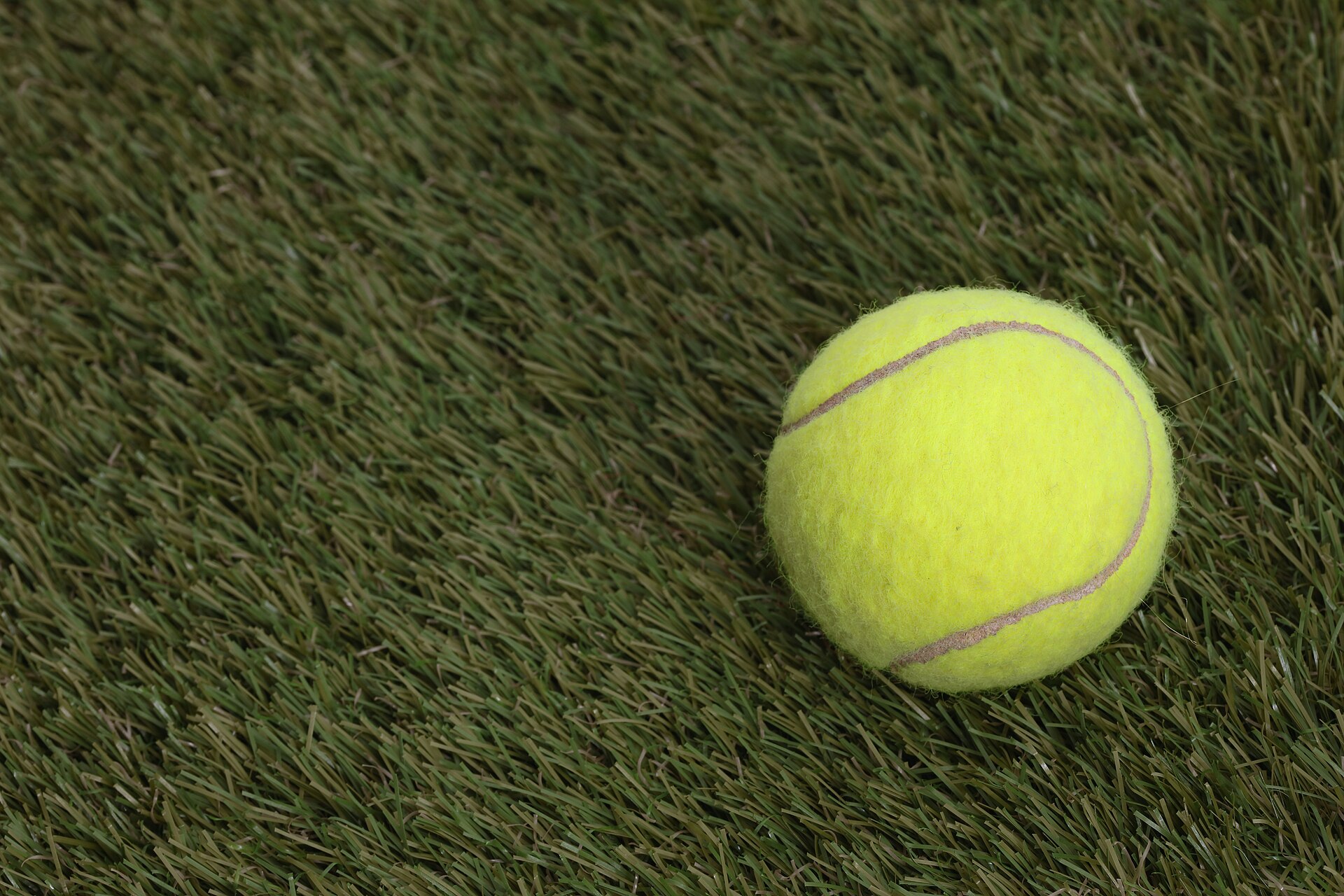
Tennis is played with four different balls. Not four brands — four specifications, each approved under the Rules of Tennis, each intended for a different situation, and each defined by five properties in one table.
Transpose that table and the interesting part is what does not vary.
Everything the four balls share
Mass is identical across all four types: 56.0 to 59.4 grams. Forward deformation — how far the ball squashes when the test load is first applied — is identical across all four: 0.56 to 0.74 cm.
Reference The mass and forward-deformation ranges, identical across Type 1, Type 2, Type 3 and High Altitude balls, from the ball specification table.
Those two facts rule out the two most obvious ways of making a ball slower. You cannot make it heavier, because the mass range is the same for the fast ball and the slow one. And you cannot make it softer on impact, because the amount it gives under load is the same for all of them.
Three properties are left, and each of them is doing a different job.
Rebound height from a 254 cm drop
Centimetres of rebound, measured to the bottom of the ball
The numbers behind this chart
| Row | Centimetres of rebound, measured to the bottom of the ball | Detail |
|---|---|---|
| Type 1 (fast) | 138 to 151 | Slow-pace court surfaces |
| Type 2 (medium) | 135 to 147 | Medium-slow, medium and medium-fast surfaces |
| Type 3 (slow) | 135 to 147 | Fast-pace court surfaces |
| High Altitude | 122 to 135 | Play above 1,219 m only |
Source ITF, Approved Tennis Balls, Classified Surfaces & Recognised Courts 2026, Appendix I.
Method Ranges as tabulated. The rebound test drops the ball from 254 ± 0.3 cm onto a smooth, rigid, horizontal block of high mass, measuring to the bottom of the ball in both cases.
Diameter, for the surface
The Type 3 ball — the slow one, intended for fast-pace surfaces — is the only type with a different size. Where Types 1, 2 and High Altitude must pass a 6.86 cm ring gauge and not pass a 6.54 cm one, the Type 3 must pass 7.30 cm and not pass 7.00 cm.
Reference The size ranges of 6.54–6.86 cm for Types 1, 2 and High Altitude, and 7.00–7.30 cm for Type 3, from the specification table.
Reference The go/no-go ring-gauge method for size, in which the ball must not drop through the smaller opening under its own weight in any orientation and must drop through the larger one in all orientations, from the test procedures.
Same mass, bigger ball. That is a specific engineering choice: it increases the frontal area the ball presents to the air without changing its inertia, so the ball decelerates more in flight while carrying exactly as much momentum into the bounce. If the aim is to give the receiving player more time on a fast court, adding drag is the way to do it without also changing what happens at the strings.
Then the balls are matched to surfaces. Type 1, the fast ball, is intended for slow-pace surfaces; Type 2 for the medium-slow, medium and medium-fast bands; Type 3, the slow ball, for fast-pace surfaces.
Reference The intended pairing of ball type to court pace category — Type 1 for slow surfaces, Type 2 for the three middle categories, Type 3 for fast surfaces — from the case guidance on which ball to use on which surface.
The pairing runs opposite to intuition, and deliberately: the fast ball goes on the slow court. The ITF is not specifying balls to suit surfaces but to compensate for them, which is the same principle a handicap works on.
Rebound, for the air
The High Altitude ball is the one that changes rebound, and it changes it decisively: 122 to 135 cm, where every other type sits between 135 and 151. Its entire permitted range lies at or below the bottom of theirs.
Reference The High Altitude ball’s rebound range of 122–135 cm against 138–151 for Type 1 and 135–147 for Types 2 and 3, from the specification table.
It is otherwise a normal-sized ball. So where the Type 3 solves a surface problem by adding drag, the High Altitude ball solves an air-density problem by taking energy out of the bounce.
That is the right lever for the right problem. At altitude the air is thinner and provides less drag, so a ball flies further and faster for the same strike. Making the ball bigger would work in principle, but the ITF has already assigned diameter to the surface question. Reducing the rebound reaches the same end through the other property, and leaves the two adjustments independent of one another.
The provisions around it are exacting. A pressureless Type 2 ball, with an internal pressure no greater than 7 kPa, may be used for high-altitude play above 1,219 m provided it has been acclimatised for sixty days or more at the altitude of the specific tournament. The Type 3 ball is also permitted and recommended above that altitude on any surface type. The High Altitude ball itself is pressurised and specified for high-altitude play only.
Reference The 7 kPa pressureless limit, the 1,219 m threshold, the sixty-day acclimatisation requirement, the recommendation of Type 3 at altitude on any surface, and the restriction of the High Altitude ball to high-altitude play, from the notes to the specification table.
Return deformation, and the one place the fast ball is alone
The fifth property is the one nobody talks about, and it is where the specification is most precise.
The deformation test applies a load of 80.07 ± 0.5 N, after an initial contact load of 15.57 ± 0.5 N has compressed the fabric cover. Deformation is then measured twice: forward, when the load is first applied, and return, under the action of the load prior to it being removed and after the ball has been compressed.
Reference The 80.07 ± 0.5 N test load, the 15.57 ± 0.5 N initial contact load applied to compress the cover, and the definitions of forward and return deformation, from the test procedures.
Two readings of the same squash, at the start and the end of holding it. The gap between them is what the rubber has not recovered while the load stayed on, and a specification that measures both is measuring energy loss rather than softness.
Return deformation — how much squash is still there before the load is released
Centimetres of remaining deformation under load
The numbers behind this chart
| Row | Centimetres of remaining deformation under load | Detail |
|---|---|---|
| Type 1 (fast) | 0.74 to 1.08 | forward deformation 0.56–0.74 cm on all four types |
| Type 2 (medium) | 0.80 to 1.08 | forward deformation 0.56–0.74 cm on all four types |
| Type 3 (slow) | 0.80 to 1.08 | forward deformation 0.56–0.74 cm on all four types |
| High Altitude | 0.80 to 1.08 | forward deformation 0.56–0.74 cm on all four types |
Source ITF, Approved Tennis Balls, Classified Surfaces & Recognised Courts 2026, Appendix I.
Method Ranges as tabulated. Each figure is the mean of one reading along each of three perpendicular axes, with individual readings limited to a 0.08 cm spread.
Every type shares the upper limit of 1.08 cm. Three of the four share a lower limit of 0.80. The Type 1 ball — and only the Type 1 ball — is permitted down to 0.74.
Reference The return-deformation ranges of 0.74–1.08 cm for Type 1 and 0.80–1.08 cm for Types 2, 3 and High Altitude, from the specification table.
At 0.74 cm the return deformation equals the maximum forward deformation, which is to say the ball has come back to where it started under load rather than creeping further. The fast ball is allowed to be the most elastic of the four, and it is allowed to be so by 0.06 cm — six hundredths of a centimetre, written into a table, separating the fastest approved ball from every other one.
Why the numbers only mean anything in a laboratory
None of the above is a claim about a ball in a match, and the testing regulations make clear why.
A ball’s properties are affected by temperature, its cover by atmospheric moisture, and its effective internal pressure by the external atmospheric pressure — so testing has to be done under controlled conditions, with balls conditioned for at least 24 hours beforehand.
Reference That the rubber core and internal gas are affected by temperature, the cover by atmospheric moisture, and the effective internal pressure by external atmospheric pressure, and the 24-hour conditioning requirement, from the general considerations.
Before any measurement, each ball is pre-compressed through 2.54 cm three times on each of three perpendicular axes — nine compressions in total — to remove any set in it. All subsequent tests must be completed within two hours of that.
Reference The pre-compression procedure of 2.54 cm three times on each of three perpendicular axes, nine in all, and the requirement that subsequent tests be completed within two hours, from the test procedures.
A tennis ball, in other words, is an object whose properties change with how recently it was squashed. The specification handles that by squashing every ball the same way first and then measuring within a fixed window — which means the numbers in the table describe a ball that has just been through nine compressions in a temperature-controlled room, and not one that has been in a can for six months.
What the table adds up to
Read across the four types and the ITF’s method becomes clear. It has three levers — size, rebound and return deformation — and it uses one for each problem rather than mixing them.
Size answers the surface. Rebound answers the air. Return deformation separates the fast ball from the rest by a fraction of a millimetre. Mass and forward deformation are held constant throughout, so that whichever ball is in play, it arrives at the strings with the same inertia and gives the same amount under the first instant of load.
That is an unusually disciplined piece of specification writing. Each variable is assigned to one job and left alone in the others, which is what makes it possible to say — as the ITF’s own guidance does — that a ball correct on one court is wrong on another, and to know exactly which property makes it so.
Read the evergreen pages
This piece is an argument. These are the reference pages on SocialSportHub that document the same subjects.
References
- [1]International Tennis FederationGoverning body. ITF Approved Tennis Balls, Classified Surfaces & Recognised Courts 2026 — Appendix I, The Ball. Accessed 6 September 2026.
- [2]International Tennis FederationGoverning body. ITF Approved Tennis Balls, Classified Surfaces & Recognised Courts 2026 — Part A, Regulations for the testing of tennis balls for ITF approval. Accessed 6 September 2026.
- [3]International Tennis FederationGoverning body. ITF Approved Tennis Balls, Classified Surfaces & Recognised Courts 2026 — Classification of Court Pace, and which ball for which surface. Accessed 6 September 2026.
Continue reading
Editor’s pick
Clay is unbound, and that one word changes tennis
The ITF's surface table separates clay from every hard court with a single word: unbound. A few millimetres of loose grit over a deep compacted base is the whole difference — and it rewrites which shots and which footwork are worth having.
Editor’s pick
One legal football can hold nearly twice the pressure of another
Law 2 specifies the ball in five lines. Read the tolerances rather than the numbers and the specification turns out to be unusually loose in the one property that most changes how the ball behaves — and to be pinned to a place and a moment that no match actually occupies.
More on tennis
Five sports paint a line around the court. Only four of them agree it is part of it
A ball on the line is in, unless you are playing basketball, where the boundary line is not court at all. The disagreement is written into the rulebooks, and it decides which edge of the paint the tape measure is held against.