
Swimming defines three of its strokes by what you may not do, and one by nothing at all
Freestyle means any style. Backstroke is bounded by an angle, breaststroke by an order of movements, and all four by the same fifteen metres. Read together, the rules describe a sport that regulates the surface of the water more than the swimmer.
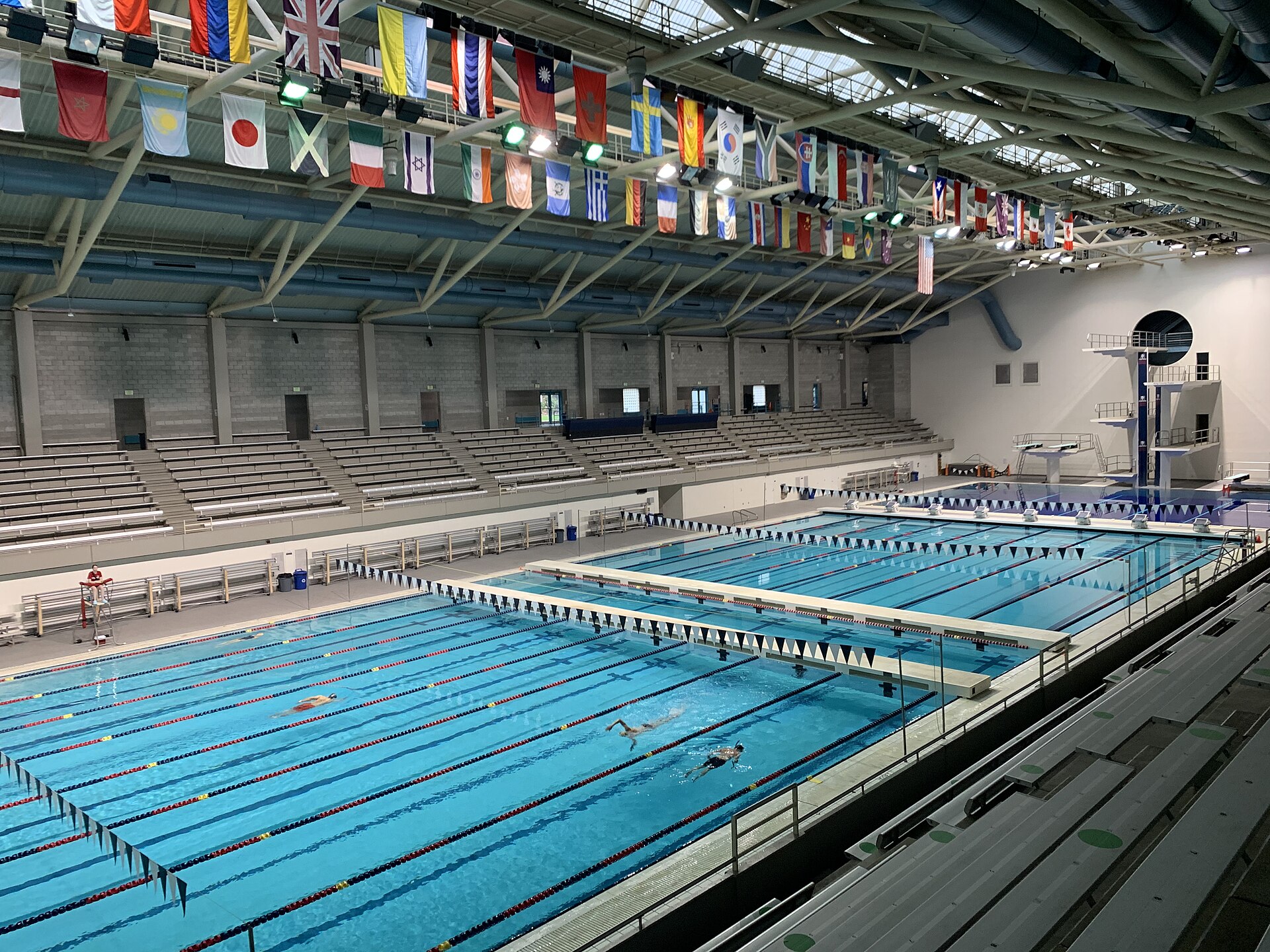
Article 5 of World Aquatics’ swimming rules is two sentences long and one of them defines a stroke by subtraction.
In a freestyle race, freestyle means an athlete may swim any style. In an individual medley or a medley relay, freestyle means any style other than backstroke, breaststroke or butterfly.
Reference The two definitions of freestyle — any style in a freestyle race, and any style other than backstroke, breaststroke or butterfly in a medley — from Article 5.1.
That is the whole specification. Freestyle is not a stroke; it is a permission, and in a medley it becomes the complement of the other three. Nothing in the rules requires front crawl, and the fact that everyone swims it is a result rather than a requirement.
The other three strokes are specified at length, and every clause is a prohibition.
Backstroke: a stroke bounded by an angle
At the starting signal and after each turn the athlete must push off and swim on their back throughout the race. And then the sentence that makes the rule usable:
The athlete’s normal position on their back may include a roll movement of the body up to but not including 90 degrees from horizontal. The position of the head is not relevant.
Reference The requirement to swim on the back, the permitted roll of up to but not including 90 degrees from horizontal, and the statement that the position of the head is not relevant, from Article 6.2.
Two things are remarkable here. The first is that “on the back” — which sounds like a description of a posture — is given a numeric boundary, because without one no official could rule on a swimmer rotating through a stroke cycle. The second is the explicit exclusion of the head. A rule that watched the head would be watching the part of the body a swimmer moves most and controls most independently; the rule watches the torso’s rotation instead, and says so.
The turn gets its own permission. On executing a turn the athlete must touch the wall with at least one part of the body; during the turn the shoulders may be turned over the vertical to the breast, after which an immediate continuous single arm pull or immediate continuous simultaneous double arm pull may be used to initiate the turn — and the athlete must have returned to the position on the back on leaving the wall.
Reference The turn procedure for backstroke, including the permitted rotation past vertical, the immediate continuous single or simultaneous double arm pull, and the requirement to have returned to the back on leaving the wall, from Article 6.4.
“Immediate” and “continuous” are doing the enforcement. The swimmer is allowed to leave the backstroke position, but only inside a movement that does not pause — so the exemption cannot be used to swim any distance on the front.
Breaststroke: a stroke defined as a sequence
Breaststroke is the most heavily specified, and the specification is about order rather than shape.
From the beginning of the first arm stroke after the start and after each turn, the athlete’s body must be on the breast. It is not permitted to roll onto the back at any time, except at the turn after touching the wall. And from the start and throughout the race, the stroke cycle must be one arm stroke and one leg kick in that order, with all movements of the arms simultaneous and without alternating movement.
Reference The requirements that the body be on the breast from the first arm stroke, that rolling onto the back is not permitted except at the turn, and that the stroke cycle be one arm stroke and one leg kick in that order with simultaneous non-alternating arm movements, from Articles 7.2 and 7.3.
The hands must be pushed forward together from the breast on, under, or over the water, and the elbows must be under water except for the final stroke before the turn, during the turn, and for the final stroke at the finish.
Reference The requirement that the hands be pushed forward together from the breast on, under or over the water, and that the elbows be under water except for the final stroke before the turn, during the turn and at the finish, from Article 7.4.
Three named exceptions to a rule about elbows. That is what a rule looks like after it has been tested against every way somebody found to gain from breaking it.
The start and turn get a precisely bounded dispensation: the athlete may take one arm stroke completely back to the legs, during which they may be submerged, and at any time before the first breaststroke kick a single butterfly kick is permitted. The head must break the surface before the hands turn inward at the widest part of the second stroke.
Reference The permitted single arm stroke back to the legs, the single butterfly kick permitted before the first breaststroke kick, and the requirement that the head break the surface before the hands turn inward at the widest part of the second stroke, from Article 7.1.
One kick. Not “a small number”, not “briefly” — one, and it must come before a specified point in a specified stroke.
The fifteen metres every stroke shares
Different as the three specified strokes are, they converge on one number, and freestyle joins them.
At least one part of the athlete’s body must break the surface of the water throughout the race, except during the turn and for a distance of not more than 15 metres after the start and after each turn. By the 15-metre mark, the athlete’s head must have broken the surface.
Reference The requirement that part of the body break the surface throughout the race, the exception for the turn and for not more than 15 metres after the start and each turn, and the requirement that the head have surfaced by the 15-metre mark, from Articles 5.3 and 6.3.
And a matching allowance at the other end: once part of the head has passed the 5-metre mark immediately before reaching for the finish wall, the athlete may be completely submerged.
Reference That an athlete may be completely submerged once part of the head has passed the 5-metre mark immediately prior to reaching for the finish wall, from Article 5.4.
Fifteen metres after every wall, five metres before the last one. In a 50 m pool that is 30 per cent of the first length available underwater; in a 25 m pool, 60 per cent.
The reason the number exists at all is that underwater is faster than the surface for a well-drilled swimmer. Wave drag — the energy a swimmer spends making the water at the surface move up and down — largely disappears a body’s depth below it. Left unregulated, the optimal race would be swum underwater, and the strokes the rules so carefully specify would be irrelevant for most of it.
So the 15-metre rule is not a technicality. It is the rule that keeps swimming a surface sport, and it is the only clause in Articles 5 to 7 that applies identically to every stroke including the one with no definition.
What the four articles add up to
Read as a set, the stroke rules are less a description of how to swim than a set of boundaries drawn around a much larger space of things a fast swimmer might otherwise do.
Freestyle marks the outer edge: no constraint at all, and the sport still converges on one technique because that technique is quickest. The other three carve out named regions inside it — on the back, on the breast, arms simultaneous — and defend each with an angle, an order, or a list of exceptions about elbows.
And underneath all four sits a single distance, protecting the one thing that a stroke definition cannot: that the race happens where somebody can see it.
Read the evergreen pages
This piece is an argument. These are the reference pages on SocialSportHub that document the same subjects.
References
- [1]World AquaticsGoverning body. Competition Regulations, Part Two: Swimming Rules, in force from February 2026 — Article 5 Freestyle, Article 6 Backstroke, Article 7 Breaststroke. Accessed 6 September 2026.
Continue reading
Editor’s pick
A racing pool may be a centimetre too long and not a millimetre too short
World Aquatics gives the 50-metre pool a tolerance of plus ten millimetres and minus nothing — and requires that length to hold from 300 millimetres above the water to 800 below it. The asymmetry is the same one athletics applies to a wind reading.
Editor’s pick
What a swimming pool is engineered to do
A competition pool has one hydraulic job: to take back the energy eight swimmers pour into it and not give any of it back. Depth, lane ropes, lane width and the gutter are four different exits for the same waves.
More on swimming
Swimming's technology rule fits in four sentences, and names no technology
Article 14 forbids anything that may aid speed, buoyancy or endurance — a test of effect rather than of shape — then permits a data recorder that must not transmit, and tape on up to two fingers or toes.