
What a swimming pool is engineered to do
A competition pool has one hydraulic job: to take back the energy eight swimmers pour into it and not give any of it back. Depth, lane ropes, lane width and the gutter are four different exits for the same waves.
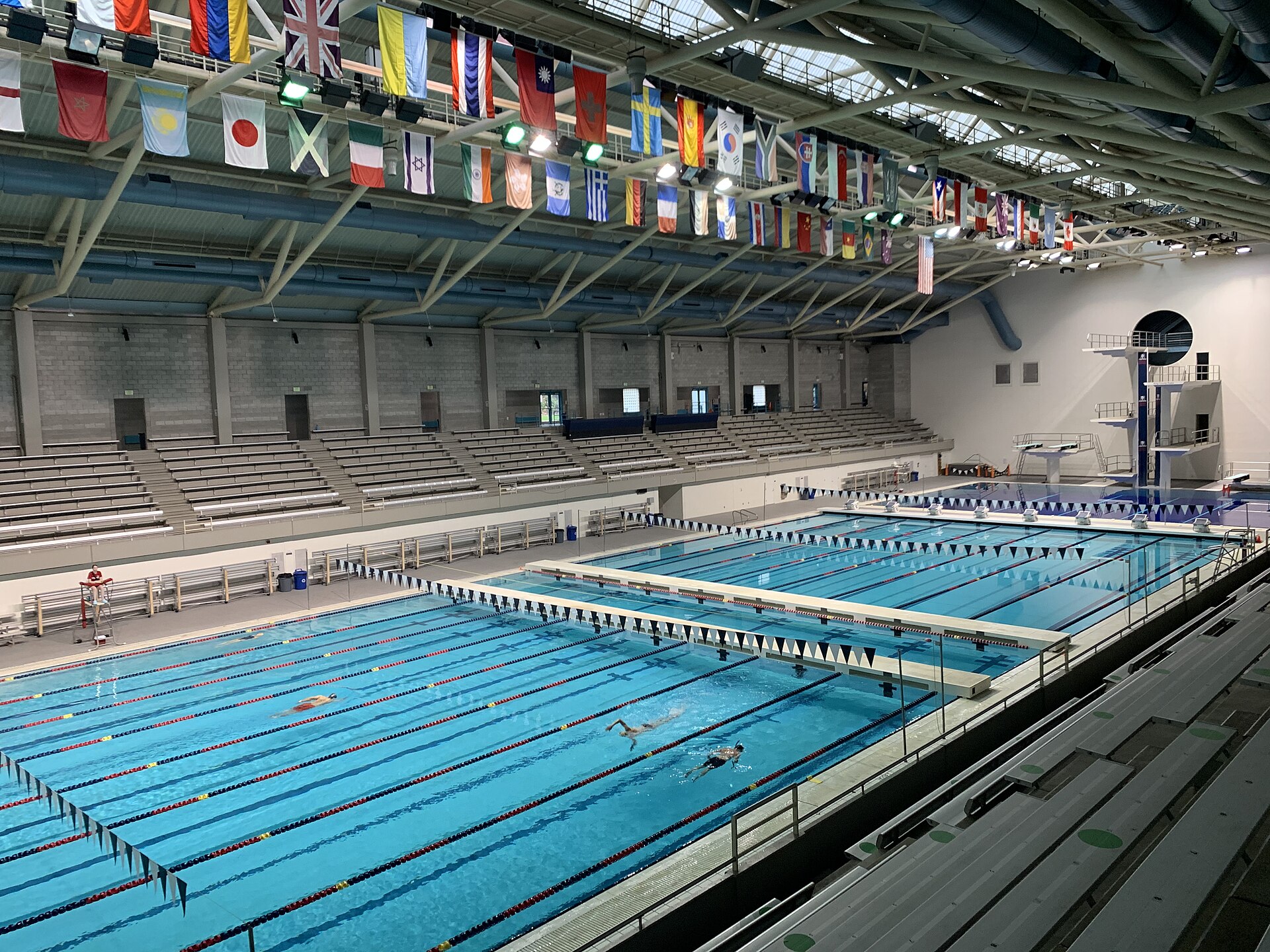
World Aquatics does not describe a lane rope only as a divider. Its regulations give the rope two main functions — separating swimming lanes and reducing the pool’s waves — and then specify the second in detail: it should reduce the impact of a wave whether that wave is continuing through to the far side or bouncing back the way it came. The clause that follows is the giveaway. Components that do not contribute to wave reduction, such as the tension spring and the take-up reel, must measure less than 200 mm at each end.
In a 50-metre pool that permits under 40 centimetres of hardware. Everything else along the rope has to be doing something to the water.
Reference The functions of a lane rope and the 200 mm limit on non-wave-reducing components are set out in Article 15.7 of the World Aquatics Competition Regulations, Part Two: Swimming Rules.
That is the design brief of a racing pool, compressed into a clause about a rope. A competition pool is not a container for water but a machine for removing energy from it — the energy the swimmers put in.
How much energy there is to remove
A body moving fast at the surface is a wave-maker, the way a hull is, and the waves are not a by-product of the stroke. Towing work on passive, streamlined bodies put wave-making at about half of total resistance at 2.25 metres per second, and found that near 2.0 metres per second a depth of about 2.8 body diameters eliminated measurable wave resistance. Earlier towing of human subjects measured around a fifth more passive drag at the surface than at 0.6 metres, at 2.2 metres per second.
Reference Those wave-drag proportions, the depth criterion and the surface-versus-submerged comparison are reported at second hand — from earlier towing studies — in a review of wave drag in human swimming presented to the International Society of Biomechanics in Sports, which also notes the difficulty of quantifying wave drag during free swimming.
Those figures describe one towed body, but they size the problem the building has to solve: eight or ten people each shedding a large share of their power into the water as waves, in a box 25 metres wide. None of that energy is destroyed. Where it goes is the only part a designer controls.
Wave energy is also not on the surface. Water under a passing wave moves in orbits whose diameter at the surface is about the wave height and shrinks with depth, until below roughly half a wavelength the water is effectively undisturbed. A wave is a moving column, not a moving skin.
Reference Orbital motion, the decrease of orbital diameter with depth and the half-wavelength limit below which water is unaffected by the wave are set out in the University of Hawaiʻi at Mānoa teaching text Exploring Our Fluid Earth.
That column has three exits: downward into deep water where it disperses, sideways across the pool where something can absorb it, or over the edge and out altogether. Every specified feature of a fast pool is one of those three. Every surface that is not an exit is a reflector.
Depth is a boundary condition, not a courtesy
The depth requirement climbs with the level of the meet. At the Olympic Games and the World Aquatics Championships the minimum is 2.5 metres; at the World Aquatics Swimming Championships (25 m) it is 2.0 metres, with 2.5 recommended. At all other World Aquatics events it is 1.0 metre, rising to 1.35 metres from 1.0 metre to at least 6.0 metres from the end wall wherever starting blocks are used.
Reference Pool depth minima by competition level are given in Article 15.4, and the 1.35 m starting-block envelope is repeated in Article 15.8.4.
The regulations give no reason for any of it. Their structure shows only that the two numbers are not the same kind of number. The 1.35-metre figure is local: it applies between 1.0 and 6.0 metres from the end wall, which is the stretch a body entering off a block travels through. The championship minimum is not local. It applies to the whole tank, including the long middle of a 50-metre pool, where nobody enters from a block.
The wave-base picture supplies a mechanism that fits, though no rule claims it. A floor inside the moving column is a boundary: the orbiting water cannot complete its circles, the motion flattens against a solid surface, and the energy stays in the layer the race happens in rather than dispersing into water nobody swims through. A floor below the column is never met at all. Depth on this reading is not absolute: a pool is deep only relative to the waves made in it.
Depth serves other purposes too. The 2021–2025 facilities rules set a 2-metre minimum for the Olympic Games and World Championships, and recommended 3 metres where a pool is shared with disciplines such as artistic swimming. That minimum is now 2.5 metres. The direction of travel is on the record; the reasoning is not.
Reference The 2 m minimum with 3 m recommended for multi-discipline use appears at FR 2.2.4 of the 2021–2025 FINA Facilities Rules, the predecessor of the current Article 15.
A rope that is mostly underwater
The lane rope specification is unusually prescriptive about geometry nobody in the stands can see. Wave-reducing components sit end to end, between 0.1 and 0.15 metres across, with a float forming an integral part between each pair of discs. Along the whole course the rope must have negative buoyancy, so that between one half and two thirds of the height of those components sits below the surface; the anchors are set so the components at each end wall are 50 per cent submerged.
The rest of the clause is about load. The rope is stretched to between 1 and 1.2 kilonewtons, carries a tension spring able to absorb sudden high point loads and a wire rated to 12 kilonewtons, and is fixed to anchors rated to 20 kilonewtons.
Reference Component diameter, buoyancy and submerged fraction, anchor submersion and the 20 kN anchor rating are specified in Article 15.7.4; the tension spring and the 12 kN wire in Article 15.7.5; the 1 to 1.2 kN rope tension in Article 15.7.8.
Each of those numbers follows from where the wave actually is. A float riding on top is lifted by an arriving crest and set down again: it moves with the wave and passes it along. A disc held two thirds under stands in the orbiting water itself, and a disc that churns turns smooth, travelling motion into small-scale disorder that goes nowhere. The tension keeps the rope straight rather than slack; the spring stops a sudden point load running the length of it as a shock.
Width buys distance, and buffers protect the walls
A racing lane is 2.5 metres wide, and the floor markings run 2.5 metres apart centre to centre. At the Olympic Games the pool holds eight of them plus a gap 2.5 metres wide outside lane 1 and outside lane 8, each separated from the racing lane by its own rope; a ninth and tenth lane are allowed only exceptionally, with approval. A permanent pool at the World Aquatics Championships holds ten: the middle eight at 2.5 metres, the outer two at 2.4, with a roped gap of at least 0.1 metres beyond. Minimum width at those events is 25 metres for a permanent pool and 26 for a temporary one.
Reference Lane counts, widths and outer gaps are set out in Article 15.6, minimum pool widths in Article 15.3 and lane-marking spacing in Article 15.13.
Width does two things. It gives a wave distance to travel before it reaches anyone, and a spreading wave loses amplitude as it goes. It also puts more interfaces in the way, each taking a cut of the energy crossing it. The outer gaps are the more revealing detail. A solid wall gives an arriving wave nowhere to go but back, and the rules will not let the outermost racing lane sit against one: they put empty water and a second rope in between. Eight lanes at 2.5 metres plus two buffers at 2.5 metres comes to 25 metres, which is exactly the permanent-pool minimum. Built to that minimum, a fifth of an Olympic pool is water nobody races in.
An edge that lets water leave
On gutters the regulations are strikingly permissive. They may be placed on all four walls, end-wall gutters must still allow touch panels to be mounted to 0.3 metres above the water, and all must be covered with a grill or screen. No profile is mandated; the outcome is. During competition the surface level of the water must be constant, with no appreciable movement.
Reference Gutter permissions appear in Article 15.5.3; the constant-level, no-appreciable-movement requirement is Article 15.11.2.1.
That is a performance specification, and the gutter is how a building meets it. If the pool edge stands proud of the water, an arriving wave has nowhere to go and comes back. If it sits at the water line and opens into a trough, the crest runs over the lip and out. The wave is not damped or redirected — it is removed, with the water it was made of.
Public-health design standards put numbers on the trough: a perimeter overflow system takes water continuously off the surface at at least 100 per cent, preferably 125 per cent, of the recirculation rate, with an effective surge capacity of no less than a gallon per square foot of pool surface — about 41 litres per square metre.
Reference Overflow sizing is section 9.5.1.1 and surge capacity section 9.5.1.3 of the Recommended Standards for Swimming Pool Design and Operation, drawn up by the Great Lakes–Upper Mississippi River Board of Public Health and Environmental Managers as a guide for the states represented on it, not as a competition rule.
United States Department of Defense criteria for recreational aquatic facilities call for continuous perimeter overflow systems, and name the purpose of the storage behind them: surge capacity for water displaced by swimmers. The same document specifies racing lane dividers as continuous disk-type, wave-quelling floats.
Reference Continuous perimeter overflow, surge storage for water displaced by swimmers and the specification of lane dividers as wave-quelling floats appear in Unified Facilities Criteria 4-750-07, Recreational Aquatic Facilities.
There is a second reason the gutter has to work. A 50-metre pool must move 220 to 250 cubic metres of water an hour on days of competition and training, and at those turnover rates the distribution must produce no appreciable current. The regulations define the term: movement able to carry a floating basketball, ballasted with six litres of water, more than 1.25 metres in 60 seconds. The test is literal. Two crossed floating lines make a square 2.5 metres on a side, the ball goes in the middle, and it must touch none of the four ropes within the minute. It is run eight times — lanes 1, 3, 6 and 8, at both ends.
Reference Turnover rates, the definition of appreciable current and the basketball test procedure are set out in Articles 15.11.2.2 to 15.11.2.6.
So the pool must move up to a quarter of a million litres an hour in and out, and stay undetectable doing it. Drawing the water off across the whole perimeter, rather than through a few concentrated outlets, is what makes those two requirements compatible.
Why the phrase is not a figure of speech
Nothing here makes a pool fast in the sense of pushing anybody along. The phrase appears nowhere in the regulations, which specify geometry, materials and tolerances, never a performance. What a pool can do is fail to slow people down, and that failure is engineered.
A swimmer converts work into forward motion and into waves, and the waves are a large enough share to build around. Whether that shed energy comes back depends on four measurable properties: how deep the floor sits relative to the wave column, how much of each lane-rope disc is underwater, how much water and how many ropes stand between a racing lane and the nearest wall, and whether the perimeter is a barrier or an opening. That is what a fast pool names. It is also why open water racing is a different problem: no floor within reach, no rope, no gutter, nothing built to take the energy back.
Read the evergreen pages
This piece is an argument. These are the reference pages on SocialSportHub that document the same subjects.
References
- [1]World AquaticsGoverning body. Competition Regulations, Part Two: Swimming Rules — Article 15, Swimming Facilities and Equipment. Accessed 2 September 2026.
- [2]International Society of Biomechanics in SportsPeer-reviewed. Wave Drag in Human Swimming, 30th Annual Conference of Biomechanics in Sports. Accessed 2 September 2026.
- [3]University of Hawaiʻi at MānoaUniversity. Wave Energy and Wave Changes with Depth — Exploring Our Fluid Earth. Accessed 2 September 2026.
- [4]FINA (now World Aquatics)Governing body. Facilities Rules 2021–2025, FR 2 Swimming. Accessed 2 September 2026.
- [5]Great Lakes–Upper Mississippi River Board of Public Health and Environmental ManagersGovernment. Recommended Standards for Swimming Pool Design and Operation (copy hosted by the South Dakota Department of Health). Accessed 2 September 2026.
- [6]United States Department of DefenseReference. Unified Facilities Criteria 4-750-07, Recreational Aquatic Facilities. Accessed 2 September 2026.
Continue reading
More on swimming
A racing pool may be a centimetre too long and not a millimetre too short
World Aquatics gives the 50-metre pool a tolerance of plus ten millimetres and minus nothing — and requires that length to hold from 300 millimetres above the water to 800 below it. The asymmetry is the same one athletics applies to a wind reading.
More on swimming
Swimming defines three of its strokes by what you may not do, and one by nothing at all
Freestyle means any style. Backstroke is bounded by an angle, breaststroke by an order of movements, and all four by the same fifteen metres. Read together, the rules describe a sport that regulates the surface of the water more than the swimmer.
More on swimming
Swimming's technology rule fits in four sentences, and names no technology
Article 14 forbids anything that may aid speed, buoyancy or endurance — a test of effect rather than of shape — then permits a data recorder that must not transmit, and tape on up to two fingers or toes.