
A racing pool may be a centimetre too long and not a millimetre too short
World Aquatics gives the 50-metre pool a tolerance of plus ten millimetres and minus nothing — and requires that length to hold from 300 millimetres above the water to 800 below it. The asymmetry is the same one athletics applies to a wind reading.
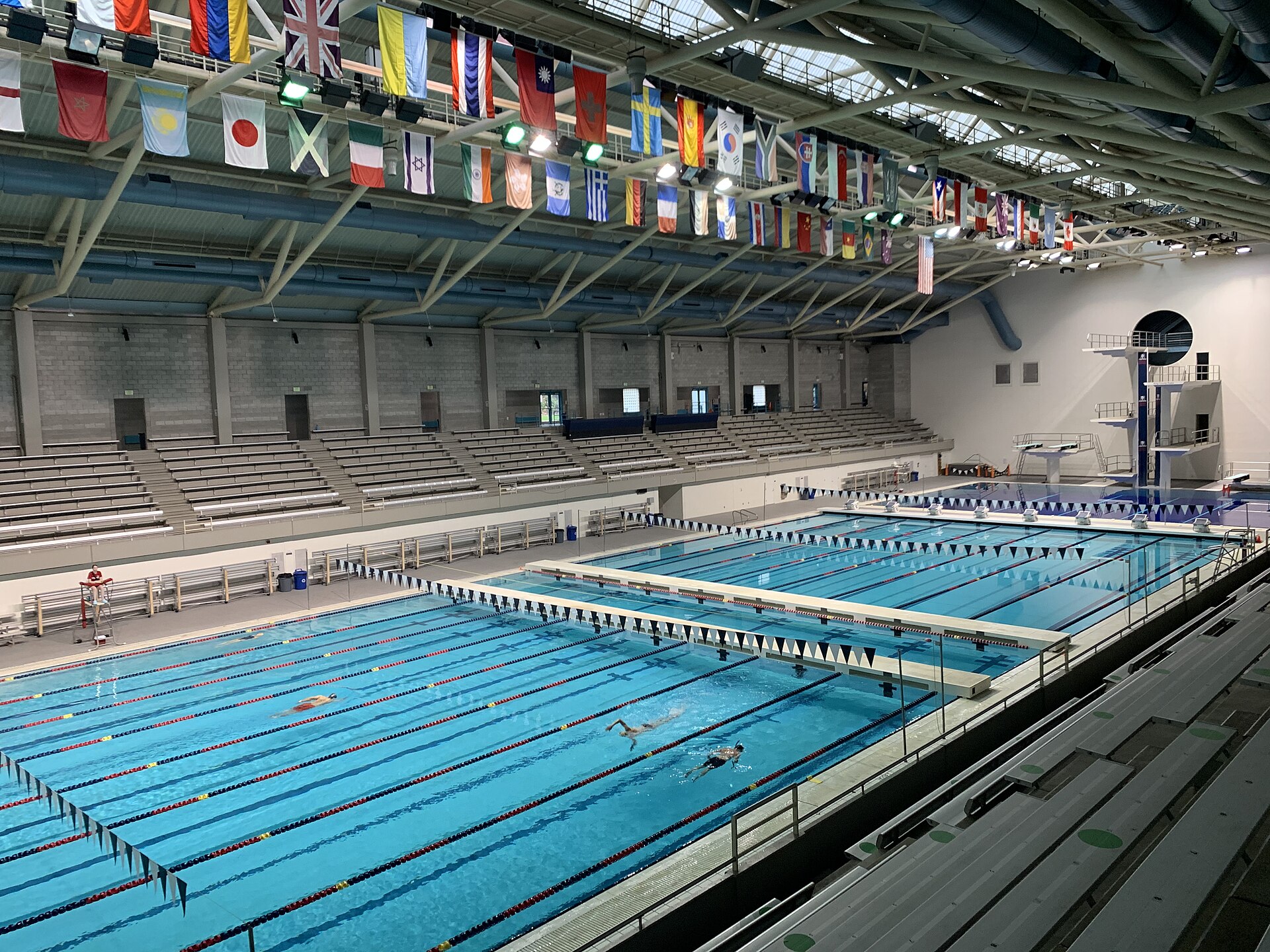
A swimming record is a distance divided by a time, and both halves have to be certified. The time is done by machine. The distance is done by a surveyor, and the rule that tells them what to certify is the most quietly opinionated paragraph in the sport’s regulations.
The number and the tolerance
Where touch panels of automatic officiating equipment are used, a 50-metre pool must be of such a length that it ensures the required distance of 50.000 metres between the two panels.
Reference That a pool using touch panels must ensure the required distance of 50.000 metres between the two panels, from Article 15.1.1.1.
Then the tolerance: in 50.000-metre pools it is +0.010 metres and −0.000 metres when touch panels are installed.
Reference The admissible tolerance in 50.000-metre pools of +0.010 metres and −0.000 metres when touch panels are installed, from Article 15.2.1.1.
Ten millimetres long is acceptable. One millimetre short is not.
That is not a manufacturing convenience — a symmetrical ±5 mm would be easier to build to. It is a decision about which kind of mistake a governing body is willing to have on its record books. A pool that is fractionally long produces times that are fractionally slow, and a record set in one is safe. A pool that is fractionally short produces a record nobody can defend.
The same instinct runs through World Athletics’ wind rule, which rounds a gauge reading to the next higher tenth of a metre per second in the positive direction, so that +2.03 m/s is recorded as +2.1 and disallowed while −2.03 is recorded as −2.0.
Reference The rule that a wind gauge is read rounded to the next higher tenth of a metre per second in the positive direction, with the worked examples of +2.03 recorded as +2.1 and −2.03 as −2.0, from the Technical Rules.
Two sports, two entirely different measurements, one principle: where the instrument is uncertain, resolve the uncertainty against the performance.
Where the length has to be right
The second half of the rule is the part that is easy to skim and hard to build to.
The required length, subject to the permitted tolerances, must be consistent from 0.300 metre above to 0.800 metre below the water surface.
Reference That the required length must be consistent from 0.300 metre above to 0.800 metre below the water surface, from Article 15.2.1.3.
A pool is not a line; it is a pair of walls. Walls lean, panels are mounted on brackets, and a structure 50 metres long that is correct at the waterline can be out of tolerance half a metre down. The rule specifies a band — 1.1 metres tall, straddling the surface — through which the 50.000 metres must hold, because that band is where a swimmer’s hand, feet and body actually touch the wall.
Then the wall-to-wall figure, which quietly tells you how thick a touch panel is. For pools with touch panels on both ends, the wall-to-wall distance will be at minimum 50.020 metres and at maximum 50.030 metres.
Reference That for pools with touch panels at both ends the wall-to-wall distance is a minimum of 50.020 and a maximum of 50.030 metres, from Article 15.2.1.2.
Fifty metres between the panel faces, 50.020 to 50.030 between the concrete. The panels take up 20 to 30 millimetres of that between them — and the concrete, therefore, has to be built to a target that is not the racing distance.
What a 50-metre pool has to hold, in millimetres
Millimetres of permitted variation
The numbers behind this chart
| Row | Millimetres of permitted variation | Detail |
|---|---|---|
| Vertical band the length must hold across | 1,100 | 0.300 m above to 0.800 m below the surface |
| Wall-to-wall permitted range | 10 | 50.020–50.030 m with panels at both ends |
| Length tolerance, long | 10 | +0.010 m |
| Length tolerance, short | 0 | −0.000 m |
Source World Aquatics, Competition Regulations Part Two, Article 15.2.1.
Method Values as stated in the rule. The vertical band is the sum of the 300 mm above and 800 mm below the water surface across which the length must be consistent; it is a depth, not a length tolerance, and is plotted here only to show its scale against the others.
Certified by somebody outside the sport
The rule does not stop at the number. It says who has to vouch for it.
These measurements must be certified by a surveyor or other qualified official, appointed or approved by the Member Federation in the country in which the pool is situated.
Reference The requirement that the measurements be certified by a surveyor or other qualified official appointed or approved by the Member Federation in the country where the pool is situated, from Article 15.2.1.4.
A surveyor is not a swimming official. The regulation reaches outside the sport for the one measurement it cannot take itself, in the same way athletics reaches for a national measurement authority to certify a wind gauge. Where a number has to be trusted, both sports end up delegating to somebody whose profession is measurement rather than competition.
The 25-metre pool gets the same treatment with one softening: its certification “should” be done by a surveyor rather than “must”.
Reference The 25-metre pool tolerances of +0.010 and −0.000 metres, the wall-to-wall ranges for panels at one or both ends, and that certification “should” be done by a surveyor, from Article 15.2.2.
Where the rule stops caring
The precision is not uniform, and the places it lapses are as informative as the places it does not.
Pool width is specified only at the top: at the Olympic Games and the World Aquatics Championships the minimum width is 25.000 metres for a permanent pool and 26.000 for a temporary one — and at all other competitions, there is no minimum width requirement at all.
Reference The minimum widths of 25.000 m for a permanent and 26.000 m for a temporary pool at the Olympic Games and World Aquatics Championships, and that there is no minimum width requirement at all other competitions, from Article 15.3.
Depth is graded the same way: 2.5 metres minimum at the Olympic Games and World Aquatics Championships, 2.0 metres at the 25 m World Championships with 2.5 recommended, and 1.0 metre at all other World Aquatics events.
Reference The minimum depths of 2.5 m at the Olympic Games and World Aquatics Championships, 2.0 m at the World Aquatics Swimming Championships (25 m) with 2.5 m recommended, and 1.0 m at all other World Aquatics events, from Article 15.4.
So a pool’s length is certified to a millimetre everywhere the rule applies, while its width and depth are only regulated at the very top of the sport and are otherwise left open.
That ordering makes sense once you notice what each dimension is for. Length is the measurement in the record. Width and depth affect how fast the race is — they govern how much of a swimmer’s wake comes back at them — but they do not enter the arithmetic of the result. A pool that is too narrow produces a slow race; a pool that is too short produces a false one.
The regulation is precise about exactly one thing, and it is precise about it in one direction.
Read the evergreen pages
This piece is an argument. These are the reference pages on SocialSportHub that document the same subjects.
References
- [1]World AquaticsGoverning body. Competition Regulations, Part Two: Swimming Rules, in force from February 2026 — Article 15, Swimming facilities and equipment. Accessed 6 September 2026.
- [2]World AthleticsGoverning body. Book C — C2.1 Technical Rules: wind measurement and rounding (World Athletics Book of Rules). Accessed 6 September 2026.
Continue reading
Editor’s pick
Swimming defines three of its strokes by what you may not do, and one by nothing at all
Freestyle means any style. Backstroke is bounded by an angle, breaststroke by an order of movements, and all four by the same fifteen metres. Read together, the rules describe a sport that regulates the surface of the water more than the swimmer.
Editor’s pick
The wind limit rounds against the sprinter, and the rule says how
A record stands or falls on a wind reading averaged over ten seconds at one point beside lane one. The rule that converts that reading into a number is not symmetrical, and the asymmetry always runs the same way.
More on swimming
Swimming's technology rule fits in four sentences, and names no technology
Article 14 forbids anything that may aid speed, buoyancy or endurance — a test of effect rather than of shape — then permits a data recorder that must not transmit, and tape on up to two fingers or toes.