
The line under the basket that nobody paints
Basketball's no-charge semi-circle is the one area of the court where the same collision changes owner. Part of its boundary is painted on the floor. The rest of it exists only in the rulebook, projected down from the front edge of a backboard three metres in the air.
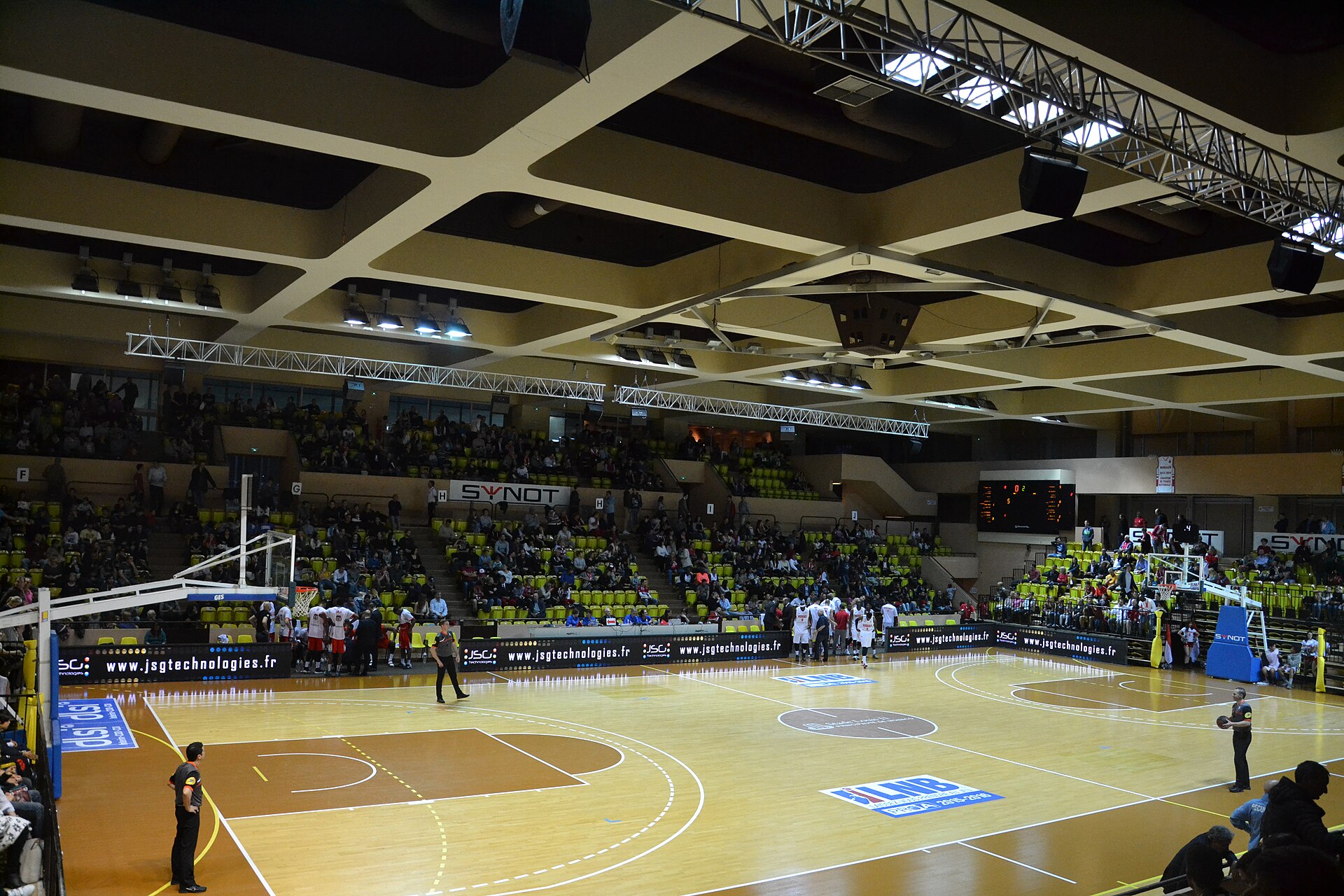
Almost every line on a basketball court answers a question about position. Is the shooter behind the arc. Is the pivot foot inside the boundary. Was the ball in the backcourt. The no-charge semi-circle answers a different kind of question: given a collision that has already happened, which of the two players is at fault.
It is the only marking on the floor that changes the attribution of an event rather than its value or its legality. And a quarter of its perimeter is not on the floor at all.
What is actually drawn
FIBA specifies the area in three pieces.
A semi-circle line of radius 1.30 m, measured from the point on the court beneath the exact centre of the basket to the outer edge of the line. Joined to it, two parallel lines perpendicular to the endline, their outer edge 1.30 m from that same point, each 0.375 m long, ending 1.20 m from the inner edge of the endline. And then the sentence that does the strange work: the areas are completed by imaginary lines joining the ends of the parallel lines directly below the front edges of the backboards.
Reference The 1.30 m radius, the two 0.375 m parallel lines ending 1.20 m from the endline, and the completion of the area by imaginary lines below the front edges of the backboards, from Article 2.5.7.
Three sides are painted. The fourth is a projection.
That fourth side has a specific place. The parallel lines start 1.20 m from the endline and run 0.375 m, so they finish at 1.575 m — and 1.575 m is exactly where the same rulebook puts the point beneath the centre of the basket, when it defines the three-point arc.
Reference That the point beneath the exact centre of the basket lies 1.575 m from the inner edge of the midpoint of the endline, from Article 2.5.4.
So the straight sections stop precisely level with the ring, and the semi-circle takes over from there. The imaginary closing line runs across the court through the centre of the basket, and it also runs directly beneath the front edge of the backboard. Two independent facts land on the same line, which is how you can tell it was placed deliberately: the front face of the board and the centre of the ring are 0.375 m apart, and the rule uses that gap as the depth of its straight sections.
What happens inside it
The geometry exists to support one interpretation, and the interpretation is narrow.
On any penetration play into the area, contact caused by an airborne offensive player with a defensive player who is inside the semi-circle is not called as a team control foul — unless the offensive player is illegally using hands, arms, legs or body.
Reference The no-charge interpretation, including the airborne requirement, the requirement that the defender be inside the semi-circle, and the exception for illegal use of hands, arms, legs or body, from Article 33.10.
Four conditions, all of which must hold. It must be a penetration play. The offensive player must be airborne. The defender must be inside the area. And the offensive player must not be using their limbs illegally, which the exception preserves as a separate question.
Miss any one and the ordinary rules apply. A defender standing a step outside the arc, on the same drive, is in a legal defensive position and the charge is available to them. A driver who has landed is no longer airborne. The area is not a sanctuary; it is a small set of circumstances in which one specific defensive claim is withdrawn.
FIBA states the purpose without ornament: the areas are marked for the purpose of designating a specific area for the interpretation of charge and block situations under the basket.
Reference The stated purpose of the areas, from Article 33.10.
Why a line was needed at all
The charge/block decision is basketball’s hardest, because both players are usually doing something legitimate. One is attacking the basket; the other is occupying ground. The rules of legal guarding position resolve most of it — who arrived first, who was moving, who was set.
Directly under the basket that method degrades. The attacking player is committed to the air and cannot change course. The defender is often arriving from a help position with the shortest possible notice. Both are behaving reasonably and a collision is close to unavoidable, so “who was there first” stops discriminating between a good defensive play and a stationary body placed in a landing zone.
The semi-circle replaces the judgement with a boundary. Inside 1.30 m of the basket, a defender cannot earn a charge simply by being there, so the incentive to stand under a rising player disappears. Outside it, everything works as before. The rule does not decide who was right. It removes the reward for a particular way of being wrong, and does so with a number.
The cost of an invisible boundary
Basketball’s other decisive lines can be checked by looking down. This one cannot, in the direction that matters most.
The semi-circle’s curve is visible and its two short straights are visible. But whether a defender is inside or outside the area on the baseline side depends on a line beneath the backboard’s front edge, and there is nothing to see there — the floor is unmarked, and the reference object is overhead. An official who has to decide whether a defender was inside the area is, in that quadrant, judging a position against a plane rather than a painted line.
FIBA closes the ambiguity in the only way available to it: the no-charge semi-circle lines are part of the area.
Reference That the no-charge semi-circle lines are part of the no-charge semi-circle areas, from Article 2.5.7.
A defender touching the curve is inside. That settles the painted boundary and leaves the imaginary one to judgement, which is presumably why the imaginary side was placed where it was. A line under the backboard is at least anchored to something a referee can locate from anywhere on the floor, and it sits behind the play rather than across it. Of the available invisible lines, it is the one least often decisive.
The three-point line is a rule about where value begins. The restricted area is a rule about how long you may stand somewhere. The no-charge semi-circle is a rule about the meaning of an accident — and its geometry is unusual because the thing it governs happens in the air, while everything a rulebook can measure happens on the floor.
Read the evergreen pages
This piece is an argument. These are the reference pages on SocialSportHub that document the same subjects.
References
- [1]FIBAGoverning body. Official Basketball Rules 2026 — Articles 2.5.4 and 2.5.7, court markings. Accessed 6 September 2026.
- [2]FIBAGoverning body. Official Basketball Rules 2026 — Article 33.10, no-charge semi-circle areas. Accessed 6 September 2026.
Continue reading
Editor’s pick
The corner three is a shorter shot, and FIBA's own rulebook says so
Basketball's three-point line is defined twice over: as an arc 6.75 m from the basket, and as a pair of straight lines 0.90 m inside the sidelines. On a 15-metre court those two definitions cannot both give the same distance, and the gap they leave is fifteen centimetres wide.
Editor’s pick
Fourteen seconds is not a shorter twenty-four
Basketball's shot clock has two numbers, and the smaller one is not a discount on the larger. Read against FIBA's Article 29, the fourteen-second reset turns out to be a rule about who lost the ball, not about how much time is left.
More on basketball
Five sports paint a line around the court. Only four of them agree it is part of it
A ball on the line is in, unless you are playing basketball, where the boundary line is not court at all. The disagreement is written into the rulebooks, and it decides which edge of the paint the tape measure is held against.