
Nobody designs a slalom course. They solve one
The ICR hands a course setter a vertical drop, two spacing windows, a turn density and a required mix of combinations — then tells them the result should match the average ability of the first thirty competitors. Every course is different, and every course is the same problem.
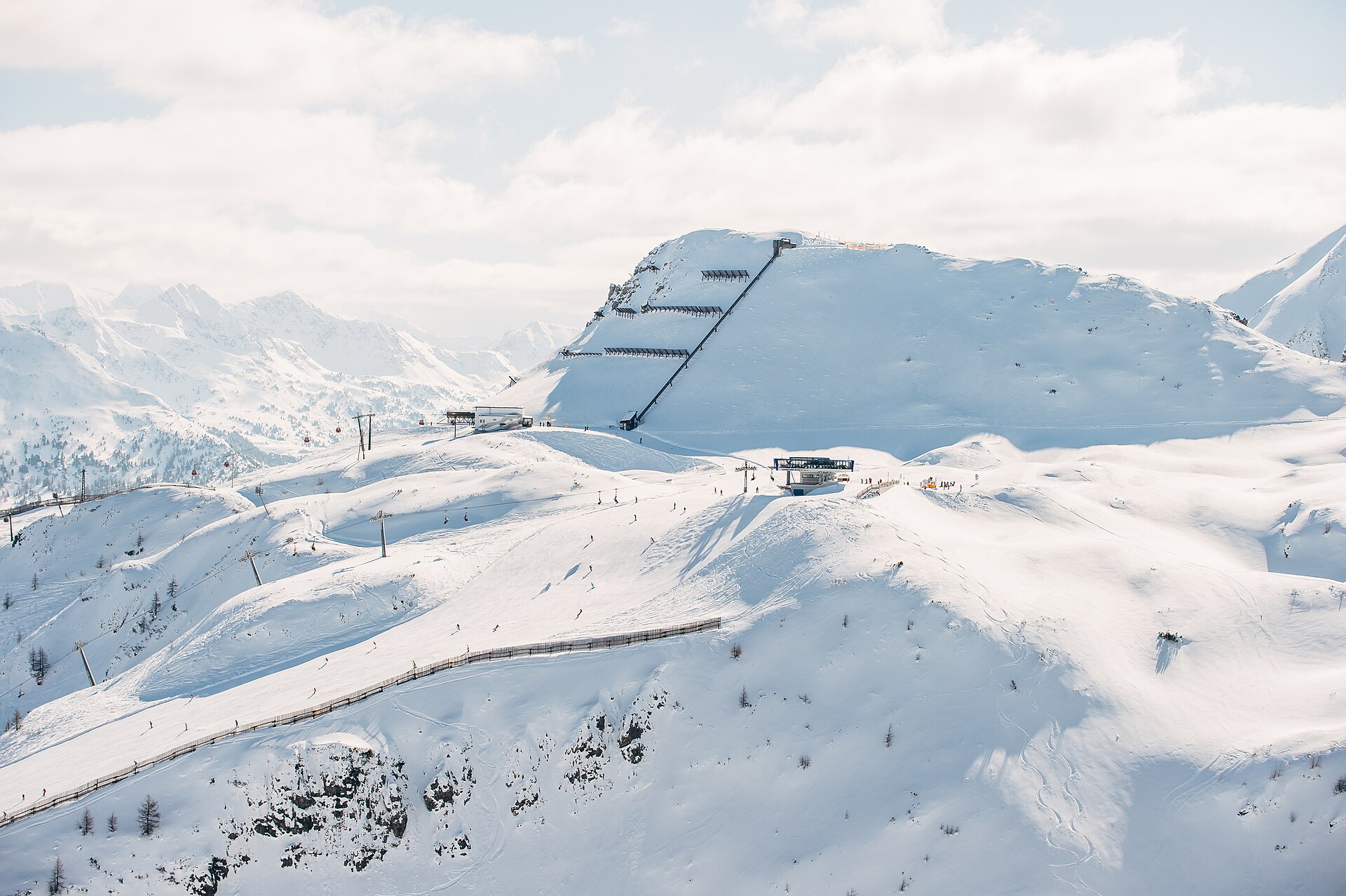
There is a phrase for what a course setter does in alpine skiing — setting a course — and it is a better description than “designing” one. A designer starts from an intention. A setter starts from a hillside and a list of constraints, and finds an arrangement that satisfies all of them.
The constraints
Article 801 gives the numbers. A slalom gate consists of two poles, or, where there is no outside pole, a single turning pole. Consecutive gates must alternate in blue and red. A gate must have a minimum width of 4 m and a maximum of 6 m. The distance from turning pole to turning pole of successive gates must not be less than 6 m and not more than 13 m.
Reference The composition of a slalom gate, the alternating blue and red, the 4–6 m gate width and the 6–13 m turning-pole spacing, from Articles 801.2.1 to 801.2.3.
Then the tighter geometry. Gates within a hairpin or vertical combination must be not less than 0.75 m and not more than 1 m apart, and must be set in a straight line. Delayed gates must be between 12 m and 18 m from turning pole to turning pole, and gates within a delayed combination not less than 0.75 m from either turning pole.
Reference The 0.75–1 m spacing within hairpin and vertical combinations, the requirement that they be set in a straight line, and the 12–18 m spacing of delayed gates, from Article 801.2.3.
And the count, which is not a count. The number of direction changes must be 30 to 35 per cent of the vertical drop, plus or minus three.
Reference The requirement of 30 to 35 per cent of the vertical drop, plus or minus three direction changes, from Article 801.2.4.
Article 803 then requires a specific mix: a slalom must contain horizontal, or open, gates and vertical, or closed, gates, as well as a minimum of one and a maximum of three vertical combinations consisting of three to four gates, and at least three hairpins.
Reference The requirement for open and closed gates, one to three vertical combinations of three to four gates, and at least three hairpins, from Article 803.2.
What is left free
Given all that, what does a setter actually choose?
Everything about where. The rule fixes how far apart gates may be and how many turns there must be per metre of drop; it says nothing about which part of the slope any of them sits on. And Article 802 makes clear that this freedom is the point.
Gates should never be set only down the fall-line, but so that some full turns are required, interspersed with traverses. The course should require the whole range of slalom technique, including changes of direction with very different radius.
Reference That gates should never be set only down the fall-line but so that full turns are required interspersed with traverses, and that the course should require the whole range of slalom technique including direction changes of very different radius, from Article 802.1.
The instruction for giant slalom is stronger still, and it says explicitly what the rule is delegating: the skilful use of the ground when setting a giant slalom is, in most cases, even more important than for a slalom, since combinations play a less important role owing to the prescribed width of the gates and the greater distances between them. It is therefore better to set mainly single gates, while exploiting the ground to the utmost.
Reference That skilful use of the ground is even more important in giant slalom than slalom because combinations matter less at the prescribed gate widths and distances, and the recommendation to set mainly single gates while exploiting the ground to the utmost, from Article 903.1.2.
Exploiting the ground to the utmost. That is a rulebook telling a course setter that the terrain is their instrument, and that a course which ignores it has been set badly even if every number checks out.
The standard the setter is measured against
The most unusual clause in Article 803 is not a number at all.
Before the course is set, the setter must carry out a pre-inspection. And then: the slalom should correspond to the average ability of the first thirty competitors.
Reference The requirement for a pre-inspection by the course setter before setting, and that the slalom should correspond to the average ability of the first thirty competitors, from Article 803.1.
Not the winner. Not the field. The average of the first thirty.
That is a calibration target, and it is doing something no dimension could. A course that only the best three can ski is a lottery; a course everyone can ski separates nobody. Pitching at the average of the top thirty produces a course that the leaders handle and the rest of the field is genuinely tested by — and it does so in a way that adapts automatically to the standard of the race, because “the first thirty competitors” means different skiers at a World Cup and at a national championship.
It is the only instruction in the whole article that refers to the people rather than the mountain.
The surface is part of the specification
One more constraint sits underneath everything, and it concerns the snow rather than the gates.
Slalom competitions must be raced on a course surface that is as hard as possible. If snow falls during the race, the chief of course must ensure that it is packed or, if possible, removed from the course.
Reference That slalom must be raced on a surface as hard as possible, and that falling snow must be packed or removed from the course during the race, from Article 802.1.4.
“As hard as possible” is an unusual specification — a direction rather than a value — and it exists because the alternative is unfairness that accumulates. Soft snow deforms under each skier, so the fiftieth competitor races a different course from the first. Hardening the surface is not about speed; it is about keeping the course the same for the whole field.
The competition course, meanwhile, should be approximately 40 m wide if two runs are set on the same slope.
Reference That the competition course should be approximately 40 m wide if two runs are set on the same slope, from Article 802.2.
Approximately. After all the millimetres — 0.75 m between gates in a combination — the width of the piste is given as a round number with a hedge on it. Which is the correct level of precision for the one dimension the setter cannot change.
What the rule amounts to
A slalom course, in FIS’s conception, is not an artefact. It is a solution to a constraint problem posed on a particular piece of ground: hit the turn density, respect the spacing windows, include the required combinations, use the terrain, and land at the ability of the thirtieth-best skier present.
Two setters given the same slope will produce different courses, and both will be correct. That is not a weakness in the specification. It is what a specification looks like when the venue cannot be standardised and the sport has decided to standardise the problem instead.
Read the evergreen pages
This piece is an argument. These are the reference pages on SocialSportHub that document the same subjects.
References
- [1]International Ski and Snowboard Federation (FIS)Governing body. The International Ski and Snowboard Competition Rules (ICR), Book IV, Edition 5 July 2024 — Articles 801 to 803, Slalom; and Articles 903 and 1003, course setting for giant slalom and super-G. Accessed 6 September 2026.
Continue reading
Editor’s pick
Alpine skiing's four disciplines are four points on a single line
FIS does not tell a course setter how many gates to use. It tells them how many direction changes to make per metre of vertical drop — and slalom's figure is five times giant slalom's, which is nearly twice super-G's, which downhill does not have at all.
Editor’s pick
A mountain becomes a racecourse by paperwork, and most of the paperwork is about the helicopter
FIS will not sanction a race on ground it has not homologated, and the dossier it requires is a portrait of what a venue has to be. Gradients and vertical drop take a few lines. Evacuation, water supply, uphill transport and cable runs take the rest.
More on alpine skiing
A ski gate has to come apart when it is hit, and stay together when it is hit
FIS asks a gate panel to release from its pole when a racer gets caught by it and not to release during a normal collision. Two requirements that sound contradictory, both tested, and both answers to what a skier at speed actually does to a gate.