
Three sports hang a cord between two posts, and all three answer the sag differently
A strung net always dips in the middle. Tennis decided to make the dip 156 millimetres and mandated a strap to produce it; badminton lets it be 26; volleyball forbids it and allows 20 millimetres of error. One physical fact, three regulatory answers.
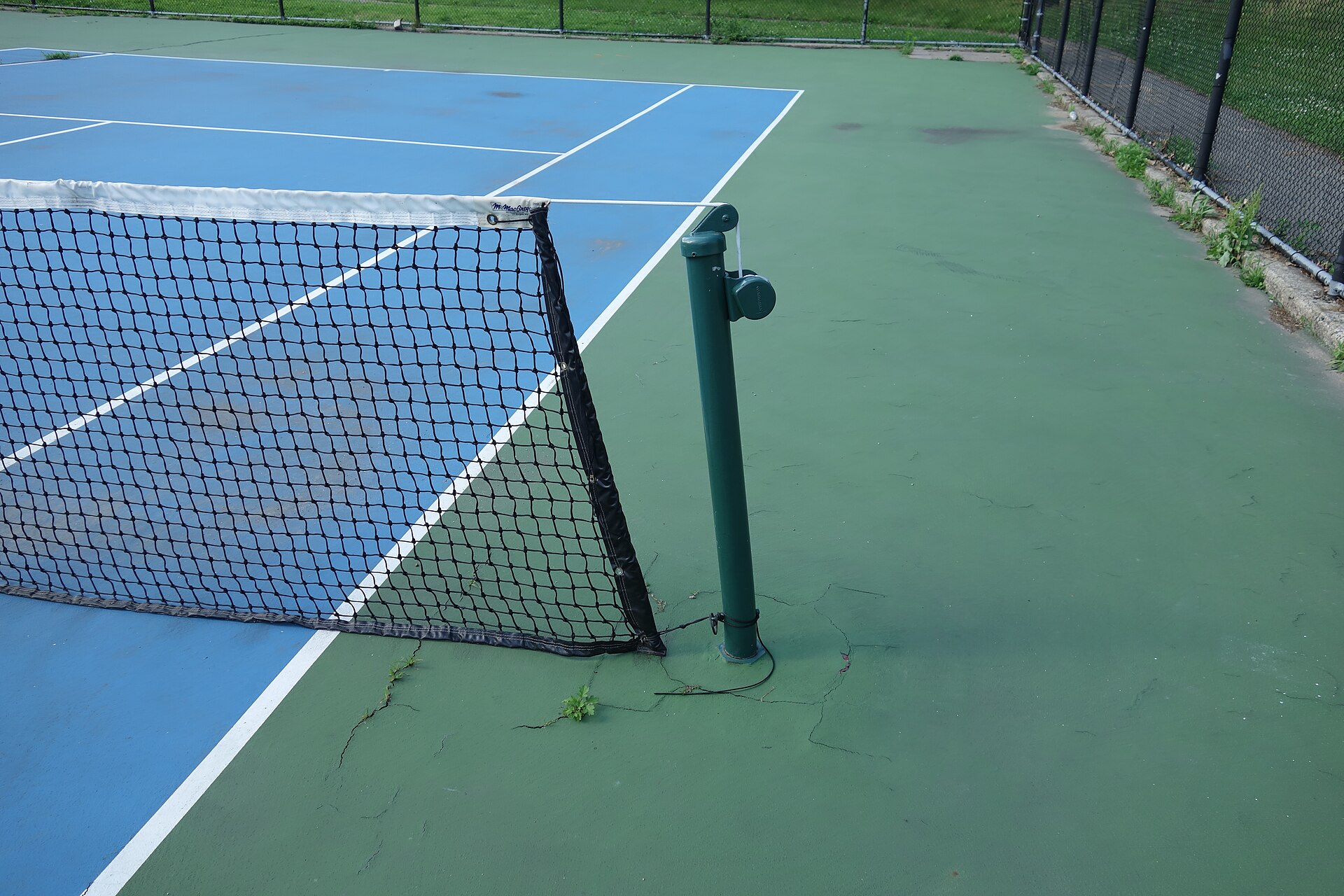
Hang a cord between two posts and it dips. There is no way round it: the cord has weight, the posts can only pull horizontally, and the shape that results is fixed by physics rather than by preference.
Every sport played over a net has had to decide what to do about that, and three of them reached three different answers.
- Volleyball — Specified level. Measured at the centre; the ends must match within 2 cm.
- Badminton — Falls 26 mm to the centre. No strap; the posts are simply 1.55 m.
- Tennis — Falls 156 mm to the centre, held down by a strap the rule requires.
Tennis: make the dip, and hold it down
The ITF specifies the net twice. It is suspended from posts at a height of 1.07 m, and the height of the net shall be 0.914 m at the centre, where it shall be held down tightly by a strap.
Reference The net-post height of 1.07 m and the centre height of 0.914 m, held down tightly by a strap, from Rule 1 of the Rules of Tennis.
A fall of 156 millimetres over a doubles court 10.97 m wide — and a piece of hardware whose only job is to produce it. A cord strung to 1.07 m at both ends would not sag that far on its own; the strap pulls it down until it does.
That is the crucial detail. Tennis’s sag is not tolerated, it is manufactured. And the rule then protects the manufacture, capping the strap at 5 cm wide and the cord or cable at 0.8 cm in diameter, and requiring both strap and the band that covers the top to be completely white.
Reference The maximum strap width of 5 cm, the maximum cord or cable diameter of 0.8 cm, and the requirement that the strap and band be completely white, from Rule 1.
Badminton: let it fall a little, and do nothing about it
Badminton’s posts are 1.55 m high. The top of the net is 1.524 m at the centre of the court and 1.55 m over the side lines for doubles.
Reference The post height of 1.55 m, the net height of 1.524 m at the centre and 1.55 m over the side lines for doubles, from Law 1 of the Laws of Badminton.
Twenty-six millimetres, over a net at least 6.1 m wide. No strap is specified, and none is needed: the figure is close to what a properly tensioned net does by itself.
The rule is really a tension specification wearing the clothes of a height specification. It gives a builder two numbers and lets them tighten until both are satisfied — and it adds the enforcement the tension needs, requiring the cord or cable to be stretched firmly, flush with the top of the posts, with no gaps between the ends of the net and the posts.
Reference That the cord or cable must be stretched firmly and flush with the top of the posts, that there shall be no gaps between the ends of the net and the posts, and that the net is 760 mm deep and at least 6.1 m wide, from Law 1.
Volleyball: forbid it, and allow twenty millimetres of failure
FIVB goes the other way entirely. The net’s top is set at 2.43 m for men and 2.24 m for women, its height is measured from the centre of the playing court, and the height over the two side lines must be exactly the same — and must not exceed the official height by more than 2 cm.
Reference The net heights of 2.43 m and 2.24 m, that the height is measured from the centre of the playing court, and that the height over the two side lines must be exactly the same and not exceed the official height by more than 2 cm, from Rules 2.1.1 and 2.1.2.
Read the sequence of that instruction. Measure at the centre. Require the ends to match. Allow the ends to be up to 2 cm high.
It is a procedure for cancelling the sag rather than accommodating it: tension until the middle is right, then check you have not overtightened the ends by more than two centimetres. The permitted error runs in exactly one direction — the ends may be too high, never too low — which is the same asymmetry a swimming pool’s length tolerance uses, and for a related reason. An end that is too low would make a shot near the sideline easier than the same shot in the middle, and the rule refuses that.
Why the three sports disagree
Each answer is right for the game it belongs to, and the reason is what each sport wants the middle of the court to be worth.
Tennis rewards the middle on purpose. A lower net in the centre makes a shot down the middle the cheapest one to play and a shot into a corner the most expensive — which runs against the geometry of the rectangle, where the corners offer more court to land in. The sag is a counterweight. Remove it and the sport’s shot selection would change.
Badminton has no such problem to solve. Its projectile decelerates so hard that a cross-court shot is not primarily a question of clearing the barrier; the shuttle’s flight is dominated by drag rather than by margin over the net. There is nothing for a 156 mm sag to correct, so the rule simply keeps the sag small and moves on.
Volleyball cannot afford one at all. Its decisive actions happen at the net and above it, along its whole length, and the ball crosses through a defined space bounded by two antennae at the sidelines. A net that is materially lower in the middle would make the middle of the net the place to attack and the place to block — collapsing a nine-metre front into a three-metre one. Level is not an aesthetic preference; it is what keeps the whole width in play.
What the comparison is worth
Three governing bodies, three eras, three sports that share almost nothing else, and one identical piece of physics between two posts.
None of them pretends the sag is not there. One builds it deliberately and adds hardware to guarantee it. One accepts what tension gives and writes the resulting number down. One suppresses it and states how much suppression can fail by.
That is what a rulebook is for. The world supplies a constraint; the sport decides what the constraint should mean; and the specification is the record of the decision.
Read the evergreen pages
This piece is an argument. These are the reference pages on SocialSportHub that document the same subjects.
References
- [1]International Tennis FederationGoverning body. Rules of Tennis 2026 — Rule 1, The Court: the net, net posts and singles sticks. Accessed 6 September 2026.
- [2]Badminton World FederationGoverning body. BWF Statutes, Section 4.1: Laws of Badminton, in force 26 April 2025 — Law 1, Court and court equipment. Accessed 6 September 2026.
- [3]FIVBGoverning body. Official Volleyball Rules 2025–2028 — Rule 2, Net and posts. Accessed 6 September 2026.
Continue reading
Editor’s pick
The tennis net sags on purpose, and the rules say by how much
Rule 1 gives the net a height at the posts and a different, lower height in the middle, then requires a strap to hold the middle down. The 15-centimetre difference is the only deliberate asymmetry on a court that is otherwise perfectly symmetrical.
Editor’s pick
Volleyball's boundary is a doorway in the air, and two fibreglass rods hold its edges
The net is not what a volleyball has to cross. The rules define a crossing space bounded laterally by two 1.80-metre antennae, and those antennae are legally part of the net even though most of each one is above it.
More on tennis
Five sports paint a line around the court. Only four of them agree it is part of it
A ball on the line is in, unless you are playing basketball, where the boundary line is not court at all. The disagreement is written into the rulebooks, and it decides which edge of the paint the tape measure is held against.