
The offside law is a design decision
Law 11 does not tidy up football's edges. It removes the shortest route to goal — and the flat back line, the trap, the press and the timed run are all downstream of that one choice.
Law 11 never forbids a player from standing next to the opposing goalkeeper. It defines a relationship between three moving things and then declines, by itself, to punish it. A player is in an offside position when any part of the head, body or feet is in the opponents’ half, halfway line excluded, and nearer to the opponents’ goal line than both the ball and the second-last opponent. Hands and arms, goalkeepers’ included, are not counted. Standing there is not an offence.
The offence is a separate question. A player who was in an offside position at the moment the ball was played or touched by a team-mate is penalised only on becoming involved in active play — by playing or touching the ball, by interfering with an opponent, or by gaining an advantage from a rebound, a deflection or a deliberate save. The sanction is an indirect free kick where the offence occurred.
Reference The IFAB’s Law 11 sets out offside position, the offside offence, the three exempt restarts — throw-in, goal kick and corner kick — and the sanction.
Reference The Football Association publishes the same Law 11 text for the English game.
Two clauses, and out of them falls most of what a football pitch looks like from the stand. That is not an accident of drafting. Offside is not etiquette that grew up around the sport; it is what makes the ground between the boxes worth contesting. Delete it and the game does not open up — it empties out.
The problem the law solves
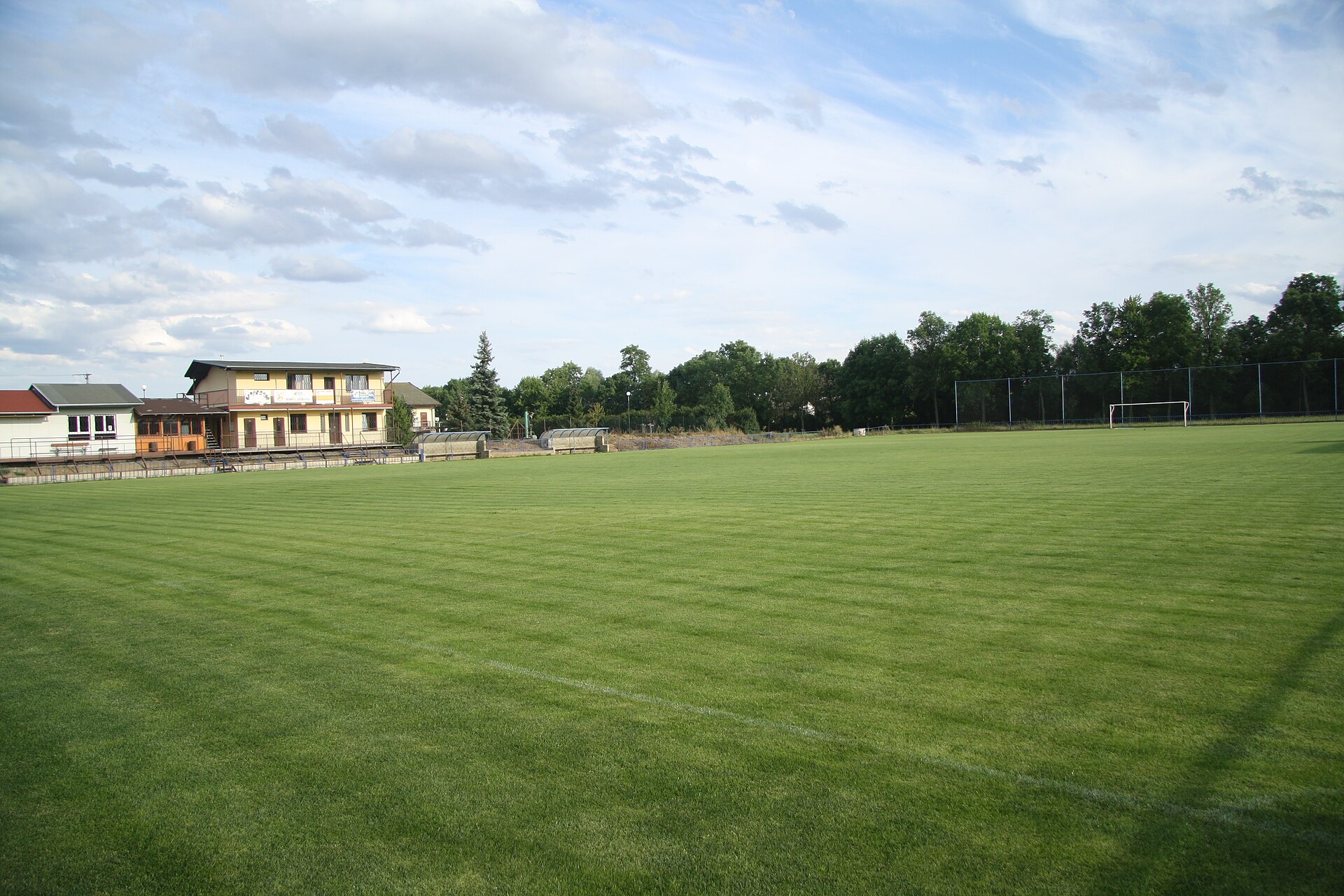
A pitch for international matches is 100 to 110 metres long. Without a positional constraint, the shortest route between the goals is one long kick, and the cheapest way to be on the end of it is to stand still. The stable outcome is a forward stationed permanently on the last defender, a defender detailed to watch that forward, and a match conducted as an exchange of punts over a vacant middle third. The ground between the penalty areas stops being contested, because nothing needs to happen there.
Reference Field dimensions from Law 1: 100–110 m long and 64–75 m wide for international matches.
Offside dismantles that equilibrium by making the long ball conditional on timing rather than on position. The pass over the top stays legal — but only if the receiver was behind the ball, or behind the second-last defender, at the instant it was struck. A player who simply waits in the space is not at a disadvantage; that player is unusable. The only lawful way into the ground behind a defence is to start behind it and run, and that synchronisation of ball and runner has to be built further back, through the pitch.
So the law does not restrict football so much as select a version of it: one in which passing is a timing problem rather than a placement problem, and possession is a way of moving a defence rather than an end in itself.
What the law measures, and when
A player is not in an offside position if level with the second-last opponent, or level with the last two opponents. That clause reads like a courtesy. It is a structural necessity.
The quantity being measured is continuous. An attacker’s position relative to a defender is a distance, and distances do not arrive in units: there is no smallest possible margin, no natural gap in which to put a boundary. A rule that must be applied has to assign the tie explicitly, and it can only assign it one way. Giving it to the attacker means a defender who steps up exactly level has conceded nothing — the line’s tolerance sits on the safe side of the edge, and the ambiguous case resolves toward play continuing.
The same instinct for a decidable edge runs through the definition. The measurement covers head, body and feet and ignores hands and arms — exactly the set of body parts with which a player could legally score. The reference instant is the moment the ball is played or touched by a team-mate, not the moment it arrives, so a run begun after the pass cannot be offside. Where that instant is ambiguous the law names one: for a goalkeeper’s throw, position is judged at release, so the same frame is chosen every time.
Position is only half of it. Involvement is the other half, and the half that keeps being refined: becoming involved in active play means one of three things.
- Interfering with play — playing or touching a ball passed or touched by a team-mate.
- Interfering with an opponent — clearly obstructing an opponent’s line of vision, challenging for the ball, clearly attempting to play a close ball in a way that impacts an opponent, or making an obvious action that clearly impacts an opponent’s ability to play it.
- Gaining an advantage — playing the ball, or interfering with an opponent, after it has rebounded or been deflected off a goalpost, the crossbar, a match official or an opponent, or after it has been deliberately saved.
A player in an offside position who receives the ball from an opponent who deliberately played it has not gained an advantage — unless that action was a deliberate save. The IFAB’s guidance on deliberate play turns on control: whether the ball travelled from distance in clear view, whether it was moving slowly, whether its direction was expected, whether the defender had time to coordinate a body movement rather than stretch instinctively, and whether it was on the ground rather than in the air. An inaccurate clearance is still deliberate play. A reflex block is not.
Reference The IFAB’s clarified ‘deliberate play’ guidelines list those criteria and confirm that an unsuccessful attempt does not stop a play from being deliberate.
That decides who owns a mistake. If a defender genuinely chose to play the ball, the attacking team is released from its earlier offside position and the defence lives with the choice. If the ball merely hit a defender, no choice was made, and the offside stands.
How one clause produces a defensive line
The most consequential words in Law 11 are second-last opponent. Because offside position is measured against a single player — normally the deepest outfield defender, with the goalkeeper behind — the position of that one player fixes the legal geometry for the whole attacking team at once.
This is unusual. In most invasion sports a defender out of position is beaten personally, and the cost is local. In football the cost is collective. A centre-back who drops five metres deeper than a partner does not only lose one duel — that player re-authorises the entire opposing forward line to stand five metres further forward. Depth becomes a shared quantity, owned by whoever is deepest.
That is why defences hold a line at all. The flat, coordinated back line is not an aesthetic preference or a coaching fashion; it is the only stable answer to a law that lets the least disciplined defender set the boundary for everyone else. Marking an individual is a private contract. Holding a line is a public one.
From there the line becomes a weapon. The offside trap is the discovery that a defence can shrink the space behind it without covering that space: by advancing at the right moment it converts ground it cannot physically reach into ground an attacker is not legally permitted to occupy. It is territory defended by statute rather than by legs. It also fails in a specific way, because the deepest player defines the line: one defender who does not step keeps every attacker onside. The trap does not degrade — it collapses.
Pressing is the other side of the same trade. A high press needs a high defensive line behind it, or the team is stretched across sixty metres and bypassed with one pass. A high line means accepting a large area behind the defence, and offside is what makes that acceptable: the area behind is reachable only by a pass timed to a run, never by a forward already standing in it. The compact vertical block that pressing depends on is a structure the offside law pays for.
For attackers, a spatial problem has become a temporal one. A through ball is judged not by where it is played but by when, so movement organises itself around runs that start behind the ball rather than positions held ahead of it. The counter-attack is potent for the same reason: a defensive line caught mid-advance has, for a second or two, no line at all.
The price of a sharp edge
A law with a geometric boundary has to be observed before it can be applied. Law 6 makes it the assistant referee’s duty to signal when a player in an offside position may be penalised — which asks one official to fix two events in the same instant: contact with the ball in the middle of the pitch, and the relative depth of two players on a line that can run up to seventy-five metres across the field. The assistant on the touchline is sampling a continuous quantity by eye, from an oblique angle, in a single frame.
Reference Law 6 lists signalling when a player in an offside position may be penalised among the assistant referees’ duties.
The response has been measurement rather than redrafting. In the video review protocol offside sits inside goal or no goal, as an attacking-team offence in the build-up to a goal, and is handled as a factual matter rather than a judgement of intensity — the class of decision for which video review can usually be completed without sending the referee to the pitchside monitor.
Reference The IFAB VAR protocol groups offside under goal/no goal and distinguishes factual from subjective decisions in choosing between a VAR-only review and an on-field review.
Semi-automated systems push the logic further. In FIFA’s implementation, dedicated tracking cameras follow up to 29 points on each player’s body 50 times a second while a sensor inside the match ball reports 500 times a second, so the kick point and the limb positions resolve to the same moment. The system alerts the video officials when the ball reaches an attacker who was in an offside position when a team-mate played it; they confirm the kick point and the generated line.
Reference Camera count, data points per player, tracking rate and ball-sensor rate as published by FIFA for its semi-automated offside technology.
None of that changes the law. It narrows the error around a boundary the law had already drawn — the clearest evidence available that offside is a designed constraint and not a natural feature of the sport. The decision was where to put the edge. The flat back line, the trap, the press, the timed run and the tracking camera are consequences of it.
Football is one of the few games whose rules deliberately make the most direct route to goal unusable, and then keep the punishment mild: not a card, not a penalty, just an indirect free kick and the ball handed back. The law is not there to punish. It is there to shape. What it produces is a sport whose central attacking skill is arriving in space rather than occupying it, and whose defensive craft is the collective maintenance of a line that exists nowhere on the grass — only in a clause about where a player was standing at one particular instant.
Read the evergreen pages
This piece is an argument. These are the reference pages on SocialSportHub that document the same subjects.
References
- [1]The IFABGoverning body. Law 11 – Offside, Laws of the Game. Accessed 2 September 2026.
- [2]The Football AssociationGoverning body. Law 11 – Offside. Accessed 2 September 2026.
- [3]The IFABGoverning body. Law 1 – The Field of Play, Laws of the Game. Accessed 2 September 2026.
- [4]The IFABGoverning body. Law 11 – Offside: 'deliberate play' guidelines clarified. Accessed 2 September 2026.
- [5]The IFABGoverning body. Law 6 – The Other Match Officials, Laws of the Game. Accessed 2 September 2026.
- [6]The IFABGoverning body. Video Assistant Referee (VAR) Protocol, Laws of the Game. Accessed 2 September 2026.
- [7]FIFAGoverning body. Semi-automated offside technology. Accessed 2 September 2026.
Continue reading
More on football
Football spent a century leaving time to the referee. The 2026/27 Laws put numbers on it
Ten seconds to leave the field when substituted. A minute off after treatment. A five-second countdown, visibly signalled, on throw-ins and goal kicks. The changes are small individually and they add up to a different way of regulating delay.
More on football
Five sports paint a line around the court. Only four of them agree it is part of it
A ball on the line is in, unless you are playing basketball, where the boundary line is not court at all. The disagreement is written into the rulebooks, and it decides which edge of the paint the tape measure is held against.
More on football
One legal football can hold nearly twice the pressure of another
Law 2 specifies the ball in five lines. Read the tolerances rather than the numbers and the specification turns out to be unusually loose in the one property that most changes how the ball behaves — and to be pinned to a place and a moment that no match actually occupies.