
The movement patterns underneath every sport
A fencer's lunge and a badminton retrieval are the same shape used for opposite purposes. Sport's variety is a set of recombinations of one short list of human movements — and the list is what makes transfer between sports legible.
World Athletics defines an entire athletics discipline with two sentences about the shape of a step. Race walking is a progression of steps taken so that the walker keeps contact with the ground, with no loss of contact visible to the human eye; and the advancing leg must be straightened, not bent at the knee, from the moment of first contact with the ground until the vertical upright position. Judges act individually, and their judgements rest on observations made by the human eye.
Reference Definition of race walking and the judging provision, World Athletics Technical Rule 54.
Take away the distance and the ranking and what remains is a specification for one movement. Race walking exists because a single variable inside human gait — whether both feet are ever off the ground at the same time — is worth a sport of its own. Walking and running are not two activities so much as one pattern on either side of a flight phase, and the rule is what holds them apart. It needs judges because the boundary is a property of the movement, not of the result.
Race walking is unusual only in saying so out loud. Most sports never write down which movements they are assembled from, and are assembled from few of them anyway — the same few surfacing in sports that share no implement, no surface, no scoring system and no common ancestor.
Three families, and then a longer list
Developmental research sorts the raw material into three families. Fundamental movement skills are grouped as locomotor skills — run, hop, jump, slide, gallop, leap — object control skills such as strike, dribble, kick, throw, underarm roll and catch, and stability skills, defined as the ability to sense a shift in the relationship of the body’s parts that alters balance and to adjust to it rapidly and accurately with compensating movements.
Reference The locomotor, object control and stability constructs, and the definition of stability skills, as set out in a study of fundamental movement skill structure.
The third family is the one that goes missing, because it produces nothing anyone can score. Locomotor and object-control skills have been widely evaluated in children; stability skills have not. When 300 Australian schoolchildren were assessed on three gymnastics-derived stability items — a rock, a log roll and a back support — alongside conventional locomotor and object-control batteries, stability loaded onto fundamental movement skills as a factor of its own, standing beside the other two rather than dissolving into them.
Reference Sample, the gymnastics-derived stability items, and the combined factor model in which locomotor, object control and stability each load on fundamental movement skills.
The catalogue kept on this platform is longer and more granular, because it is written for adult sport rather than for childhood: the movement index names twenty-seven patterns. It is really two vocabularies fused. One set — squat, hinge, lunge, push, pull, carry, rotation — describes how a body produces force against a load. The other — cut, shuffle, backpedal, bound, glide — describes how a body is moved around a playing area. Almost every sport draws on both.
The same order, in sports that share nothing
Throw is the clearest case, because it has been measured so often. Assessments of segmental sequencing describe a progressive sequence of muscle activity and joint motions running from the proximal parts of the chain towards the distal ones — a thrust of the lower limbs, a forward rotation of the pelvis, then the trunk, then the throwing arm. The same ordering has been reported in baseball pitching, cricket bowling, javelin, the tennis service, volleyball spiking and team handball.
Reference Definition of proximal-to-distal sequencing and the list of upper-limb throwing and striking sports in which it has been observed.
A meta-analysis of handball throwing put timings on it. Pooling studies of experienced players performing the penalty throw, the peak joint angular velocities arrived in a fixed order relative to the instant of release: pelvis rotation about 118 milliseconds before, trunk rotation about 57 before, trunk flexion about 34 before, elbow extension about 9 before, and shoulder internal rotation about 6 milliseconds after the ball had already gone.
Reference Pooled timings of maximal joint angular velocities relative to ball release for the penalty throw in experienced team handball players.
Nothing about a handball resembles a javelin, and a volleyball spike is not normally filed beside a cricket delivery. Underneath they are one problem solved one way: set the heavy, slow segments moving first and let each hand its speed to the next. That is the kinetic chain, and it belongs to the pattern, not the sport.
Lunge repeats just as widely with far less ceremony. The shape is a long step onto a lead leg that absorbs the body while the trailing leg stays extended behind. Fencing has written it into the rulebook: a simple attack with a lunge is correctly carried out only if the straightening of the arm has begun before the lunge is launched, and the hit arrives at the latest when the front foot hits the piste. The lunge is not only how a fencer arrives; it is the clock the attack is timed against. Badminton and squash use the identical geometry as the last step of a retrieval — a step that has to be reversed the instant it lands, because the next shot is already on its way. One lunge is an attack; the other is a recovery. The joint angles do not know the difference.
Reference Correct execution of an attack with a lunge, timed against the straightening of the arm and the landing of the front foot.
- Glide — travelling without adding propulsion. A speed skater between pushes, a swimmer off the wall after a flip turn, a curling delivery. Each is the same task: hold a shape that costs nothing while the body spends speed it already has.
- Carry — locomotion while holding an external load, the trunk braced so that the load does not move the body. A rugby ball carrier running into contact, an American football runner, a canoeist portaging a boat, a hiker under a pack.
- Pull — drawing a load towards the body, or the body towards a fixed point. Rowing, the propulsive phase of front crawl in swimming, a move on a climbing wall, a grip exchange in judo.
- Rotation — turning the trunk about its long axis to swing something attached to it. A golf full swing, a discus turn, a boxing cross, a field hockey hit.
The pattern with the lowest profile
Deceleration is the pattern with no popular name. Defined properly it is two things at once: reducing whole-body momentum in accordance with the demands of the task, and skilfully attenuating and distributing the forces that the braking itself generates.
Reference Definition of horizontal deceleration ability as braking force control together with braking force attenuation.
Braking is not a lesser version of accelerating. In a review of the biomechanics, total exposure to ground reaction forces over the opening steps of a maximal horizontal deceleration was reported as up to 2.7 times greater than over the corresponding steps of an acceleration — and the load arrives early, the impact peak falling inside the first 10 to 40 per cent of the stance phase, with under 50 milliseconds to attenuate and distribute it.
Reference Ground reaction force exposure relative to acceleration, and the timing of the impact peak within stance.
The exposure is also relentless. The same review reports professional football players performing 80 to 104 per cent more high-intensity decelerations than high-intensity accelerations across a match, and basketball players in every positional role performing several times more of them per minute than accelerations.
Reference Match-play counts of high-intensity decelerations against accelerations in professional soccer, and per-minute rates by position in basketball.
This is why the vocabulary splits so finely at this end of the list. Change of direction, cut, pivot and landing are separate entries because the mechanics do not blend smoothly as the angle changes — they reorganise. Braking is shared across the last two foot contacts at shallow angles and concentrated in the penultimate contact at sharp ones, and ground contact lengthens as the turn tightens.
Reference Role of the penultimate foot contact at angles at or below 45 degrees against 60 degrees and above, and the lengthening of ground contact time with angle.
The turn also fights the speed carrying into it. When athletes were asked for a 45-degree sidestep at approach velocities of 2, 3, 4 and 5 metres per second, the angles they actually produced fell away to roughly 35, 29, 24 and 18 degrees. The intention was constant; at the higher speeds the movement was simply not available.
Reference Executed cutting angles at four approach velocities for an intended 45-degree sidestep, reported as the angle-velocity trade-off.
Why the transfer is legible
Motor-learning research explains why an athlete crossing into a new sport is not starting from nothing. Under identical elements theory, the degree of transfer between two skills depends on the number of elements they hold in common, so that the greater the number of common elements, the stronger the transfer. Near transfer is the term for effects between similar tasks; far transfer describes effects between tasks sharing few common elements.
Reference Identical elements theory, and the near-transfer and far-transfer definitions.
Read the pattern list as an inventory of elements and the map becomes readable. A volleyball middle blocker and a high jumper share jump and landing, and disagree about nearly everything else. A handball thrower and a javelin thrower share a single sequence of segment rotations. A netball player and a basketball guard share catch, pivot and deceleration, and diverge over the dribble, which netball does not have. The sports look nothing alike. The elements overlap heavily. That overlap is where a newcomer arrives already competent.
The account has limits. The same literature records training effects appearing in untrained tasks that shared few common motor elements with what was practised — a result that sits awkwardly with a strict reading of both identical elements and training specificity. Transfer is not simply proportional to overlap, and the pattern list is a map of where to look, not a formula.
Reference Reported transfer effects on untrained tasks with few common elements, described as partly at odds with identical elements and specificity.
A shared pattern is also not a shared skill. What the vocabulary captures is the biomechanics: the shape of a movement and the order in which segments act. What it leaves out is the perceptual half — when to begin, which cue to read, what an opponent has already committed to. That half belongs to motor learning, and it is bound to a particular sport in a way the movement is not. A fencer moving to badminton brings a lunge that is fluent in shape and blind in timing.
None of this is a prescription. The movement index is descriptive taxonomy: it says what is happening, not what anyone should do about it. Its value is that it makes an enormous field small enough to hold in view. Every sport in the index, and every technique named inside it, rests on a list you could read in a minute — gait, throw, strike, kick, catch, reach, squat, hinge, lunge, push, pull, carry, rotation, and the few ways a body starts, stops and turns. Every sport is a different set of constraints wrapped around the same things a human being can do to the ground, to an object and to itself.
Read the evergreen pages
This piece is an argument. These are the reference pages on SocialSportHub that document the same subjects.
References
- [1]World AthleticsGoverning body. Book C — C2.1 Technical Rules: Part VI, Race Walking Events (Rule 54). Accessed 2 September 2026.
- [2]PLOS ONEPeer-reviewed. Fundamental Movement Skills Are More than Run, Throw and Catch: The Role of Stability Skills. Accessed 2 September 2026.
- [3]Journal of Human KineticsPeer-reviewed. Systematic Review and Meta-Analysis on Proximal-to-Distal Sequencing in Team Handball: Prospects for Talent Detection?. Accessed 2 September 2026.
- [4]International Fencing Federation (FIE)Governing body. Technical Rules, August 2026 — correct execution of an attack with a lunge. Accessed 2 September 2026.
- [5]Sports MedicinePeer-reviewed. Biomechanical and Neuromuscular Performance Requirements of Horizontal Deceleration: A Review with Implications for Random Intermittent Multi-Directional Sports. Accessed 2 September 2026.
- [6]Sports MedicinePeer-reviewed. The Effect of Angle and Velocity on Change of Direction Biomechanics: An Angle-Velocity Trade-Off. Accessed 2 September 2026.
- [7]PLOS ONEPeer-reviewed. Learning better by repetition or variation? Is transfer at odds with task specific training?. Accessed 2 September 2026.
Continue reading
More on football
Football spent a century leaving time to the referee. The 2026/27 Laws put numbers on it
Ten seconds to leave the field when substituted. A minute off after treatment. A five-second countdown, visibly signalled, on throw-ins and goal kicks. The changes are small individually and they add up to a different way of regulating delay.
More on basketball
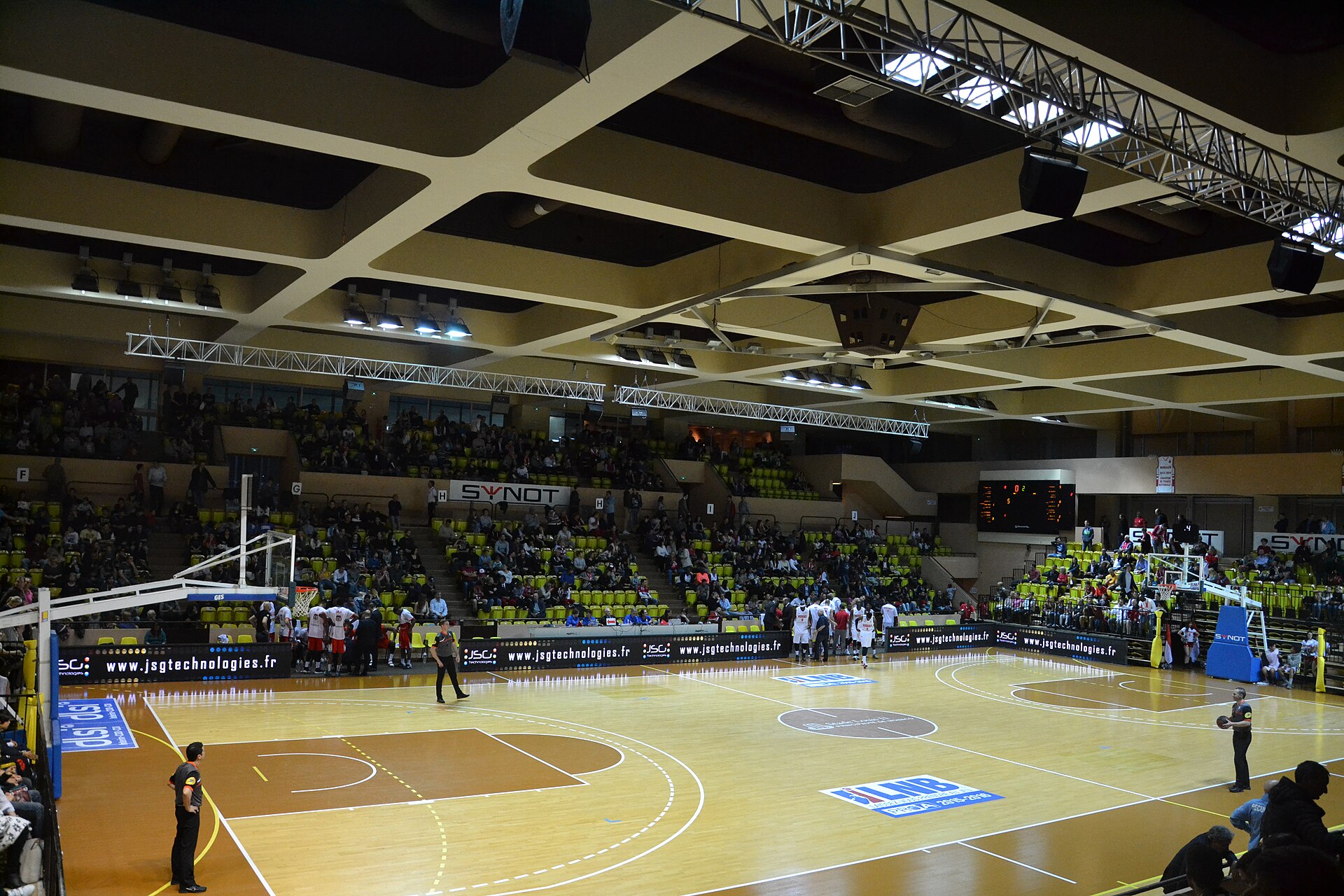
Five sports paint a line around the court. Only four of them agree it is part of it
A ball on the line is in, unless you are playing basketball, where the boundary line is not court at all. The disagreement is written into the rulebooks, and it decides which edge of the paint the tape measure is held against.
More on football
One legal football can hold nearly twice the pressure of another
Law 2 specifies the ball in five lines. Read the tolerances rather than the numbers and the specification turns out to be unusually loose in the one property that most changes how the ball behaves — and to be pinned to a place and a moment that no match actually occupies.